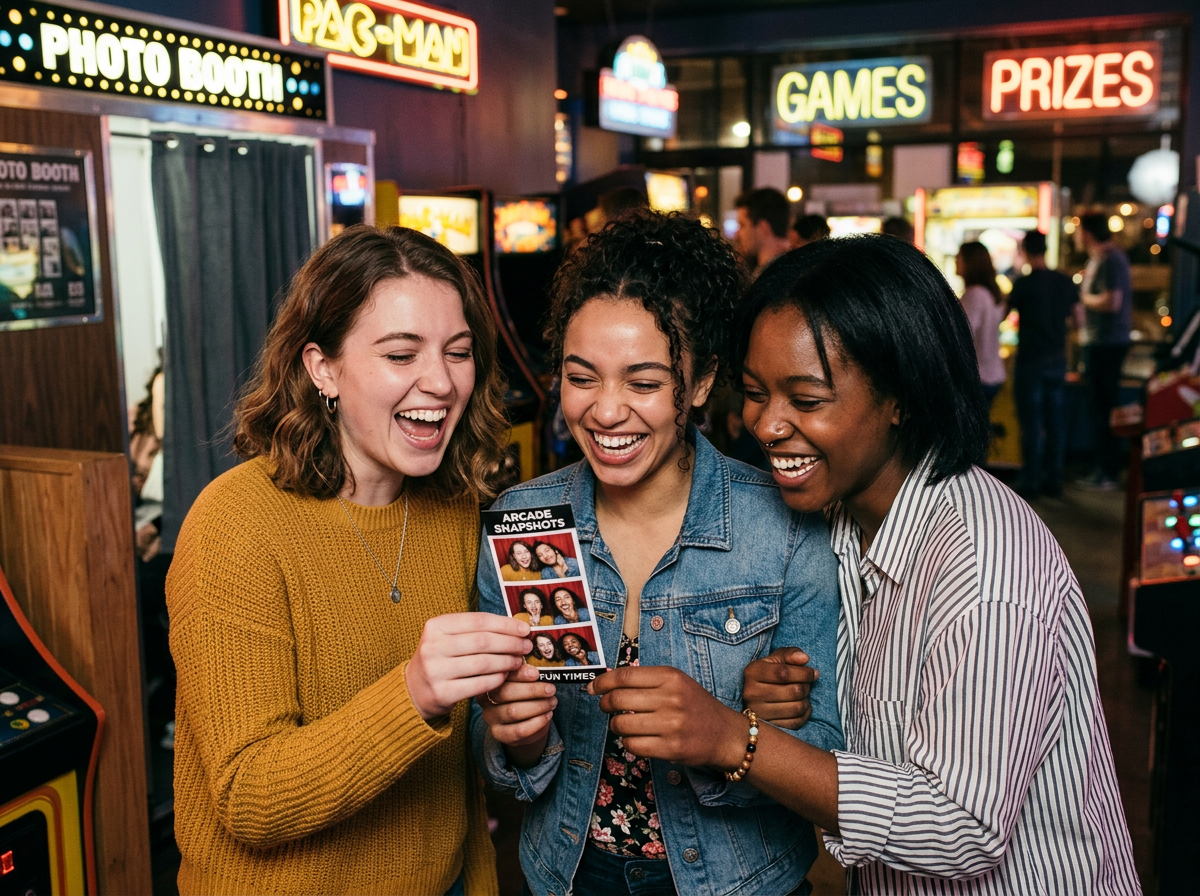
The human brain is wired for story. We seek structure, we crave progression, and we find satisfaction in a complete arc, no matter how small. This fundamental truth is the secret sauce behind the enduring success of the 2×2 photo grid…the layout that sits at the very heart of the ZillaBooth experience. It’s more than just a template; it’s a canvas for a four-act play, a psychological framework that transforms spontaneous laughter into a carefully constructed, unforgettable micro-narrative.
Why does the 2×2 format feel so right, so classic, and so consistently engaging? The answer lies in its perfect balance of constraint and freedom. By restricting users to just four frames, the 2×2 grid forces a sense of deliberate, though often unconscious, storytelling. It asks you, and your friends, to engage in a rapid-fire sequence of emotional shifts that capture a dynamic moment rather than a static pose. It’s the difference between a single portrait and a complete short film.
The Psychology of the Four-Shot Sequence
The magic of the 2×2 is the inherent rhythm it establishes, a rhythm that guides users through a natural psychological progression of expression. The sequence is not random; it’s a journey from initial self-consciousness to uninhibited joy, a quick, safe space to shed social filters.
Act I: The Setup (Pose 1: The Smile) The first frame is the moment of calibration. The red light blinks, the flash is imminent, and users typically default to their “camera-ready” face. This is the pose designed for public consumption, the one you might use for a professional headshot or a polite social media post. As suggested, Pose 1 is almost always a “Smile.” It’s the initial, slightly formal, and conscious acknowledgment of the camera. Psychologically, this pose serves as the setup. It establishes the characters (the people in the booth) and the setting (the start of the experience). It’s the baseline from which all subsequent spontaneity will be measured. It says, “We are here, and we are ready.” It is the moment where the guard is highest, and the expression is most curated.
Act II: The Transition (Pose 2: The Idea) The second shot is critical. Having established the baseline, the internal pressure to “do something different” mounts, and the creative collaboration begins. This is where the first idea is tested. Perhaps it’s a quick head tilt, a funny hand gesture, or the introduction of a prop. This pose marks the transition from formality to engagement. It’s often the shot of collaboration…a glance shared, a whisper exchanged, or a synchronized movement that shows the group is beginning to loosen up and play off each other. The constraint of the timer accelerates this process; there’s no time for deliberation, only instinctive reaction. This shot is generally less polished than Pose 1 but is still somewhat intentional.
Act III: The Peak (Pose 3: The Wacky) The third frame is the emotional and expressive climax of the 2×2 narrative. By this point, the initial stiffness is gone. The laughter from the silliness of Pose 2 often bleeds directly into this shot, resulting in genuine, unforced expressions. This is the point of no return…the moment when the conscious effort to “look good” is completely abandoned in favor of pure, unadulterated fun. It’s often the wackiest pose…a shout, a surprised face, an over-the-top expression of joy or mock terror. Psychologically, the rapid succession of flashes has acted like a mini-meditation, pushing the rational mind aside and allowing the subconscious, playful self to emerge. It’s a shot of catharsis, the release of pent-up inhibition that the entire booth experience is designed to facilitate.
Act IV: The Punchline (Pose 4: The Silly) The final frame, the “Silly” pose, is the resolution, the punchline that completes the arc. It serves as a bookend to the formal Smile of Pose 1. The contrast between the two is the entire story. If Pose 1 was the polite introduction, Pose 4 is the ridiculous, intimate farewell. Often, this pose is a reflection of the group’s final, exhausted burst of collective humor. It might be a collective slump, a final exaggerated cross-eye, or the ultimate non-sequitur…a totally random, unexpected gesture. The transition from Pose 1 (Smile/Controlled) to Pose 4 (Silly/Uncontrolled) is the entire narrative tension and release. This shot locks in the memory of the experience as one that started well and ended with a bang of unforgettable silliness. It ensures that the final take-away is one of genuine, shared happiness.
The Geometry of Enduring Design

The 2×2 grid also works because of its inherent visual stability. In design, symmetry and structure are profoundly comforting. The perfect square format, with its four equal quadrants, is inherently balanced and aesthetically pleasing. * Balance: The four shots offer immediate visual symmetry, making the final strip easy to scan, share, and appreciate.
- Containment: The grid acts as a clear frame for the mini-story, ensuring that the four disparate moments are unified as a single, coherent whole.
- Readability: Unlike a single long strip of four vertical photos, the 2×2 provides a compact, square artifact that maximizes visual information in a small space, perfect for printing, sharing online, or tucking into a wallet.The cultural resonance of the 2×2 also plays a major part. While many modern photo booths default to long strips, the 2×2 square often evokes the vintage, passport-style photos of a bygone era. It has a slightly more “editorial” feel, like a contact sheet or a storyboard, lending an air of importance to the captured moments. It is a nod to the past, modernized for the instant sharing of the present.
ZillaBooth’s Commitment to Narrative

For ZillaBooth, the 2×2 grid is non-negotiable…it is the company’s core mechanical and philosophical difference. We understand that in a world saturated with digital photos, what people truly value is not just a picture, but an experience that yields a story. The 2×2 layout is the primary tool for encouraging that story. We don’t just sell technology; we facilitate the creation of those four-frame narratives.
By building our interface and timing around this format, ZillaBooth intentionally engineers moments of genuine human connection. The rapid pace and the limited number of frames are designed to bypass the ‘perfect pose’ instinct that dominates smartphone photography. In a ZillaBooth, you don’t have time to review, delete, and retake a hundred shots. You have four chances to capture the arc of the moment, and that creative constraint is the source of the magic. It ensures that the resulting artifact is authentic, slightly chaotic, and utterly unique to the people in the frame.

The 2×2 grid is a masterclass in behavioral design. It uses a simple, geometric structure to elicit a complex, yet predictable, emotional journey.
It takes users from a self-aware “Smile” to a celebratory “Silly” pose, and in doing so, it captures the complete, beautiful spectrum of a few seconds of human interaction. This is why the classic layout never dies: it perfectly mirrors our fundamental need to tell a story and to experience a full range of emotion, all contained within the neat, perfect boundaries of four little squares. It’s an exercise in spontaneity, a document of joy, and the most compelling storytelling format we have.