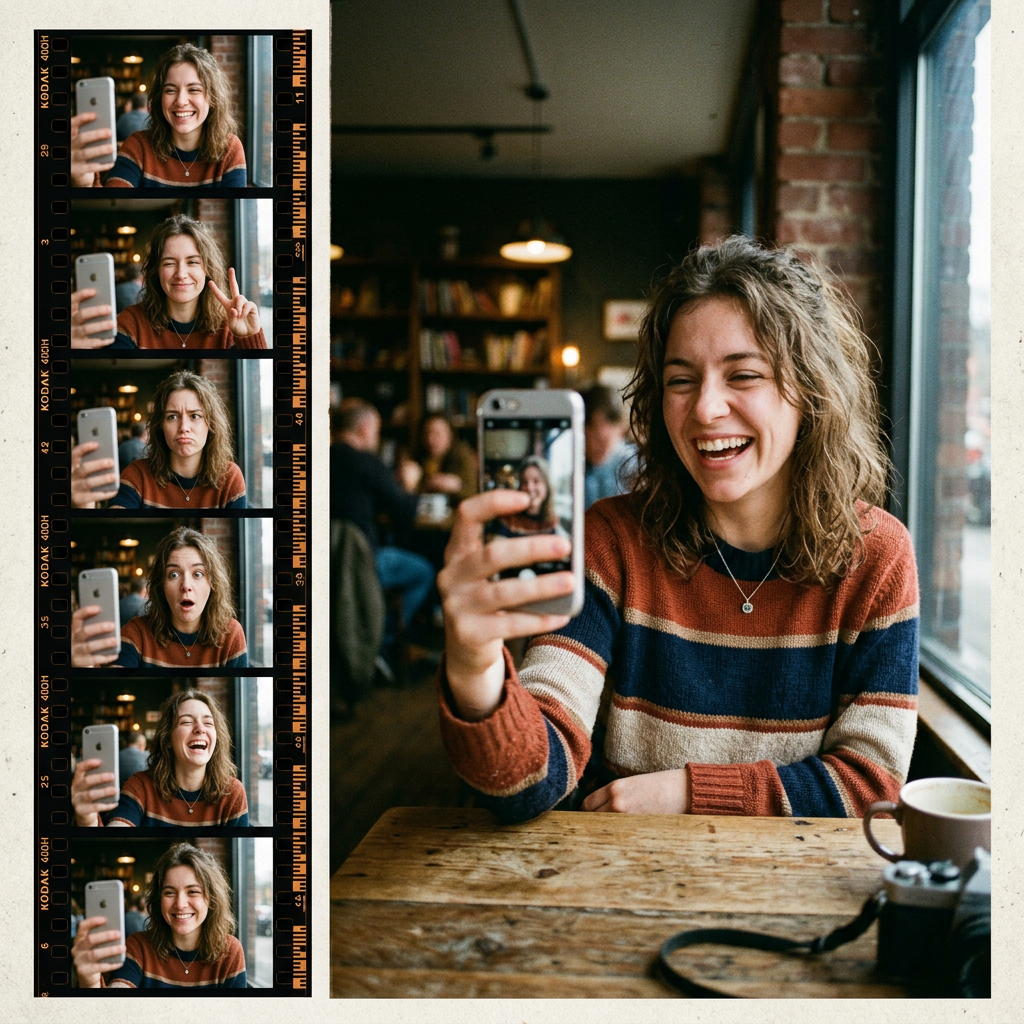
The modern landscape of digital identity is a minefield of comparison, performance, and external validation. Every uploaded image is a negotiation, a highly-edited statement designed to navigate the fickle currents of social approval. In this hyper-visible, public arena, where does one go to simply be? Where is the space to explore the messy, beautiful, contradictory reality of the self without the immediate pressure of a thousand judging eyes and an algorithmic thumbs-up or thumbs-down?
The answer lies not in turning off the camera, but in stepping into a designated digital sanctuary: the booth. This feature transforms your phone from a public broadcasting device into a private creative studio, a darkroom for the soul. It provides a unique, safe space where the act of capturing “The Real You” is divorced from the expectation of public consumption. It is, fundamentally, a tool for introspection, enabling a profound form of identity exploration through the lens of the self-portrait.
The genius of the booth is its enforced privacy. When you enter the space, the digital doors close. The usual metrics of social media…the like counts, the comments, the shares…vanish entirely. What remains is a pure, unadulterated relationship between you, your camera, and the vast, unmapped territory of your own face and persona. This lack of an immediate, critical audience is the key to unlocking true creative freedom. It permits experimentation with the self that would feel too vulnerable or too “off-brand” for public sharing.
In the booth, the camera is no longer a documentarian of social moments but a mirror for the mind. It allows the user to consciously shed the “curated self,” the polished avatar maintained for the outside world, and experiment with the myriad other selves that constitute a genuine, complex identity. Are you the serious intellectual, the goofy friend, the melancholic artist, the defiant rebel? In the booth, you can be all of them, serially, without commitment. Each click of the shutter is an attempt to capture a fleeting facet of the truth, a momentary expression of an internal state. This is not about narcissism; it is about necessary self-inventory. It’s a visual diary where the images are less about aesthetics and more about information…data points on the trajectory of one’s becoming.
To understand the profound potential of this simple, private act, we must look back to a master of self-image manipulation and serial identity: Andy Warhol. Warhol’s prolific output of self-portraits, particularly those utilizing the immediacy of the Polaroid camera, provides the perfect artistic and philosophical context for the modern digital self-portrait in the booth.
Warhol understood that the self is inherently performative, a commodity to be replicated, scrutinized, and eventually, consumed. His self-portraits…from the early, starkly honest photo-booth strips to the later, garishly wigged and highly stylized silk-screen canvases…weren’t about finding the real Andy. They were about exploring the idea of Andy, the famous artist, the detached observer, the mutable icon. He used repetition and slight variation to deconstruct his own image, turning his face into an object of study, a Pop Art emblem.
The booth allows users to follow in Warhol’s footsteps, democratizing his process for the digital age. Like the early, often unflattering photo-booth strips Warhol collected, the booth captures the raw, instantaneous moment. The user can take a dozen, two dozen, or a hundred self-portraits in a single session. This high-volume, serial approach is critical.
When you take one self-portrait, you are trying to capture perfection. When you take fifty, the goal shifts. You are no longer chasing the “best” photo, but exploring a sequence, a range, and the subtle variations of light, mood, and expression that flicker across the face over time. This sequence becomes a personal gallery, a time-lapse of the self. This serialization allows a user to explore their identity as a fluid, rather than fixed, entity…the Warholian realization that the performance is the reality.
In the safety of the booth, the user can consciously try on personas. They can adopt an aesthetic or a mood that feels true internally but might not align with their established public identity. This is more than just dressing up; it’s a psychological exercise. By projecting a new self into the camera’s lens…the ‘rockstar self,’ the ‘vulnerable self,’ the ‘unfazed self’…the user gets to witness how that persona looks and feels. The resulting images become prototypes for future public identities or simply private acknowledgments of hidden facets. This act of “trying on” different selves in a non-judgemental space is a critical step in maturation and self-understanding.
The power of the booth’s privacy also encourages a return to authenticity that social media often erodes. Where the main feed demands soft focus, perfect lighting, and subtle filters, the booth allows for the raw, the unflattering, and the immediate. Users are encouraged to capture the moments of genuine vulnerability: the tired eyes, the messy hair, the quiet sadness, the uninhibited joy. These “imperfect” images are, paradoxically, the most truthful. They are the data points that validate the user’s lived experience, providing a grounding counterpoint to the glossy fiction of the online world.
Furthermore, the booth fosters a relationship with the self over time. By returning to the private space repeatedly, users build an archive of their own evolution. A collection of self-portraits taken over weeks, months, or years forms an unprecedented visual autobiography. This archive is immune to the editing and deletion cycles of public platforms; it’s a record for the self, by the self. Looking back at this collection allows for a powerful form of reflective self-knowledge: seeing how sadness turned into determination, or how a tentative new style became a confident statement. The images become a tool for tracking personal growth, resilience, and transformation.
The digital self-portrait, when created in this safe, private environment, reclaims the power of the image from the public algorithm. It asserts that the most important audience for an image of the self is the self. This is the difference between performing for the world and simply experimenting for yourself. The booth is the modern darkroom where the negatives of the self…the doubts, the conflicts, the unpolished truths…are allowed to develop into fully realized, complex, and beautiful positive images.
Ultimately, the self-portrait taken in the booth is not intended as a final product for exhibition. It is an artifact of a process…the process of actively, consciously, and privately investigating one’s own identity. It is a rebellion against the pressure to be instantly understandable, perfectly branded, and universally appealing. By offering a safe private space akin to Warhol’s studio, the booth doesn’t just enable picture-taking; it facilitates the essential work of self-discovery, allowing every individual to become the sole curator and subject of their most important masterpiece: their own evolving, complex, and real identity. In a world that constantly demands we look outward for validation, the booth provides a crucial, private mirror, turning the gaze inward, where true self-possession begins. It is a digital space of genuine freedom, where the only validation that matters is your own, and “The Real You” is finally allowed to emerge from the shadows, one self-portrait at a time.