Tag: Photo Booth Posing

  • Capturing “The Real You”: Identity in the Booth

    Capturing “The Real You”: Identity in the Booth

    The modern landscape of digital identity is a minefield of comparison, performance, and external validation. Every uploaded image is a negotiation, a highly-edited statement designed to navigate the fickle currents of social approval. In this hyper-visible, public arena, where does one go to simply be? Where is the space to explore the messy, beautiful, contradictory reality of the self without the immediate pressure of a thousand judging eyes and an algorithmic thumbs-up or thumbs-down?

    The answer lies not in turning off the camera, but in stepping into a designated digital sanctuary: the booth. This feature transforms your phone from a public broadcasting device into a private creative studio, a darkroom for the soul. It provides a unique, safe space where the act of capturing “The Real You” is divorced from the expectation of public consumption. It is, fundamentally, a tool for introspection, enabling a profound form of identity exploration through the lens of the self-portrait.

    The genius of the booth is its enforced privacy. When you enter the space, the digital doors close. The usual metrics of social media…the like counts, the comments, the shares…vanish entirely. What remains is a pure, unadulterated relationship between you, your camera, and the vast, unmapped territory of your own face and persona. This lack of an immediate, critical audience is the key to unlocking true creative freedom. It permits experimentation with the self that would feel too vulnerable or too “off-brand” for public sharing.

    In the booth, the camera is no longer a documentarian of social moments but a mirror for the mind. It allows the user to consciously shed the “curated self,” the polished avatar maintained for the outside world, and experiment with the myriad other selves that constitute a genuine, complex identity. Are you the serious intellectual, the goofy friend, the melancholic artist, the defiant rebel? In the booth, you can be all of them, serially, without commitment. Each click of the shutter is an attempt to capture a fleeting facet of the truth, a momentary expression of an internal state. This is not about narcissism; it is about necessary self-inventory. It’s a visual diary where the images are less about aesthetics and more about information…data points on the trajectory of one’s becoming.

    To understand the profound potential of this simple, private act, we must look back to a master of self-image manipulation and serial identity: Andy Warhol. Warhol’s prolific output of self-portraits, particularly those utilizing the immediacy of the Polaroid camera, provides the perfect artistic and philosophical context for the modern digital self-portrait in the booth.

    Warhol understood that the self is inherently performative, a commodity to be replicated, scrutinized, and eventually, consumed. His self-portraits…from the early, starkly honest photo-booth strips to the later, garishly wigged and highly stylized silk-screen canvases…weren’t about finding the real Andy. They were about exploring the idea of Andy, the famous artist, the detached observer, the mutable icon. He used repetition and slight variation to deconstruct his own image, turning his face into an object of study, a Pop Art emblem.

    The booth allows users to follow in Warhol’s footsteps, democratizing his process for the digital age. Like the early, often unflattering photo-booth strips Warhol collected, the booth captures the raw, instantaneous moment. The user can take a dozen, two dozen, or a hundred self-portraits in a single session. This high-volume, serial approach is critical.

    When you take one self-portrait, you are trying to capture perfection. When you take fifty, the goal shifts. You are no longer chasing the “best” photo, but exploring a sequence, a range, and the subtle variations of light, mood, and expression that flicker across the face over time. This sequence becomes a personal gallery, a time-lapse of the self. This serialization allows a user to explore their identity as a fluid, rather than fixed, entity…the Warholian realization that the performance is the reality.

    In the safety of the booth, the user can consciously try on personas. They can adopt an aesthetic or a mood that feels true internally but might not align with their established public identity. This is more than just dressing up; it’s a psychological exercise. By projecting a new self into the camera’s lens…the ‘rockstar self,’ the ‘vulnerable self,’ the ‘unfazed self’…the user gets to witness how that persona looks and feels. The resulting images become prototypes for future public identities or simply private acknowledgments of hidden facets. This act of “trying on” different selves in a non-judgemental space is a critical step in maturation and self-understanding.

    The power of the booth’s privacy also encourages a return to authenticity that social media often erodes. Where the main feed demands soft focus, perfect lighting, and subtle filters, the booth allows for the raw, the unflattering, and the immediate. Users are encouraged to capture the moments of genuine vulnerability: the tired eyes, the messy hair, the quiet sadness, the uninhibited joy. These “imperfect” images are, paradoxically, the most truthful. They are the data points that validate the user’s lived experience, providing a grounding counterpoint to the glossy fiction of the online world.

    Furthermore, the booth fosters a relationship with the self over time. By returning to the private space repeatedly, users build an archive of their own evolution. A collection of self-portraits taken over weeks, months, or years forms an unprecedented visual autobiography. This archive is immune to the editing and deletion cycles of public platforms; it’s a record for the self, by the self. Looking back at this collection allows for a powerful form of reflective self-knowledge: seeing how sadness turned into determination, or how a tentative new style became a confident statement. The images become a tool for tracking personal growth, resilience, and transformation.

    The digital self-portrait, when created in this safe, private environment, reclaims the power of the image from the public algorithm. It asserts that the most important audience for an image of the self is the self. This is the difference between performing for the world and simply experimenting for yourself. The booth is the modern darkroom where the negatives of the self…the doubts, the conflicts, the unpolished truths…are allowed to develop into fully realized, complex, and beautiful positive images.

    Ultimately, the self-portrait taken in the booth is not intended as a final product for exhibition. It is an artifact of a process…the process of actively, consciously, and privately investigating one’s own identity. It is a rebellion against the pressure to be instantly understandable, perfectly branded, and universally appealing. By offering a safe private space akin to Warhol’s studio, the booth doesn’t just enable picture-taking; it facilitates the essential work of self-discovery, allowing every individual to become the sole curator and subject of their most important masterpiece: their own evolving, complex, and real identity. In a world that constantly demands we look outward for validation, the booth provides a crucial, private mirror, turning the gaze inward, where true self-possession begins. It is a digital space of genuine freedom, where the only validation that matters is your own, and “The Real You” is finally allowed to emerge from the shadows, one self-portrait at a time.
  • Visual Storytelling: The 4-Frame Narrative

    Visual Storytelling: The 4-Frame Narrative

    The modern wedding is no longer just a ceremony; it’s an experience. Today’s couples are curating full, immersive narratives, turning their special day into a multi-sensory story their guests can actively participate in, not just observe. From themed decor to interactive stations, the goal is to create memories that feel immediate, raw, and deeply personal.

    But what happens when the lights come up and the dance floor clears? How do you distill a night-long, elaborate narrative into a single, tangible keepsake?

    Enter the ZillaBooth photo strip.

    For decades, the photo booth has been a wedding staple, but the traditional four-frame strip is vastly undervalued as a storytelling tool. It’s not just a place to snap silly selfies; it is a four-panel canvas…a miniature storyboard…that can capture a complete, compelling narrative arc in a matter of seconds. It offers a unique challenge: tell an immersive story using nothing but four perfectly timed frames.

    This guide will teach you, the junior writer and the enthusiastic guest, how to transform the ZillaBooth strip from a sequence of random poses into a powerful, four-act story. Mastering this technique allows guests to leave the wedding not just with a photo, but with a physical record of a micro-performance, a piece of the night’s immersive narrative that will be treasured long after the vows.

    The Four-Frame Story Arc: Your Narrative Blueprint

    Think of the four frames not as individual snapshots, but as the rising and falling action of a classic short story. Each frame has a distinct, mandatory role in the narrative. By adhering to this structure, you guarantee a payoff, a beginning, middle, and end that makes the strip feel complete and satisfying.

    Analog film photograph of section 1 related to Visual Storytelling: The 4-Frame Narrative

    Frame 1: The Inciting Incident (The Setup)

    This is your establishing shot, the “Once upon a time…” moment. The purpose of Frame 1 is to set the scene, introduce the character(s), and hint at the action to come. It should be relatively static, yet full of intention. You are loading the gun for the next three shots. What to do: * Introduce the Prop: Hold a mustache, a sign, or a silly hat, but do not use it yet. Look at it with curiosity, or hold it up to the camera like a silent declaration.

    Analog film photograph of section 2 related to Visual Storytelling: The 4-Frame Narrative
    • Establish Tension: Two people look at each other with a serious, anticipatory, or even slightly bored expression. The lack of action is the setup.
    • The Silent Cue: One person points to the other or looks off-camera as if about to begin a task. The focus is on the “before” moment.

    Frame 2: The Rising Action (The Reaction/The Turn)

    This is where the story gets its momentum. Something must happen between Frame 1 and Frame 2. This is often the quickest frame, a blur of motion, a moment of profound realization, or a quick change of state. The action begins, or the subject reacts to the action that has just started. This frame is the key pivot point. What to do: * The Quick Change: The prop from Frame 1 is now partially on, or an aggressive change of pose/expression has taken place. The person who was looking bored is now actively engaging.

    Analog film photograph of section 3 related to Visual Storytelling: The 4-Frame Narrative
    • The Visual Dialogue: If it’s a two-person strip, the action starts on one person and the other person has a clear, shocked, or amused reaction. This turn elevates the story from simple posing to genuine interaction.
    • The Build-Up: If the climax is a huge kiss, Frame 2 is the dramatic lean-in, the lips-not-quite-touching moment. It’s the moment of maximum anticipation before the payoff.

    Frame 3: The Climax (The Peak Moment/The Punchline)

    This is the moment the whole strip has been building toward. It must be the most visually dynamic, emotionally charged, and satisfying shot. This frame represents the peak of the action, the visual punchline, or the grand emotional fulfillment of the miniature story. It should leave no doubt as to the story’s main point. What to do: * The Full Transformation: The prop is fully in use, the pose is at its most exaggerated, or the initial tension is completely broken. The energy must be at 100%.

    Analog film photograph of section 4 related to Visual Storytelling: The 4-Frame Narrative
    • The Shared Emotion: This is the perfect moment for a shared, uninhibited belly laugh, a full, dramatic dip-and-kiss, or a triumphant high-five/fist bump that takes up the frame. It must be a moment of full release.
    • The Visual Statement: If the story is about love, this is the most affectionate kiss or hug. If it’s about silliness, this is the most ridiculous, tongue-out, eyes-crossed face possible. Go big or go home.

    Frame 4: The Resolution (The Aftermath)

    The story is over, the climax has passed, and the tension has been resolved. The final frame serves as a cool-down, a shared look of satisfaction, exhaustion, or simply the acknowledgment that a story has just been successfully told. It’s the visual equivalent of the curtain closing, letting the audience know the performance is complete. The key is to drop the energy from Frame 3, but not the connection. What to do: * The Satisfied Smirk: Look directly at the camera with a look of “We did it” or “You just saw that.” A shared, knowing glance.

    Analog film photograph of section 5 related to Visual Storytelling: The 4-Frame Narrative
    • The Exit: The subjects slightly back out of the frame, giving a small wave or a thumbs-up as a visual sign-off.
    • The Embrace: A quiet, affectionate lean on one another, suggesting comfort and resolution after the high-energy climax. The mood is relaxed, happy, and conclusive.

    Case Study: The Proposal Re-enactment

    The suggestion to use the ZillaBooth strip to re-enact “The Proposal” is a perfect demonstration of a powerful, mini-narrative that uses the four-frame structure flawlessly. Here is a step-by-step breakdown of how a guest couple could capture this timeless story in under a minute, creating a treasured memento of the event:

    The Goal: To capture the emotional arc of a proposal…the setup, the shock, the acceptance, and the triumph…using only expressions and body language.

    Frame 1: The Setup * Action: Person A kneels awkwardly (or dramatically) on one knee in the booth, perhaps holding a prop like a small paper ring or a champagne cork. Person B stands over them with a look of mild confusion or intense anticipation. The atmosphere is tense.


    * Narrative Role: Establishes the core dramatic situation (the proposal) before the action begins. The tension is palpable. This frame provides all the necessary context.

    Frame 2: The Rising Action/The Question * Action: Person A is still kneeling, but now dramatically presenting the prop to Person B. Person B’s hands fly up to their mouth or their eyes widen in a sudden, theatrical moment of shock or realization. The action is fully underway.


    * Narrative Role: The question has been asked, and the reaction is immediate. The story accelerates, heightening the emotional stakes and making the viewer anticipate the answer.

    Frame 3: The Climax/The Acceptance * Action: Person B (who was shocked) is now lunging forward, dramatically hugging Person A (who is still attempting to kneel, or has risen for the embrace). It’s a chaotic, loving, all-encompassing embrace.


    * Narrative Role: The peak of the emotion. The answer is “Yes!” The physical explosion of love confirms the story’s happy outcome. This frame should feel the most crowded, joyful, and visually intense.

    Frame 4: The Resolution/The Triumph * Action: Person A and Person B stand side-by-side, holding up their hands in a celebratory gesture. Person A shows a proud fist pump or a confident, satisfied smile. Person B shows off the imaginary ring (or the prop) with an exaggerated, happy smirk directly to the camera.


    * Narrative Role: The story is complete. The tension is resolved into shared joy and success. It’s the final, triumphant sign-off, confirming that their “immersive story” has a happy ending. This frame grounds the emotional explosion of the previous shot.

    Advanced Pro-Tips for Storytelling in the Booth

    Once you understand the four-frame blueprint, you can elevate your booth performance from good to editorial-quality content. The secret is to use the constraints of the booth…the speed, the small space, and the props…as narrative tools.1. Props as Plot Devices, Not Decorations
    Don’t just wear the feather boa; use it to drive the plot. For example, the boa could be the prize in a dramatic conflict: *

    Frame 1: Two people are looking at the same feather boa, both reaching for it.


    *

    Frame 2: They are having a comical tug-of-war over it (conflict).


    *

    Frame 3: One person successfully wears it like a trophy, giving a triumphant, “I win!” face (climax/victory).


    *

    Frame 4: The winner is preening into the camera while the loser is slumped in the corner with a mock pout (resolution/consequence). The prop is a core character in the story.2. The Power of the Gaze

    Since there is no verbal dialogue, your eye line is the dialogue. Direct your gaze to tell the viewer where the focus is and how the relationship between the subjects is shifting: * Start Frame 1 looking at each other (establishing the relationship or anticipation). * Shift Frame 2 looking at the action/prop (reaction to the inciting incident).

    * Frame 3, the climax, should be a quick look at the camera to share the moment with the “audience” (the machine/the person holding the strip). * End Frame 4 looking back at each other (the shared secret/completion).3. Mastering the Temporal Jump The most common mistake is to try and pose.

    You must act . The machine is taking pictures very quickly, often with a slight delay. Use this time lag to your advantage. Between Frame 1 and 2, commit to a quick, dramatic shift of body language and expression. This rapid change is what makes the strip feel like a genuine, unfolding narrative instead of four separate portraits. A great four-frame strip feels like a flipbook, with smooth, intentional transitions. The best storytellers in the booth are those who are already preparing for Frame 3 while Frame 2 is still being taken…always plan your next move.

    1. Creating Themed Mini-Series
      Encourage guests to pick a single character or persona…The Villain, The Hero, The Diva…and commit to telling a full four-frame story based on that character. A collection of these mini-narratives from the same booth becomes an authentic, multi-perspective view of the wedding’s “immersive story,” far more compelling than a scrapbook of random, uncontextualized smiles. The wedding album becomes a collection of tiny, perfect, themed plays.

    2. The Value of Imperfection
      Do not try to be technically perfect. A slightly blurry Frame 2 because you were mid-action (mid-lean, mid-toss) adds authenticity and movement to the story. It shows the raw, immediate action. The small, confined space of the ZillaBooth and the harsh flash lighting are your friends, forcing you to focus on the expressive performance. Let the environment work for the narrative, not against it. The light will often cast deep, dramatic shadows, which you can use to amplify the dramatic tension of your story.In an age where every moment is captured, filtered, and uploaded to the cloud, the physical ZillaBooth strip offers a powerful, tactile rebellion. It’s an immediate, unfiltered, non-editable piece of tangible art. When you and your guests step into that booth, you’re not just taking photos; you’re writing a script, directing a scene, and leaving the wedding with a tiny, perfect, and completely unique four-act play that memorializes the joy and narrative experience of the day. Master the structure, and you master the story. Go forth and narrate! (1110 words)

    ❤️

  • The Psychology of the Curtain: Why We Act Differently in Booths

    The Psychology of the Curtain: Why We Act Differently in Booths

    It’s a peculiar phenomenon, one almost universally experienced: the moment you step across the threshold into a small, enclosed space, your demeanor changes. Whether it was the classic strip-photo machine of the 1950s or the sleek, modern digital enclosure at a contemporary event, the photo booth has always served as a tiny, psychological theater where the rules of public decorum are momentarily suspended.

    Why is it that inside this temporary box, surrounded by vinyl or canvas, we feel permission to be goofy, to pose outrageously, to let loose with an unfiltered laugh that would feel awkward anywhere else? The answer lies in the deep-seated psychology of the barrier…the curtain…and the profound sense of privacy it guarantees.

    The earliest photo booths were fundamentally machines built around an act of disappearance. The heavy velvet or vinyl curtain was more than just a light seal; it was an impenetrable, temporary wall against the outside world. Stepping behind it was a deliberate, ceremonial act of separation. Once the curtain fell closed, the individual or group vanished from public view, entering a space of radical, albeit brief, autonomy. This physical act of exclusion is the psychological root of the phenomenon described in the prompt: it gives people license to “let their guard down.”

    In psychological terms, this is a controlled moment of deindividuation . In a large crowd, deindividuation can lead to regrettable behavior because the individual identity is lost. But in the photo booth, the effect is inverted. By removing the individual from the social contract of the public space, the small enclosure allows a positive, momentary loss of self-consciousness .

    Analog film photograph of section 1 related to The Psychology of the Curtain: Why We Act Differently in Booths

    You are no longer subject to the immediate, judging gaze of the audience outside the booth. This removal of external surveillance is what frees people to shed the carefully constructed mask they wear in public and express their genuine, often playful, personality. The camera, a machine without judgment or memory, becomes an accomplice rather than an observer. The curtain tells the brain: “What happens in the booth, stays in the booth.”

    This sense of a private sanctuary stands in stark opposition to the modern age of perpetual performance. Today, particularly at major social events, the camera is an instrument of the public domain.

    Every action, every outfit, and every reaction is potentially curated, captured, and instantly broadcast to a vast, invisible audience on social media. The shift from private memory to public content has introduced a pervasive sense of self-monitoring. We become acutely aware that the photos being taken are not just for us; they are for the ‘feed,’ for the metrics, for the thousands of passive followers we will never meet.

    This pressure is the enemy of authenticity. When a couple poses for a wedding photographer, for example, the image is often immaculate, perfectly lit, and composed to tell a specific, idealized story. But that image is also a performance . The photographer is an active participant in the staging, directing the pose, adjusting the angle, and maintaining an intimate, watchful eye.

    While the resulting photograph is beautiful, it captures a moment that is inherently aware of being captured. The self-consciousness of being watched…a mild form of the well-known Hawthorne effect …means the subject is acting for the camera, not simply reacting to the moment. The photographer, by their very presence, is a constant reminder of the public’s anticipated consumption of the image. They are the human embodiment of the external gaze.

    Analog film photograph of section 2 related to The Psychology of the Curtain: Why We Act Differently in Booths

    This is where the genius of modern, unattended photo technology, exemplified by ZillaBooth, comes into sharp focus. The traditional photo booth’s power came from its physical curtain; ZillaBooth’s power comes from its unattended, privacy-first design, which serves as the psychological equivalent of that barrier.

    ZillaBooth is not a prop or an accessory for the photographer; it is a discrete experience. The most critical factor is the absence of the human operator. In a traditional setting, even a casual photographer or booth attendant introduces a layer of public accountability. That person is another eye, a potential critic, and a proxy for the wider social audience. When a group steps into the ZillaBooth, they are not posing for anyone; they are posing with each other. The booth becomes a silent, automated confidante. The pressure is instantly off.

    The design emphasizes that the action inside the booth is a self-contained unit of fun. There is no instant, public-facing sharing mechanism; the focus is solely on the immediate, internal dynamic of the group. The sense of being unwatched, even when fully aware a camera is flashing, is what restores the psychological condition of the original, curtained space. The subject is freed from the social burden of producing content and allowed to simply produce memory.

    This is why the resulting images are invariably “goofier” and more “natural.” Goofiness is not an action you can successfully stage; it is the spontaneous overflow of genuine, uninhibited joy. It is a moment of shared, unselfconscious absurdity that only erupts when the participants feel completely secure and unjudged. The photographs capture the real, chaotic, and often hilarious essence of friendship and relationship dynamics.

    Consider the typical photo booth strip:1. Frame One: Initial self-conscious pose, often a bit stiff.

    Analog film photograph of section 3 related to The Psychology of the Curtain: Why We Act Differently in Booths
    • Frame Two: The subjects realize they are truly alone, and the first hint of a real smile appears.
    • Frame Three: The group dynamic takes over, prompting a genuinely funny pose or a spontaneous, shared laugh.
    • Frame Four: Complete, joyous absurdity…a wild gesture, a silly face, an image that is deeply personal and truly captures a moment of connection.The transition from Frame One to Frame Four is the journey from performance to authenticity, facilitated entirely by the psychological safety of the private, unattended space. A photographer is often asked to capture the ideal version of the event; the photo booth captures the real version.

    This contrast is crucial for the discerning host or event planner. While professional photography captures the grandeur and the aesthetics, ZillaBooth captures the soul and the intimacy. The professional photographer is tasked with documenting the curated narrative; the unattended booth is allowed to document the spontaneous truth. The images produced are not merely complementary; they are two sides of the same psychological coin. One is the public face; the other is the private, shared joke.

    Ultimately, the power of the booth is the power of a temporary, communal blind spot. In a world saturated by surveillance…from CCTV to the omnipresent smartphone camera…the photo booth offers a small, defiant sanctuary. It is a declaration that for four quick flashes, you are exempt from the requirements of the stage. The attendant is gone, the social media link is severed, and the outside world is muted. All that remains is the interaction between the people in the frame.

    ZillaBooth’s successful recreation of the “Psychology of the Curtain” is not about nostalgia; it is about addressing a very modern need. It acknowledges that true, uninhibited connection is best captured when the subjects forget the camera exists, and the best way to make them forget the camera is to ensure they are only conscious of the company they keep.

    By removing the watchful, judging eye of the human operator and the immediate, judging audience of the internet, ZillaBooth facilitates the kind of natural, goofy, and profoundly human moments that become not just great photos, but true, unblemished private memories. It is where the human guard comes down, and the true picture emerges.

  • The 4-Pose Challenge: A History of Photo Booth Posing

    The 4-Pose Challenge: A History of Photo Booth Posing

    Long before phone cameras gave us a million takes and filters could erase a shadow, there was the photo booth. A simple, curtained-off enclosure that offered four flashes, four moments, and one strip of undeniable, unfiltered truth. It was more than just a novelty; the photo booth became a democratic canvas, a stage for cultural expression, and an accidental time machine, perfectly chronicling the evolution of how we present ourselves to the world.

    We all know the ritual: You pay your coin, pull the curtain, and suddenly the pressure is on. Four poses. A countdown begins. What do you do?

    The way people answered that question changed dramatically from decade to decade. The poses, the expressions, the proximity…they weren’t random; they were a direct reflection of the social, cinematic, and artistic trends of the era. To celebrate this history, we’re launching the ultimate style guide and fun experiment: How to Pose Like Every Decade, perfectly timed and executed using ZillaBooth’s unique in-app countdown feature.

    Your mission, should you choose to accept it, is to step into your ZillaBooth…whether in real life or via the app…and dedicate each of your four precious flashes to a specific decade. Ready to travel through time without leaving your seat?

    Flash One: The Stiff Upper Lip (The 1920s & 1930s)

    The first automatic photo machine, or “Autophotograph,” opened in New York City in 1925. In its earliest days, getting your picture taken was still a serious, formal affair. Photography was expensive, and the tradition of the studio portrait…where you stood stock-still for minutes…had not yet faded. The mood was less “fun” and more “proof of existence.” People viewed the resulting image as a legacy piece, something that needed to convey dignity, not fleeting joy.

    Analog film photograph of section 1 related to The 4-Pose Challenge: A History of Photo Booth Posing

    The Pose: Think of silent film stars and passport photos.1. The Head-On Gaze: Look directly and unsmilingly into the lens. The technology was slow, and holding a genuine, relaxed smile for the duration was physically uncomfortable, leading to the serious, almost somber expression we associate with early photography. Smiles were considered undignified for formal portraits.

    • The Stiff Spine: Shoulders back, chin slightly down, and zero slump. Posture was paramount. Even when sitting with a partner, there was often a visible inch of space between bodies, a relic of Victorian formality that lingered in public life.
    • The Somber Expression: No teeth, no exuberant joy. A subtle, almost stoic expression conveys respectability and maturity. The focus is on the architecture of the face, not the emotion.

    How to Execute with ZillaBooth: Use the first flash for your most formal, hea

    d-of-state portrait. The ZillaBooth timer gives you just enough time to perfect your posture and set your gaze, reminding you that this pose is about solemnity, not spontaneity. Challenge yourself to keep your eyebrows neutral and your jaw relaxed, avoiding any hint of a smile. This pose is the most historically challenging, forcing you to suppress modern instincts for cheerfulness.

    Flash Two: The Wartime Sweetheart (The 1940s & 1950s)

    The photo booth took on a new, deeply sentimental significance during World War II. For soldiers shipping overseas and the loved ones they left behind, a photo strip became a precious, tangible token of intimacy. The booth was no longer just for formal portraits; it was a private place for emotional connection, a final moment of contact before separation. This era gave rise to the classic, intimate “kiss strip,” a raw form of documentation that spoke to the era’s emotional intensity.

    Analog film photograph of section 2 related to The 4-Pose Challenge: A History of Photo Booth Posing

    The Pose: Focus entirely on the human connection…this is where posing begins to get playful and deeply emotional.1. The Shared Close-Up: Partners squeeze tightly together to ensure both faces are in the frame, often pressing cheek-to-cheek. This physical closeness was a direct, necessary contrast to the formality of the prior decade. The focus is exclusively on the two individuals.

    • The Classic Kiss: The most iconic pose of the era. A deep, long-lasting kiss that lasted for multiple flashes, often with eyes closed to heighten the sense of privacy. Alternatively, the “Forehead Press,” where two heads touch, eyes closed, conveying deep affection and reliance.
    • The Dramatic Prop: This era was heavily influenced by film noir. A cigarette, a fedora, a letter from the front, or a flower could be held, adding a cinematic, bittersweet drama to the moment, hinting at the context outside the curtain.

    How to Execute with ZillaBooth: If you’re alone, use the frame to capture an

    emotional moment with a hand gesture (a heart shape or a dramatic wave of farewell). If with a partner, challenge yourself to hold the kiss for the first two flashes after the ZillaBooth timer goes off, recreating the timeless romantic reel. The proximity is crucial; you should fill the frame.

    Analog film photograph of section 3 related to The 4-Pose Challenge: A History of Photo Booth Posing

    Flash Three: The Rebel’s Edge (The 1960s & 1970s)

    The rise of youth culture, rock and roll, and the counter-culture movement injected a new, playful, and often chaotic energy into the photo booth. This was the era of the ‘go-go’ pose…rapid, chaotic, and brimming with personality. Poses began to borrow heavily from magazine covers, album art, and fashion photography, becoming more performative. The goal was no longer dignity, but attitude and showing off one’s ‘groovy’ personality.

    Analog film photograph of section 4 related to The 4-Pose Challenge: A History of Photo Booth Posing

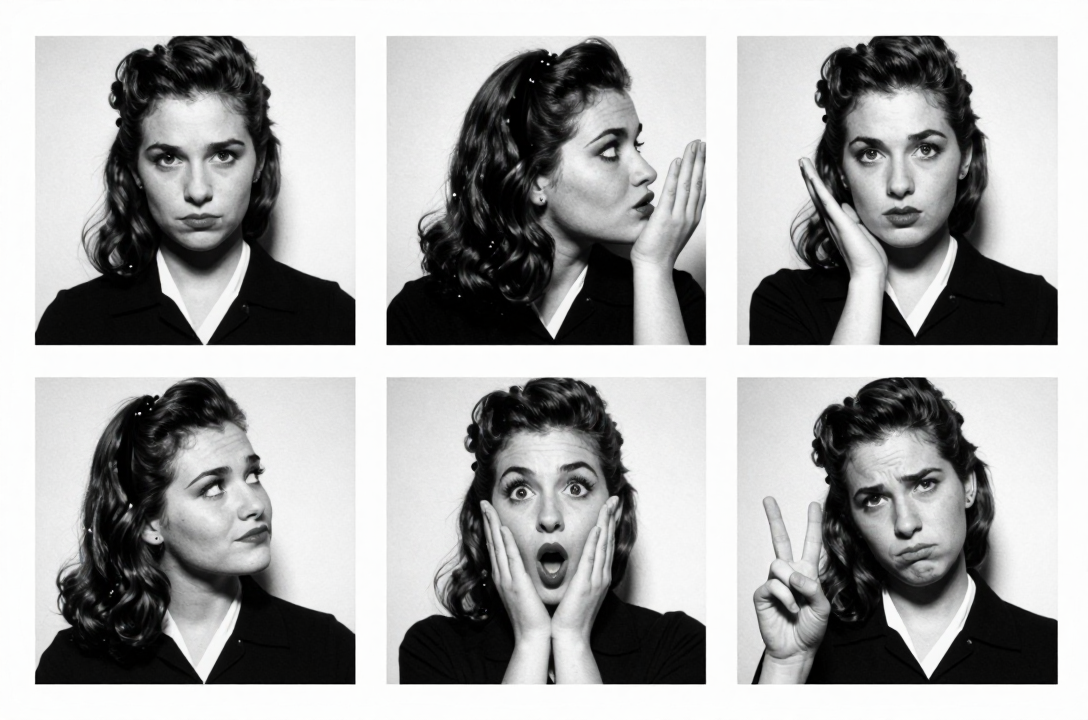
    The Pose: Think Twiggy, Andy Warhol, and Studio 54 disco queens. The poses are sharp, angular, and often feature the hands.1. The Exaggerated Reaction: Hands fly to the face…a shocked open mouth, eyes widened, a tongue might stick out. The expressions are intentionally over the top and designed to be funny or provocative. This is a move toward embracing imperfection.

    • The Head Tilt and Chin Prop: The classic “pensive” or “intellectual” look. Tilt the head dramatically and rest the chin on a fist or open palm. It’s an intellectual-meets-model moment, often looking away from the camera for an aloof effect.
    • The Side Profile: Instead of facing the camera, subjects would turn to the side and look ‘out of frame,’ adding an element of mystery or high-fashion drama, mimicking candid shots by a photographer.
    • The Peace Sign: While fully embracing the 90s, the peace sign had its roots here, used as a sincere symbol of anti-war and counter-culture sentiment, often combined with long, flowing hair obscuring the face.

    How to Execute with ZillaBooth: Use the ZillaBooth’s flash notification sound

    as a trigger for a dramatic switch in attitude. Start calm, then when the timer counts down, switch to an exaggerated expression or a sharp profile turn. The speed of the pose change is key to capturing the chaotic, restless energy of the era. Aim for a graphic, bold silhouette against the background.

    Flash Four: Pop Culture Irony (The 1980s & 1990s)

    This is the era that cemented the photo booth as a truly iconic pop culture staple, largely thanks to its prominence in malls, arcades, and movies like Clerks and Amelie. The poses became self-aware, ironic, and often a parody of celebrity culture. The 80s brought big hair, bold makeup, and power poses, and the 90s ushered in grunge, anti-fashion, and a universal hand gesture that reigns supreme: the peace sign. This is the last stop on our historical tour before the digital selfie revolution.

    Analog film photograph of section 5 related to The 4-Pose Challenge: A History of Photo Booth Posing

    The Pose: A complex mix of super-confidence (80s) and complete apathy (90s).1. The Power Shrug (1980s): A flash of dramatic shoulder-pad posture, a hands-on-hips stance, and an intense, direct glare. This pose is about projecting ambition and saying, “I’m important, and I know it,” even if the subject is a teenager in acid-wash jeans.

    • The Peace Sign (1990s): The most essential element of the challenge. The peace sign went from a serious symbol to a casual, ubiquitous placeholder for “Hey, I’m here.” Hold it up next to your face, slightly off-center, with a genuine sense of relaxed irony.
    • The Duck Face / Kissy Face (Pre-Selfie Era): A precursor to modern posing. Pout the lips slightly for an exaggerated, playful kissy face. Crucially, in this era, it was often done ironically to mock the idea of ‘sexy’ posing, not seriously.
    • The Group Huddle: Squeezing three or four people into a tiny booth, all looking in different directions, was a badge of social honor. The goal was to maximize the chaos and make sure everyone’s hair was perfectly visible.

    How to Execute with ZillaBooth: For this flash, go full 90s

    . Use your ZillaBooth timer to nail the perfect peace sign right as the light fires. For the ultimate nostalgic touch, pair your peace sign with a genuine shrug and a deadpan expression. The ZillaBooth’s countdown is the perfect cue for the spontaneous-yet-practiced casualness of the 90s aesthetic.—–The 4-Pose Challenge: Your ZillaBooth Checklist

    Ready to put history into practice? Here is your quick-fire checklist for the ultimate 4-Pose Photo Booth Challenge, using the ZillaBooth in-app timer to control your flashes and ensure authentic, high-pressure results.

    Step 1: Set the Stage Find your best photo booth environment…a real booth, the ZillaBooth app, or a simple wall with direct, harsh lighting. Use the ZillaBooth app’s countdown timer, which perfectly replicates the high-stakes pressure of the classic four-frame strip.

    Step 2: Pose Like a Puritan (The 1920s) * The Pose: The Serious, Formal Stare. * Action: Shoulders back, chin level. Look straight at the lens. Zero smile. Look like you’re posing for a marble bust that will be placed in a library. Hold your breath for the flash. * ZillaBooth Cue: When the countdown hits 1, freeze and hold the stare with complete stillness.Step 3: Pose Like a Soldier’s Sweetheart (The 1940s) * The Pose: Intimacy and Emotion. * Action: If alone, a hand dramatically covering half your face, eyes looking up with longing. If with a partner, squeeze in close and execute a tight, affectionate cheek-to-cheek pose, or a partial kiss that gets cut off by the frame. * ZillaBooth Cue: Use the last two seconds of the timer to adjust your hand or head placement for maximum dramatic, film-noir effect before the flash.Step 4: Pose Like a Pop Artist (The 1970s) * The Pose: Attitude and Profile. * Action: A sharp 45-degree turn of your head to the side. Chin up, a slight, knowing smirk. This is your ‘high-fashion’ moment. Alternatively, flash an exaggerated ‘gasp’ with hands pressed to your cheeks. * ZillaBooth Cue: Do a rapid, sharp turn into the profile pose just as the timer ends…the sharper the movement, the better the moment will look in the final, fixed frame.Step 5: Pose Like You’re Over It (The 1990s) * The Pose: Casual Irony (The Peace Sign). * Action: A relaxed shoulder shrug, a slight head cock, and the classic, two-fingered peace sign held casually up next to your eye or cheek. Your expression should be completely deadpan or slightly amused, embodying the era’s anti-effort cool. * ZillaBooth Cue: Hold this relaxed pose for the full countdown. This pose is about studied casualness; no last-second change is needed. Let the timer count down while you look unimpressed.The photo booth strip, across a century of change, has always been the visual scrapbook of human interaction. It’s a spontaneous moment, forever encased in glossy paper. By taking The 4-Pose Challenge, you’re not just taking four pictures; you’re honoring the history of self-expression, from the dignified silence of the Jazz Age to the ironic flash of the Grunge era. Now go, get into your ZillaBooth, and show us how you pose like every decade! Don’t forget to share your 4-Pose strip with the hashtag #ZillaBoothChallenge!

  • The “No Do-Over” Challenge

    The “No Do-Over” Challenge

    It was a simpler time. A time when a night out wasn’t complete until you and your friends crammed yourselves into a tiny, velvet-curtained box, frantically trying to strike a pose before the blinding flash stole four precious moments of your evening. This wasn’t just photography; it was a performance art of rushed expressions, accidental intimacy, and absolute, unchangeable finality.

    You paid your four quarters, you pressed the button, and whatever happened in the next thirty seconds…the hair falling across your face, the untimely blink, the awkward, half-formed smile, the friend who couldn’t fit in the frame…that was it . There were no screens to check, no “Delete and Retake” button, and certainly no gallery of 50 similar attempts to scroll through later. The resulting strip, still warm and damp, was a genuine, raw, unedited, four-panel portrait of a specific moment in time.

    That tangible artifact, that imperfect strip of memories, holds a lesson that has been utterly lost in our digital age.

    Today, we are all professional curators of our own existence. The average person takes dozens of photos to get “the one”…the perfect angle, the ideal lighting, the candid-but-staged moment that makes us look effortlessly flawless. Our camera rolls are graveyards of near-misses, a constant cycle of correction, refinement, and elimination.

    The philosophy of digital photography is simple: if it’s not perfect, it doesn’t exist. We are terrified of the flaw, the shadow, the unpolished glimpse of reality. We airbrush our lives, creating a grid of sun-drenched, wrinkle-free, perfectly composed moments that bear only a passing resemblance to our actual, messy, wonderful lives. We’ve replaced memory with myth, and spontaneity with a script.

    But what if we could bring back the high-stakes, authentic thrill of the original photo booth? What if we could celebrate the raw, unrehearsed shot? What if we declared war on the delete button?

    This is the inspiration behind the challenge, and it’s built on the principle that the most meaningful photos are the ones we don’t take 17 times.

    The Challenge is simple, but the mental hurdle is immense: You must use the ZillaBooth app for a session, and you are forbidden from retaking any of the photos. You take the shots, and you live with the strip. The “blinked eyes,” the “awkward smiles,” the wild, windblown hair, the strange glare from the streetlamp…these are not errors to be corrected; they are the essential elements that elevate the strip from a staged moment into a true piece of art.

    We know what you’re thinking: But what if it’s bad?

    That’s precisely the point. “Bad” is subjective, and in the context of authenticity, “bad” often means real. The reason we cherish those vintage photo booth strips isn’t because they are technically superior to a modern portrait. They are cherished because they are an immediate, unfiltered snapshot of personality and interaction. They carry the energy of the moment. The forced, unflattering nature of the flash, the tiny space, and the knowledge that this is your one and only chance all conspire to create a genuine vulnerability that a 30-minute photoshoot could never replicate.

    Analog film photograph of section 1 related to The

    Think about the psychological shift that occurs when the delete button is off the table. Suddenly, you stop trying to control the outcome. You stop posing and you start being.

    In the age of infinite digital storage and immediate preview, the delete function is both a blessing and a curse. It has allowed us to perfect our craft, but it has simultaneously eroded our confidence in the genuine. The moment you look at the screen after a snap and judge it, you’ve already broken the spell of spontaneity. You are no longer documenting; you are criticizing and reprocessing. The “No Do-Over” Challenge forces you to commit to the moment, trusting that the true magic happens when you let go of the reins.

    It’s an exercise in trusting your own life.

    We are specifically calling on the power of ZillaBooth to help enforce this radical shift. While most apps are designed for endless refinement, ZillaBooth’s intuitive interface and commitment to the classic photo strip format is the perfect vessel for this challenge. Its rapid-fire capture and layout mimic the pressure and pacing of the original booths, helping you to bypass your internal editor and simply react. The app becomes a tool for discipline, a digital velvet curtain forcing you to stay present.

    But this challenge is about more than just one app or one photo strip. It’s a cultural counter-movement. It’s a quiet rebellion against the curated perfection that has begun to exhaust an entire generation. We are all suffering from “Curation Fatigue”…the mental exhaustion that comes from maintaining a perpetually flawless facade. The desire for “authenticity” has become a massive, powerful trend because people are genuinely tired of the lie. They are tired of comparing their real, messy lives to the highlight reels of others.

    Analog film photograph of section 2 related to The

    The “No Do-Over” photo strip is a powerful antidote to this fatigue.

    It says, “Here I am. This is what I looked like at 11:37 PM, after two cups of coffee and a long talk with my friend. I’m blinking in the third frame, and my smile is lopsided, but this is the real memory.”

    When you share an imperfect photo that you know you could have deleted and retaken, you are making a profound statement. You are granting permission to others…and to yourself…to be less than perfect. You are declaring that the story encoded in the image is more valuable than its technical polish. The photo where you’re mid-laughter, blurry and out of focus, is often a more accurate representation of true joy than the one where you’re perfectly composed, staring placidly into the lens.

    Analog film photograph of section 3 related to The

    Embracing the Unflattering: A Practical Guide to Winning the Challenge

    To successfully complete the “No Do-Over” Challenge, you need to fundamentally change your approach to taking photos. It requires a shift from “posing for the camera” to “living in front of the camera.”1. Don’t Look at the Screen (Until the End): The core rule of the classic photo booth was delayed gratification.

    You didn’t see the results until the process was over. When using ZillaBooth for this challenge, resist the urge to peek at the camera preview. Focus on your friend, on the environment, on the feeling. Pretend the camera is a mystery box; your only job is to fill it with genuine reactions.

    1. Move Faster Than Your Internal Critic: The rapid-fire nature of the ZillaBooth strip is your friend. Don’t pause to adjust between shots. Change expressions quickly. Lean in, lean out, make a funny face, look serious, then burst into laughter. The speed prevents your brain from engaging in the pose-and-check cycle. The faster you move, the more authentic the results will be.

    2. Lean Into the “Flaw”: Specifically try to capture what you would normally avoid. Is the light source creating a harsh shadow? Great, use it to frame your face dramatically. Is a friend about to sneeze? Capture the sneeze! A “blinked eye” in a final photo is a timestamp, a clear signal that the shot was spontaneous and real. The mistake is the memory.

    3. Focus on Connection, Not Composition: Use the photo session as a chance to connect with your companion. Tell an inside joke. Whisper a secret. Make each click a reaction to something real happening between you, not a reaction to the camera itself. The strip will then become a document of your relationship, not just a document of your faces.

    4. Share the Strip as-is: Once the challenge is complete, share the entire strip. Do not crop. Do not filter. Do not use external editing apps. The power of the “No Do-Over” Challenge is in its raw presentation. Tag your post with #NoDoOverChallenge and #ZillaBooth and declare your commitment to the unfiltered reality.The beauty of the “No Do-Over” Challenge is that you cannot fail, because there is no perfect outcome to aim for. The goal is not to produce a technically beautiful photograph, but to produce an authentic, memorable moment. The success of the challenge is measured not in likes or comments, but in the moment you look at that final, imperfect strip and smile, knowing that every strange look and accidental gesture is a genuine piece of your life, captured with the brutal, beautiful honesty of a simpler time.

    We invite you to step away from the curated facade. Shut down your internal editor. Embrace the awkwardness. Get ready to blink, smile awkwardly, and reclaim the joy of the unrehearsed moment. Pay your quarters, press the button, and let your real life begin to show up in your feed. Join the “No Do-Over” Challenge today, and let’s make imperfection the new standard. Your most honest photo is waiting to be taken.

  • The Science of the Strip: Why 4 Photos?

    The Science of the Strip: Why 4 Photos?

    The most common tools for visual storytelling…from the cinematic masterpiece to the humble social media carousel…often rely on a complex, multi-layered structure. We’re taught about the three-act play, the twelve-step hero’s journey, or the endless scroll of a feed. Yet, one of the most powerful, oldest, and universally understood visual narrative formats operates on a deceptively simple number: four.

    Think about the classic photo booth strip. Four small squares, captured in quick succession. Think about the most iconic newspaper comic strips, which almost universally adhere to four panels. Think about the emerging dominance of the four-image Instagram carousel or the quad-split video on platforms like TikTok, forcing a miniature narrative to play out in a constrained space.

    Why does this specific structure, this quartet of frames, hold such a profound and magnetic appeal? The answer lies not just in visual design, but in the elemental structure of storytelling itself. Four is the precise number of steps required to execute a complete, satisfying narrative arc: Introduction, Action, Climax, and Resolution. It is the narrative minimum, a perfect, self-contained loop that ensures emotional engagement and instant comprehension. Master this four-frame science, and you master the art of the miniature epic.Frame One: The Introduction (The Setup)

    The purpose of the first frame is simple: establish context. This is the “Once upon a time” of the strip. It must clearly define the setting, the subject, and the initial state of the story. The viewer needs to know who we are looking at and where they are. This frame sets the tone and the baseline from which all subsequent drama will deviate.

    Analog film photograph of section 1 related to The Science of the Strip: Why 4 Photos?

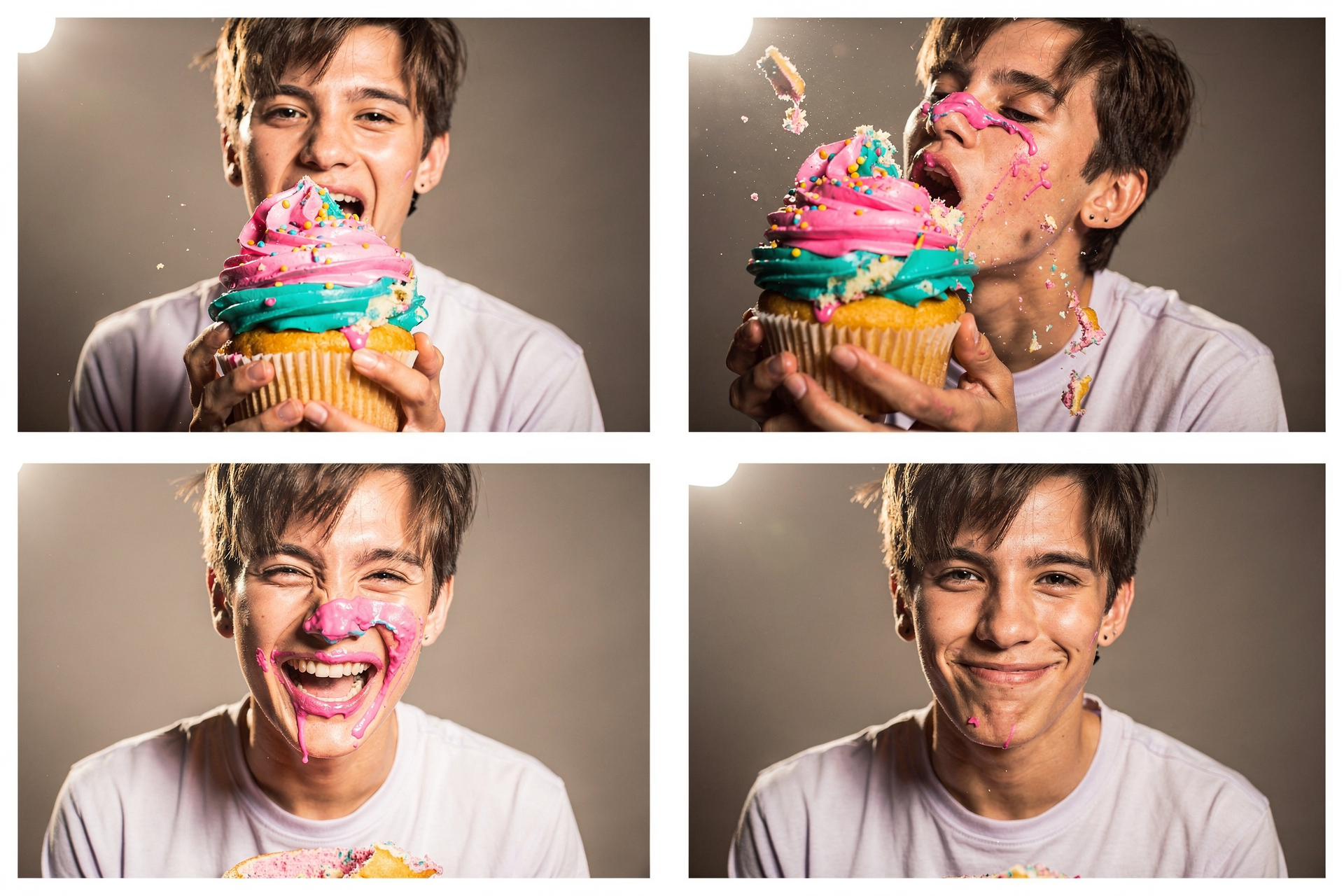
    Visually, this frame should prioritize clarity and space. It is often a wider shot, or a composition that clearly illustrates the environment. If your subject is a person, Frame One is their baseline expression…calm, expectant, or perhaps slightly bored. This establishes a “normal” state. For example, in a photo strip about eating a giant ice cream cone, Frame One is the subject standing with the perfectly intact, untouched cone, a look of pure anticipation on their face.

    The viewer’s mind immediately files this away: “Okay, this is the beginning. This is how things stand before the change.” Without this necessary initial setup, the next frames…the action…will lack the contrast required to feel like a story. The first frame is the anchor; it gives weight to the movement that is about to follow.

    It manages expectations and subtly promises that the next three frames will deliver a shift from this initial stasis. It is the quiet before the storm, the still moment that makes the subsequent movement kinetic. Its success is measured by how effectively it lays the foundational layer of reality for the story to be built upon.Frame Two: The Action (The Rising Tension)

    The second frame is where the story truly begins to move. Having established the “who” and “where,” Frame Two introduces the “what.” This is the catalyst, the complication, or the movement toward a goal. This frame creates tension because it is a direct deviation from the established norm of Frame One. The visual shift should be undeniable.

    Analog film photograph of section 2 related to The Science of the Strip: Why 4 Photos?

    In the narrative arc, this is the rising action. It’s the moment the character begins the task, or the problem makes itself known. Returning to the ice cream example, Frame Two is the moment the subject takes the first, massive bite, or perhaps the moment the cone begins to melt slightly, dripping over their hand. This is not the point of maximum drama, but the point of escalating drama. It’s the commitment shot. The expression on the subject’s face often shifts here…from anticipation to engagement, effort, or perhaps mild concern.

    Frame Two is crucial because it ensures the story isn’t just a collection of moments; it’s a process. It moves the subject from a passive state (being with the ice cream) to an active state (interacting with the ice cream). For a comic strip, this is the dialogue panel that reveals the conflict.

    For a fashion strip, this might be the moment a model begins a dramatic turn or interaction with a prop. It must confirm the promise of movement made by Frame One and set the stage for the inevitable climax. The visual language here is all about momentum, indicating that things are progressing and building toward an inescapable conclusion, heightening the sense of forward propulsion.Frame Three: The Climax (The Peak Moment)

    The third frame is the narrative apex…the reason the strip exists. This is the moment of maximum release, the punchline, the peak emotion, or the critical event. If the viewer remembers only one frame, it should be Frame Three. In the traditional three-act structure, the climax occurs at the end of Act Two or the beginning of Act Three. By placing it in the third of four frames, the structure acknowledges the narrative necessity of a brief, final conclusion.

    Analog film photograph of section 3 related to The Science of the Strip: Why 4 Photos?

    Visually, Frame Three should be the most dramatic, highest-energy, or most impactful image. In the photo booth, this is often the most exaggerated pose: the eyes crossed, the dramatic laugh, the sudden hug, or the full-face expression of delight or distress.

    Following our ice cream narrative, Frame Three is the glorious, messy peak: the cone has collapsed, the ice cream is smeared all over their face, and the subject is reacting with either pure, ecstatic joy or frustrated, messy surrender. The composition often benefits from being a tight, close-up shot, focusing exclusively on the intense reaction or the dramatic result of the action initiated in Frame Two.

    The chaos, the emotion, the visual noise…it all peaks here. Frame Three is the explosive release of the tension built across the first two frames. It is the moment where the story’s core thesis…the struggle, the joy, the transformation…is delivered with maximum force. Without a powerful Frame Three, the entire strip falls flat, lacking the necessary payoff that the setup frames promised. It must be visually and emotionally the loudest beat in the sequence.Frame Four: The Resolution (The Aftermath)

    The final frame serves to gently lower the viewer back to reality and provide closure. This is the “happily ever after” or, more often, the “lesson learned.” It is the moment of reflection and conclusion, ensuring the narrative loop is fully closed. After the high energy of the climax, Frame Four offers a necessary emotional and visual cool-down.

    Analog film photograph of section 4 related to The Science of the Strip: Why 4 Photos?

    Its visual aesthetic is often a return to calm, mirroring Frame One but with a crucial difference: the subject or scene has been fundamentally changed by the action. For the ice cream strip, Frame Four is the aftermath. The ice cream is gone (or mostly gone). The subject is looking tired but satisfied, perhaps wiping their face, or simply offering a knowing, post-chaos smile to the camera. It’s a moment of reflection and consequence.

    It doesn’t need to be high energy; its power comes from its quiet acknowledgment of what just occurred. Frame Four provides the necessary emotional safety for the viewer, letting them know the adventure is over. It validates the climax.

    The strip might end with a punchline, a knowing glance, or a return to the initial pose but with a subtle new detail…a smudge on the cheek, a changed backdrop, or a lingering expression of contentment. This final frame is what elevates the sequence from a mere series of snapshots into a coherent story, allowing the viewer to process the narrative and internalize the emotional journey. It’s the final punctuation mark…the period at the end of a perfectly formed sentence.The Science of the Quartet: Practical Application

    Understanding the four-frame narrative arc is incredibly useful for any content creator working in constrained media. The success of this structure lies in its forced economy. Since you only have four chances, every single frame must carry maximum narrative load.

    Analog film photograph of section 5 related to The Science of the Strip: Why 4 Photos?

    1. The Pacing is Non-Negotiable:

    You cannot linger in the introduction (Frame 1) or the action (Frame 2). These must be brief, crisp setups. Similarly, the climax must be instantaneous. This forced brevity is why the four-frame strip feels so dynamic. It’s a hyper-compressed drama, designed for an attention economy where speed of comprehension is paramount. The viewer must grasp the whole story in less than five seconds.

    2. Visual Contrast is Key: The transition between frames must be visually clear to signal the change in narrative stage. – Frame 1 to Frame 2: Change in posture or introduction of a new element (e.g., subject moves from sitting to standing). – Frame 2 to Frame 3: The most dramatic contrast. Often a change from an action-in-progress to the ultimate, messy result (e.g., from pouring liquid to spilling liquid).

    – Frame 3 to Frame 4: A distinct drop in energy. A move from a tight close-up back to a medium shot, or from an exaggerated expression back to a muted, reflective one. 3. Medium Agnostic Magic: This principle works across all mediums that rely on sequential imagery: – Photography: A social media photo dump should be organized to follow this structure. The first photo sets the scene (the venue), the second introduces the activity (the dancing), the third is the chaotic peak (the group selfie with confetti), and the fourth is the reflective morning-after shot (the coffee).

    – Graphic Design/Presentation: When explaining a concept, use the four-frame structure: Frame 1…Problem Statement, Frame 2…Proposed Solution, Frame 3…The Result (Data/Outcome), Frame 4…Conclusion/Next Steps. This ensures maximum clarity and narrative drive in professional communication. – Video: Even in a short video, the first second should be the Introduction, the next two seconds the Action, the fourth second the Climax, and the final second the Resolution. The narrative integrity of a short clip is fundamentally dependent on hitting these four beats quickly and clearly.The enduring power of the four-frame strip is a testament to the fact that complexity is not required for depth. It proves that the most relatable stories are often the most concise.

    By forcing a creator to distill their story down to its four essential pillars…the establishment of the world, the introduction of the struggle, the moment of ultimate impact, and the final breath of conclusion…the structure eliminates all narrative fat, leaving behind a sequence of pure, unadulterated storytelling. It is a powerful constraint, but one that yields the most satisfying and perfectly paced miniature epic every single time. It is, quite simply, the most efficient narrative engine ever designed. The universality of this arc, from ancient friezes to modern digital strips, confirms its position as the ultimate guide to instant, powerful communication. When you only have a moment to connect with an audience, four frames are not a limitation…they are the perfect, infallible law of narrative physics. The magic is not in adding more, but in knowing precisely what to include in the perfect, powerful quartet.

  • The Amelie Effect: Romanticizing the Photo Booth

    The Amelie Effect: Romanticizing the Photo Booth

    In a world dominated by meticulously curated Instagram feeds and high-resolution, professionally-lit portraits, there remains a persistent, almost rebellious allure to the old-fashioned photo booth. It is a portal, a small, velvet-curtained confessional that offers an instant of genuine, unfiltered intimacy. For couples, it’s not just about taking a picture; it’s about sharing a sealed, spontaneous micro-memory. This unique, cinematic quality of the photo booth is what we call The Amelie Effect, a phenomenon rooted in the whimsical, deeply romantic mystery of the 2001 French masterpiece, Le Fabuleux Destin d’Amélie Poulain.

    The film Amélie, directed by Jean-Pierre Jeunet, did more than just popularize Paris; it elevated the ordinary into the magical, and its most potent symbol of hidden connection and destiny is the photo booth, or autofoto machine. The story’s central mystery…Amélie’s quest to return a childhood trinket box to its rightful owner…sets the stage for her larger mission as a secret agent of happiness. But the photo booth provides the emotional architecture for her own destiny, binding her fate to the charmingly awkward photo booth repairman, Nino Quincampoix.

    In one of the film’s most crucial subplots, Nino collects the discarded, often mangled, passport photos that people tear up and toss away near the photo booth. He compiles them into a strange, wonderful album…a catalog of urban anonymity, fleeting emotions, and fragmented identities. The most perplexing inclusion is a recurring image of a man in a wide-brimmed hat whose face is always obscured, a man who consistently re-appears in the booth only to immediately discard his fresh photo strip. This figure becomes a mystery for Amélie to solve, a breadcrumb trail of fate that leads her closer to Nino.

    Analog film photograph of section 1 related to The Amelie Effect: Romanticizing the Photo Booth

    The genius of this narrative device…what the celebrated Autofoto article has explored in depth regarding the photo booth’s cultural legacy…is its connection between automatic photography and profound mystery. The photo booth is an impartial witness.

    It captures the moment of truth before self-consciousness kicks in, often catching people in a state of raw, unposed sincerity or, conversely, in the deliberate act of performing an identity. The resulting photo strip is an artifact , a piece of evidence from a sealed-off moment in time, destined for either a government document or, in Nino’s case, a strange museum of lost souls. Amélie, in her intricate plan to lure Nino, utilizes this very property: the forced, immediate capture of the self, transforming the mundane machine into a tool of high-stakes, romantic espionage.

    The inherent romance of the photo booth flows directly from this mystery and spontaneity. Unlike a selfie taken on a smartphone, which is subject to endless retakes and immediate digital curation, the photo booth demands commitment.

    Analog film photograph of section 2 related to The Amelie Effect: Romanticizing the Photo Booth

    Once the curtain is drawn and the flash sequence begins, you are locked into a narrative of four to six frames. This constraint creates an intense, shared pressure for a couple, leading to moments of genuine connection: a forced giggle, an accidental bump of the head, a sudden, surprising kiss just as the flash fires. It’s a shared secret, a performance only for each other and the camera lens.

    The small, enclosed space amplifies intimacy. The world outside disappears, replaced by the sound of the developing machine and the bright, momentary blast of the flash. This is why the photo booth strip becomes a superior souvenir of a date…it is tangible proof of a contained, perfect moment of shared vulnerability. The print itself, often slightly flawed, chemically developed, and physically present, acts as a physical anchor for the memory, unlike the fleeting and infinite stream of digital images.

    For modern couples seeking to capture this raw, romantic, and slightly mysterious Amelie Effect, the challenge is to replicate that sense of confinement and spontaneity in the digital age. This is where a professional photo booth app like ZillaBooth becomes the essential tool, bridging the gap between the film’s analog magic and the convenience of a smartphone. ZillaBooth allows you to take manual control of the shooting sequence, replicating the classic photo booth experience, only with professional-grade quality and creative control.

    Analog film photograph of section 3 related to The Amelie Effect: Romanticizing the Photo Booth

    Here are detailed tips for staging a romantic couples’ photo shoot using the ZillaBooth application to capture The Amelie Effect.

    Tip 1: Recreate the Confessional. The first step is to simulate the physical confinement of a traditional booth. Instead of just holding your phone, find a small, defined space. If you’re at home, drape a blanket over two chairs to create a small “tent.” If you’re out, squeeze into a narrow doorway or stand tightly against a textured wall.

    The goal is forced proximity. Get your bodies as close as possible, chest-to-chest, head-to-head. The more cramped you are, the more genuine the spontaneous giggles and shared breaths will be, which are the hallmarks of a truly romantic photo booth strip. The camera (your phone running ZillaBooth) should be fixed on a tripod or propped up at a height that requires you both to look slightly up or straight ahead, mirroring the fixed lens of a classic machine.

    Analog film photograph of section 4 related to The Amelie Effect: Romanticizing the Photo Booth

    Tip 2: The Mystery Prop and Atmosphere. The Amélie effect is all about adding a layer of charming complexity. Bring a single, simple prop that tells a small, non-obvious story.

    This could be a single shared scarf, a pair of vintage sunglasses, or a half-eaten dessert on a spoon. This prop gives you a shared focus beyond the camera and adds a touch of mystery to the final strip…a silent question mark that only the two of you understand. Before starting ZillaBooth, set the mood with music…classic French jazz, perhaps, or a low-key, romantic instrumental track…to help you forget the camera is there.

    Tip 3: Mastering the ZillaBooth Countdown and Sequence. The ZillaBooth app is key because it allows you to set a fixed delay and a multi-shot sequence, removing the impulse to check the photo after every frame. * The Delay: Set ZillaBooth’s timer for a 5-second initial delay. This time is crucial. It’s the moment where the internal monologue (‘Are we ready? How do I look?’) is replaced by genuine, shared anticipation. Use the delay to look at each other, not the camera. * The Sequence: Set the app to take four to six shots with only a 2-second interval between flashes. This tight interval forces spontaneity.

    Analog film photograph of section 5 related to The Amelie Effect: Romanticizing the Photo Booth

    You have no time to compose a new pose, only to react to the previous flash.Tip 4: The Four-Frame Romantic Narrative Arc. To get a compelling strip that tells a story, plan a loose arc, but allow for improvisation. * Frame 1: The Look of Mystery. Start with a serious, slightly mysterious pose. Look directly at the lens, but with a slight, knowing smile…the way Amélie herself often regards the world. This establishes the cinematic tone. * Frame 2: The Spontaneous Reaction. In the short interval, do something impulsive. Whisper a secret, lean in suddenly, or make a funny face.

    The resulting image should be one of genuine laughter or surprise, breaking the seriousness of the first frame. * Frame 3: The Confirmed Romance. This is the classic shot: a kiss. It could be a simple peck, a playful nibble, or a closed-eye, romantic embrace. The flash freezes the peak of the intimate moment. * Frame 4: The Shared Exit. In the final frame, try to obscure your faces slightly. Look away from the camera, or put the shared prop in front of your eyes, or pull the curtain closed (if simulating one). This final moment mirrors the obscured photos from Nino’s album…a fragment of identity that returns to the realm of the anonymous and the mysterious, concluding the romantic tale with an elegant fade to black.Tip 5: Post-Production in the Amélie Style.

    ZillaBooth offers various filter options, and your choice is vital to achieving the specific aesthetic. * High-Contrast Monochrome: For true Amelie-style mystery and nostalgia, select a high-contrast Black and White filter. This emphasizes the texture, the deep shadows, and the intensity of the flash, making the images look like vintage newspaper clippings or the found fragments in Nino’s album. * Vibrant Saturation: Alternatively, for the whimsical, highly-saturated Parisian palette of the film, choose a filter that slightly boosts the greens and reds, giving the strip a warm, cinematic quality.Tip 6: The Tangible Souvenir. Crucially, resist the urge to simply save the file digitally. ZillaBooth allows for easy printing. Get the strip printed immediately, ideally in a format that mirrors the long, narrow classic style. Once printed, resist the modern impulse to post it instantly. Instead, place it in a book or a special box…a hidden memento just for the two of you. By giving it a physical life, you transform it from a fleeting digital file into a permanent, tangible artifact of your shared romance, fully embodying the magical, nostalgic, and deeply personal connection celebrated by the Amelie Effect.

    The photo booth, whether the heavy mechanical box of the past or the advanced application on your phone, is fundamentally a machine designed to document love with an unblinking, honest eye. It strips away the artifice of professional photography and captures the beautiful, slightly chaotic truth of a couple’s connection. By embracing the constraints and focusing on the shared, spontaneous moment, you can step into the magical, romantic world of Amélie and create a photographic memory that is both a spontaneous snapshot and a piece of your own unfolding, romantic destiny.