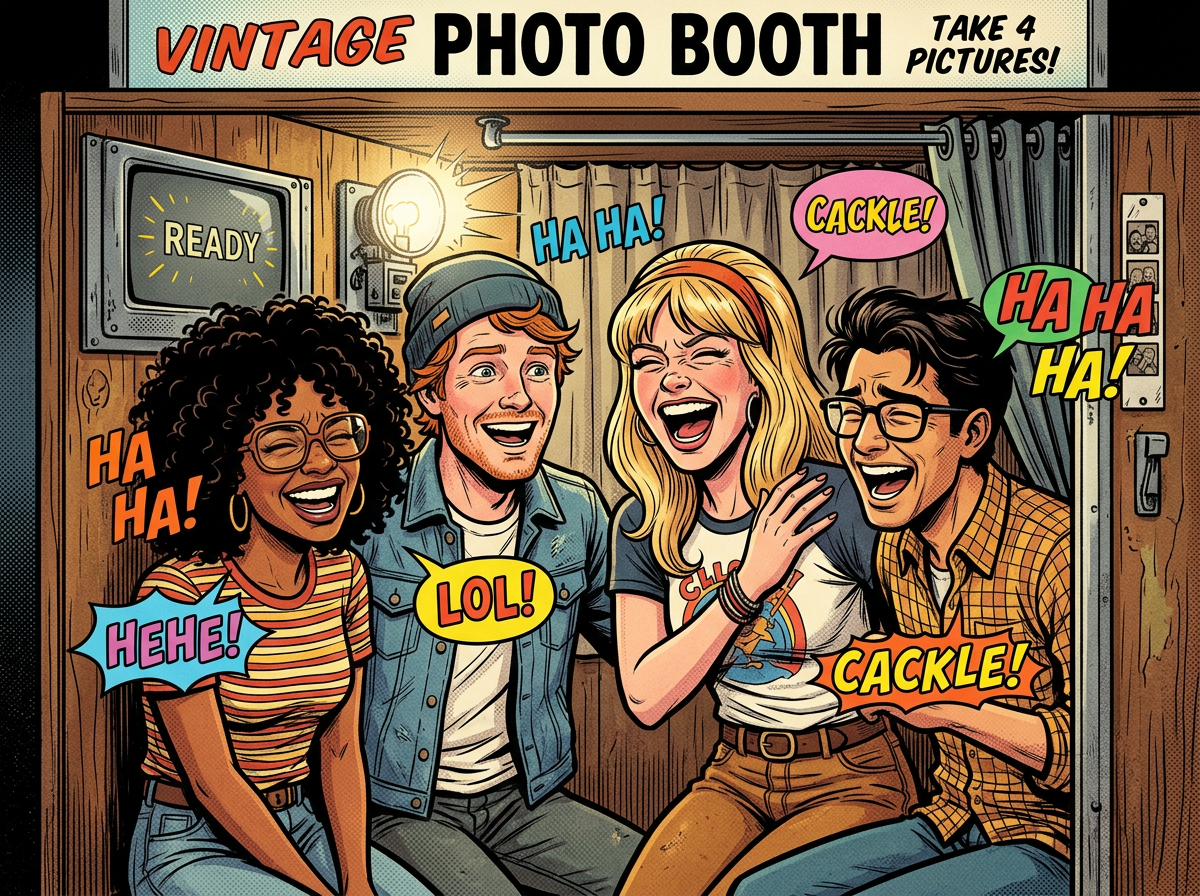
The year is 1925. In the bustling, electric heart of New York City, a quiet revolution is taking place, not in politics or industry, but in the simple, ephemeral act of recording oneself. A Russian immigrant named Anatol Josepho, driven by a vision of accessible, instant self-portraiture, introduces his invention to the world: the Photomaton.
The concept was simple, yet utterly transformative: step inside a small booth, drop 25 cents into the slot, and moments later, emerge with a strip of eight photographic portraits. No professional photographer, no long waits for developing, no technical skill required…just you, a curtain, and the machine. Josepho’s invention was an instant, overwhelming sensation. Within six months, over 280,000 people lined up to experience this new automaton, propelling the photo booth from novelty to cultural cornerstone.
As we stand on the cusp of celebrating the photo booth’s centennial, it’s not just a time for nostalgia, but for appreciating one of the greatest stories of technological survival and adaptation. What Josepho invented was not merely a mechanical box that took pictures; he codified an experience…the act of creating an instant, intimate, and often silly self-portrait…that has survived wars, technological leaps, and the complete transformation of human communication to find its ultimate form right where Josepho may have least expected it: living in your pocket.
Act I: The Birth of Instant Self-Portraiture (1925–1950s)
To understand the genius of the Photomaton, you must first understand the context of 1925. Photography was still a relatively formal, expensive, and time-consuming process. Getting a portrait meant scheduling an appointment with a studio photographer, enduring long exposures under bright, hot lights, and then waiting days or weeks for prints to be developed.
Josepho’s machine blew all those barriers away. The Photomaton offered an unprecedented combination of speed, privacy, and affordability. For a quarter, anyone could get a photographic souvenir. The act of entering the booth and drawing the curtain was a radical moment of personal freedom. Behind that felt curtain, the typical formality of the photograph dissolved, replaced by playfulness.

The original Photomaton was a marvel of mechanical engineering. It was a darkroom in a box, a complex machine that took and developed the photographs on a single continuous roll of film and photographic paper. The multi-step process…exposing the film, developing it in a series of chemical baths, washing, and drying…all happened autonomously within the machine, culminating in the strip of finished photos sliding out a chute. This mechanical complexity was Josepho’s stroke of genius, earning him over a million dollars for the American rights to his invention…a staggering sum at the time…and sparking a global craze.
The photo booth quickly became a fixture in train stations, boardwalks, dime stores, and arcades. It was the place where people took passport photos, but more importantly, it was the location for a first date’s stolen kiss, a group of friends making funny faces, or a soldier capturing a final memory before deployment. The photo booth created a new, vital visual artifact: the photo strip, a sequential narrative of four or eight images that told a micro-story.
Act II: Pop Culture and the Icon Strip (1960s–1990s)
While the technology slowly changed…color processing arrived, and the chemistry became a little cleaner…the core photo booth experience remained static, allowing its cultural significance to deepen.
By the mid-20th century, the photo booth was no longer just a machine; it was an icon. It became indelibly associated with youth culture, rebellion, and a specific kind of urban grittiness. Its raw, direct lighting and the inherent sequential nature of the strip were perfect for capturing candid, unpolished moments, a sharp contrast to the staged photos of family albums.
Perhaps the greatest artistic endorsement came from Andy Warhol, who, in the 1960s, embraced the photo booth aesthetic. Warhol saw the booth’s capacity for creating instant, cheap, reproducible portraits as an extension of his own Pop Art philosophy. He would use photo booth strips as source material for his iconic silkscreen portraits, or simply present the strips themselves as art. In his hands, the humble photo booth strip was elevated from a novelty souvenir to a meditation on identity, celebrity, and mass production.
For generations of teenagers in the 70s, 80s, and 90s, the photo booth was the ultimate analog social media. It was where you cemented a friendship with a strip of four identical, often goofy, poses, trading them with friends to keep in wallets or tape on lockers. The limited space forced intimacy, and the rapid-fire camera encouraged spontaneity, a shared performance under the brief spotlight of the flash. This physical strip, a tangible, slightly fragile piece of evidence, was a testament to “we were here.”

Act III: The Digital Metamorphosis (2000s–Present)
As the digital camera emerged in the early 2000s, the physical photo booth faced a crisis. Why pay for a paper strip when you could take an unlimited number of high-resolution digital photos for free? The number of traditional, chemical-processing booths plummeted, and it looked for a time as though Josepho’s invention would be relegated to museum exhibits and vintage arcade corners.
But Josepho’s true invention…the concept of the instant, fun, disposable self-portrait…was not dead; it was merely preparing for its greatest evolution: it was about to move into your pocket.
The rise of the smartphone was the photo booth’s ultimate salvation. The modern smartphone is, in essence, the perfect digital Photomaton. It provides the privacy (or lack thereof, if you’re using the front-facing camera) of the original booth, the instant gratification of an immediate result, and the capability to print (or share) the results instantly.
Every time a user snaps a selfie and applies a filter, they are engaging in a digitized version of the photo booth ritual. When a group of friends takes four sequential pictures in an app to create an animated GIF, they are recreating the photo strip…the digital frames are the new physical paper. When they use an app that mimics the aesthetic of the 90s booth (harsh flash, blown-out highlights), they are consciously engaging in the nostalgic legacy of the original machine.
The photo booth’s survival in the digital age is a case study in technological abstraction. The mechanics are gone…no chemicals, no gears, no paper roll. But the core functional elements have been translated directly to software: * The Curtain: Replaced by the front-facing camera, a mirror, and the personal space of the user.

* The Quarter: Replaced by the “cost” of data or the subscription fee of a premium filter. * The Strip: Replaced by the multi-shot GIF, the collage feature, or the album of sequential selfies.The photo booth concept survived because it taps into a fundamental human desire for accessible, non-professional self-documentation that prioritizes fun and memory over technical perfection. It offered a middle ground between the perfect studio portrait and the fleeting memory of a moment.
Act IV: Nostalgia, Events, and the Next 100 Years
Today, the photo booth concept thrives in two parallel worlds.
First, there is the nostalgic revival. High-end digital photo booths are a mandatory feature at weddings, parties, and corporate events. These modern booths offer the enclosed space, the instant print (now a digital thermal print), and the props, but they also integrate green screens, digital sharing options, and social media connectivity. They are physical, premium experiences that channel the intimacy and fun of the original machine. This market demonstrates that the appetite for the physical ritual remains powerful, even in a digital world.
Second, and more universally, is the digital ubiquity. The photo booth now lives in the pocket of billions of people. From Snapchat filters that encourage playful transformation to Instagram’s Stories that prioritize immediate, unpolished visual updates, the principle of the quick, disposable self-portrait has become the dominant mode of visual communication.
As the photo booth concept approaches its official centennial in 2025, we celebrate not just an invention of metal and chemicals, but a powerful idea. Anatol Josepho was not just an inventor; he was a visionary who understood the human desire for a quick, unfiltered look at themselves. He created a moment that broke through the formality of a bygone era and paved the way for the age of the selfie.
From the complex machinery of 1925 to the sleek software running on the chips inside our phones today, the photo booth has completed a perfect century-long circle. It began as a mechanical marvel in a public space, and it has found its future as a digital marvel…powerful, instant, and ready to capture a moment…permanently nestled in the hands of its users. Happy centennial, old friend. The concept you created has never been more alive.