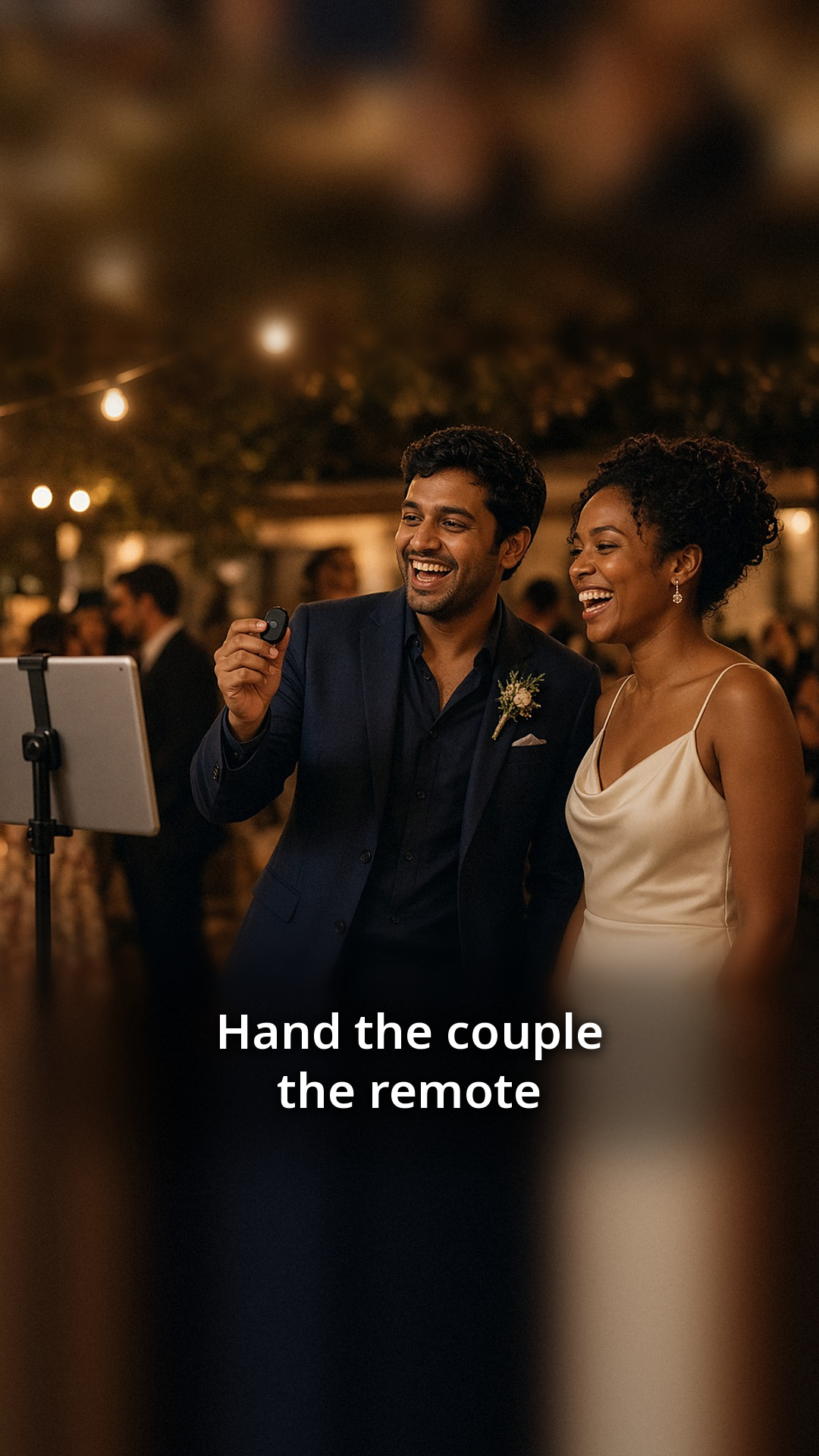
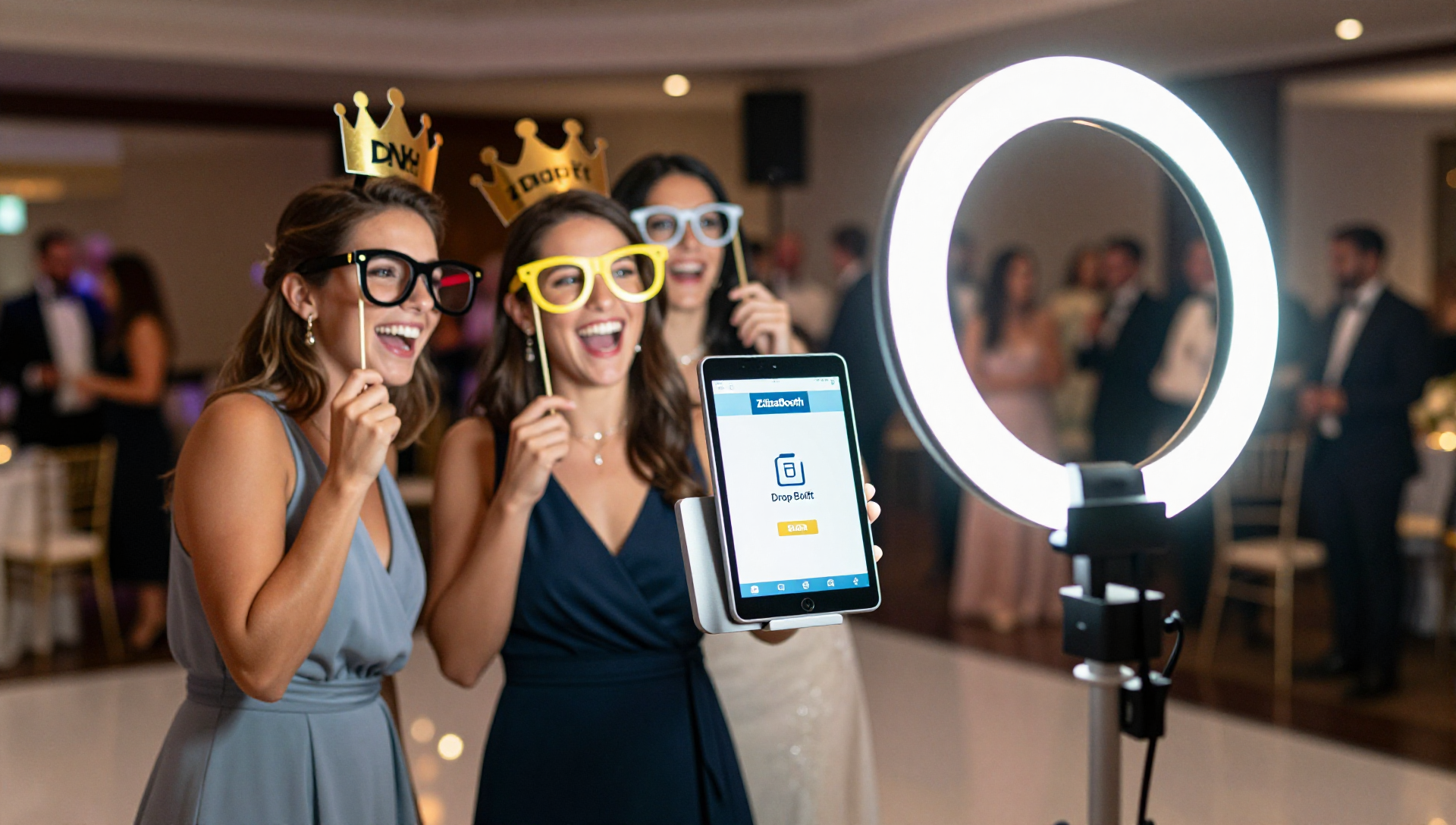
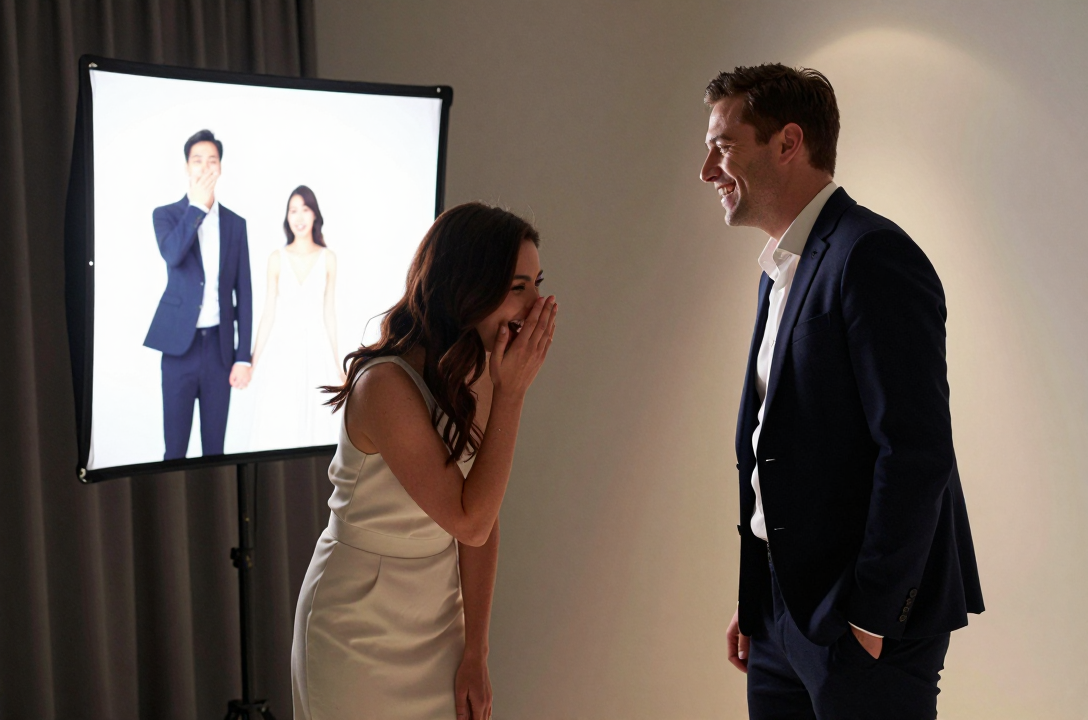
Most couples never get a proper turn at their own photo booth. Guests crowd around it, the line moves fast, and the newlyweds are busy greeting people. A small Bluetooth remote fixes that. Hand it to the couple, and they decide exactly when the countdown starts.
What the remote does
With ZillaBooth Pro, you can turn on Bluetooth Remote Shutter, pair a small Bluetooth shutter remote, and a single click starts the countdown. One press starts the countdown and then all four shots. Four photos later, the couple has a strip of their own. The booth runs the same way for guests, who tap the screen as usual.
It is an opt-in setting, so it does not change anything until you switch it on.
How to set it up
The setup is quick, and it is worth doing a day or two before the reception:
Open ZillaBooth on the iPad and go to Settings.
Turn on Bluetooth Remote Shutter in the Pro settings.
Pair your remote with the iPad as you would any Bluetooth accessory, then test it with ZillaBooth before the event, since remotes vary.
Run a test session and click the remote once. Check that the countdown starts and four photos are taken.
Try it from the spot where the couple will be standing. Bluetooth works best within a normal room distance, so a short test saves surprises later.
When to hand over the remote
Some couples use it right after the first dance, when the room is buzzing and everyone wants a photo. Others hold it for the end of the night, when the crowd has thinned and they can take a few relaxed strips together. A good rule is to give it to the couple at the start of the reception and let them choose.
If you have a friend acting as the booth contact, ask them to show the couple how to click once and hold still for the countdown.
Prints for the couple
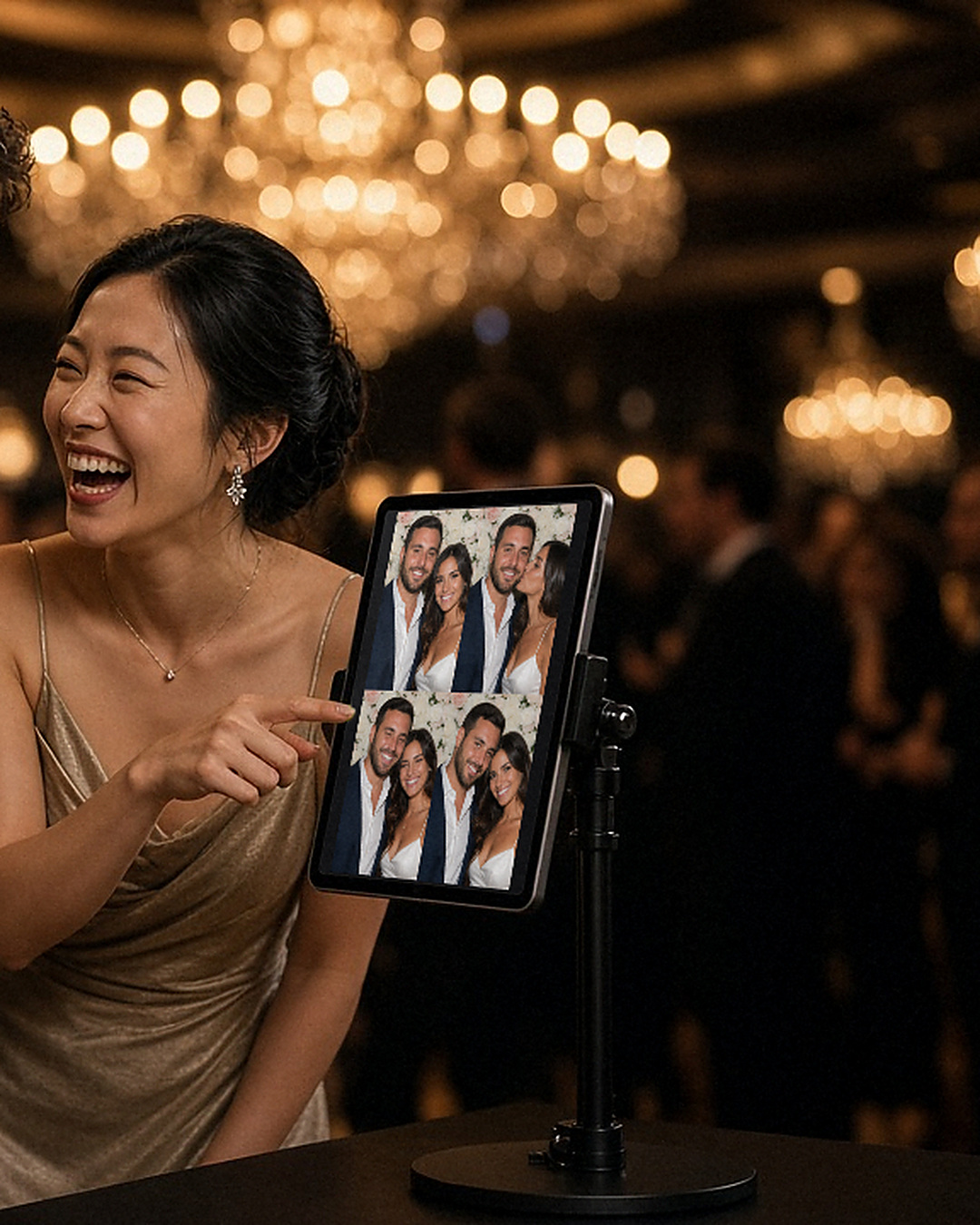
After the session, the couple can print their strip right away. Printing works on every tier through AirPrint, and Pro adds Simple Printing, a one-tap Print button. Keep the printer close to the booth so the couple does not have to walk across the room to collect the print.
A fun idea: keep the first strip of the night for the guest book or the thank-you card.
What it costs
ZillaBooth is free to download. Pro is a monthly or yearly subscription that includes Pocket, and you can see current pricing in the app. If you only need Pro for a wedding weekend, a monthly plan covers it.
Small details that help
Put a fresh battery in the remote and pack a spare.
Pair the remote at home, not during the reception.
Add a “Tap to start” sign so guests know they do not need the remote.
Make sure the iPad is plugged in and the stand is stable.
Where this fits in your wedding plan
The remote is a nice extra, not a requirement. Your reception booth will work well with just the iPad and a stand. If you are still planning, start with our wedding reception photo booth checklist and add the remote once the basics are in place. The wedding photo booth page also shows how couples set up ZillaBooth at receptions.
The rehearsal dinner is the calm before the wedding. The wedding party is relaxed, family is meeting for the first time, and nobody is in a rush. That makes it the best moment to try out your photo booth, and a very good excuse to take the first photos of the weekend.
Why test at the rehearsal dinner
Running the booth the night before gives you three things.
First, a real test. You will see how long a session takes, where the stand works best, and whether the light is flattering. Second, a trained group. The wedding party will know how the booth works, so they can show other guests the next day. Third, a head start on the guest book. If you are planning a photo guest book, a few early strips already fill the first page.
Keep it low-key
A rehearsal dinner is not a full reception, so the booth should be simple. Put the iPad on a stand near the tables, where people are already milling around. Open ZillaBooth, choose a 2×2 grid, and let people walk up on their own.
The countdown does most of the directing. Guests tap, pose, and see the finished picture in a few seconds. A small sign that says “Tap to start” helps.
A few things to find out
Use the evening as a rehearsal in the proper sense. Check these items:
Who hogs the frame, and who needs a nudge to join in?
How loud is the room, and can guests hear the countdown?
Which pose wins? Every group has one.
Does the stand sit steady on the floor or table you plan to use?
Is the light soft enough, or do you need a lamp in front?
Write down what you learn. You will use it the next day.
Prints and email
If you want to try printing, printing works on every tier through AirPrint, so any AirPrint printer on the same Wi-Fi is enough to test. You can also share the pictures from the iPad. A printed strip makes a lovely thank-you for parents and grandparents.
If you plan to use a names-and-date design at the reception, Pro lets you add your own PNG overlay to every picture. The rehearsal dinner is a great time to check that the text is readable on the iPad screen. The Pro page has the details.
Who should be the booth friend?
Ask one person in the wedding party to take charge. They do not need to be technical. They just need to remember where the paper and charger live and be willing to show guests how to start. By the reception, that person will be a pro.
What to do afterward
Look through the test pictures with the wedding party. Pick a favorite and save it for the slideshow or the thank-you card. If anything looked off, adjust the stand, the light or the printer location before the big day.
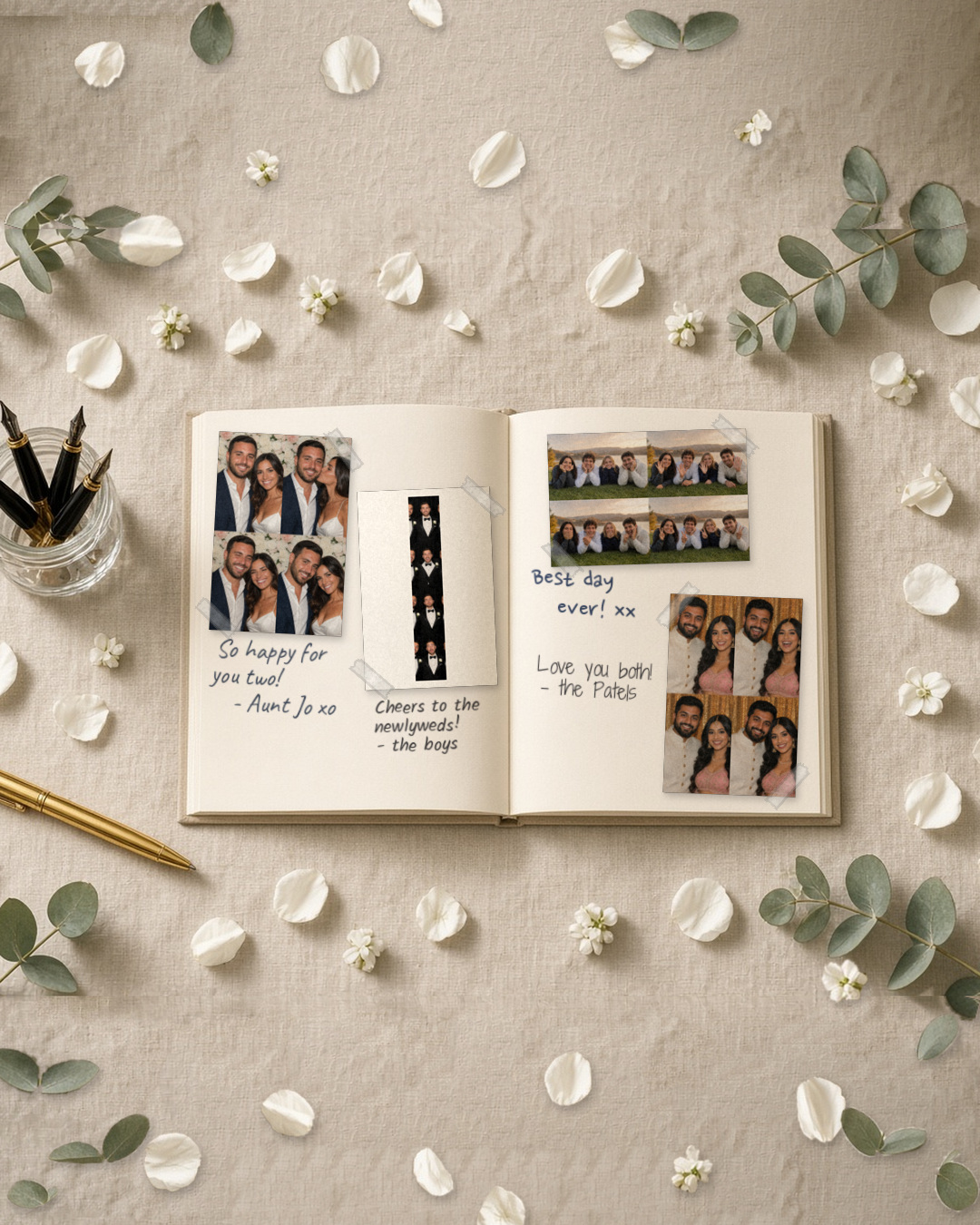
A classic guest book has a problem. By the end of the night, the pages are a mix of neat signatures and hurried scribbles, and half the guests have no idea what to write. A photo guest book solves that by giving every group a face and a reason to leave a note.
How it works
Set an iPad photo booth next to the guest book table, with a printer beside it. Each group takes their four photos, prints the strip or 2×2 grid, tapes it into the book, and writes a line next to it. Years from now, you will not just have a name, you will have a face and a handwritten message.
It is a small change, but it gives the guest book table a purpose. People wander over, take a photo, and stay for a minute.
What you need
An iPad on a stand with ZillaBooth open.
An AirPrint printer and enough paper for the guest list.
A guest book with plenty of blank pages. Thick paper holds tape better.
Photo corners or double-sided tape.
A few pens in a jar, so no one hunts for one.
Strips or grids?
Both work well. ZillaBooth makes a classic 1×4 strip or a 2×2 grid. A 1×4 strip prints on its own, centered on the paper, so you will want to trim it to size before taping it in. A 2×2 grid is squarer and easier to fit on a page. If you want to compare, our post on the 2×2 grid explains why it stays popular.
Think about the page layout too. A grid and a strip can share a spread, with a note under each.
Printing at the table
Printing works on every tier through AirPrint, and Pro adds Simple Printing, a one-tap Print button once you have chosen a printer. Guests can still send themselves a copy too. With Pro, Simple Email Sharing sends the photos from your own email address, so guests get a copy and the print stays with you.
Make the table inviting
A few touches help:
Put a small sign next to the iPad: “Take four photos, tape one in, sign beside it.”
Keep the printer where guests can see it work. The little moment of waiting becomes part of the fun.
Leave a handful of pages near the front for the wedding party, who tend to arrive first.
Add a small tray of tape and scissors so nobody fumbles.
Planning the flow
Place the guest book near the cocktail hour area rather than at the entrance. That way guests have time to take a photo without blocking the door. If the cocktail hour is short, a small table in the reception room works as well.
Have a friend check the table at the start of the evening and restock paper once during the night. After that, it should run on its own momentum.
A keepsake you will actually open
Guest books often end up on a shelf. A photo guest book tends to come off the shelf, because it is full of faces. Couples often say the best part is flipping through years later and finding someone they had not seen in a while.
You can see how couples use ZillaBooth at weddings on the wedding photo booth page, and the Pro page shows the print and email extras.
When you are ready, take a look at ZillaBooth Pro or start with the free app and print a test strip for your own book.
Planning a reception means a hundred small decisions, and the photo booth should not be one of the hard ones. This is a one-page checklist you can save to your planning document. It assumes you are using an iPad and ZillaBooth, and it is built so that guests can run the booth themselves while the wedding party enjoys the night.
The gear
An iPad you already own, running iOS 26 or later.
A sturdy stand that holds it at chest height.
A power cable long enough to reach the nearest outlet.
An AirPrint printer and paper, if you want prints.
The spot
Put the booth near the bar, not on the dance floor. People linger by the bar, so they will happily wait for a turn. Keep an outlet within reach and leave a little space around the stand so a group of six can stand together. If you want a deeper dive on placement, our guide to lighting a dim venue also covers where to put the stand.
The light
Reception lighting drops after dinner. One soft light in front of the booth, pointed at faces, makes the biggest difference. Take a test grid at the time of day the party will be at its darkest, and adjust from there.
The layout
ZillaBooth gives you a classic 1×4 strip or a 2×2 grid after a four-photo countdown. A grid is easier for groups, and a strip is lovely for couples. Both are free, with no watermark and no account. If you are undecided, read why the 2×2 grid is still a favorite.
Your names on the strip
With Pro, you can add a PNG overlay with your names and the date, one design for each layout. Most couples make it in a graphics app or ask a designer friend. Keep the text away from the edges and make sure it has enough contrast against photos.
How guests take it home
Some guests want a printed strip and some want an email. Printing works on every tier through AirPrint, and Pro adds Simple Printing, a one-tap Print button after you choose a printer. For email, Pro includes Simple Email Sharing, which sends the photos from your own email address. Offering both means nobody leaves without their picture.
Lock it in
By the end of a long reception, someone has usually found the settings. Turn on Apple’s Guided Access to lock the iPad to ZillaBooth, and with Pro, Hide Settings keeps the settings button out of sight.
If the reception runs late, set Auto-Lock to Never in the iPad’s Display & Brightness settings, start Guided Access, and keep the iPad plugged in so the screen stays on all event.
The final test
Do a full run-through the day before:
Take a strip as a couple and print it.
Check that the printer is on the same Wi-Fi network as the iPad.
Walk a friend through the booth without explaining it, and see what they ask.
Pack spare paper and a charger.
Who looks after it
Name one friend as the booth contact, someone who can refill paper and answer a question. The booth itself does not need a staff member, but a single contact person keeps small problems from becoming big ones.
Where to learn more
The wedding photo booth page has more details on how couples use ZillaBooth at receptions, and the Pro page lists the features that matter for overlays, printing and email. When you are ready, try ZillaBooth Pro or start with the free app and run a practice session at home.
To turn an iPad into a wedding photo booth, put it on a sturdy stand at chest height near soft, even light, install ZillaBooth from the App Store, and with ZillaBooth Pro, lock it to the app with Guided Access so guests can run it themselves. ZillaBooth Pro also lets guests tap Print for a strip through Simple Printing and email their photos to themselves from your own email address.
Stand: mount the iPad on a sturdy stand at about chest height, near an outlet so it stays plugged in. In Guided Access, set Display Auto-Lock to Never and keep the iPad plugged in so the screen stays on all event.
Lighting: face guests toward soft, even light, such as a window by day or a lamp or LED panel at night, and keep bright windows behind the iPad, not behind the guests.
ZillaBooth: install ZillaBooth (iPadOS 26 or later) and pick a 2×2 grid or a 1×4 strip.
Guided Access (Pro recommended): lock the iPad to ZillaBooth. With ZillaBooth Pro, the settings button hides automatically while the iPad or iPhone is locked in Guided Access or Single App Mode, and comes back when you end it.
Simple Printing (Pro): select your AirPrint printer once in Simple Printing so guests can tap Print to send their strip to it. DNP printers work through DNP’s WCM-Plus.
Guest email (Pro): set up Simple Email Sharing with your email account’s SMTP settings so photos arrive from your own email address.
Test run: run a full session, including printing and email, before guests arrive.
A wedding photo booth does not have to be a big rented box with a curtain. If you own an iPad, you already have most of what you need. Here is how couples and planners set one up with ZillaBooth, step by step.
Step 1: Stand and spot
Start with a sturdy stand, the kind that holds the iPad at about chest height. Place it near the bar or the lounge area rather than on the dance floor. People linger by the bar, and they will wait for a turn without grumbling. Keep an outlet nearby so the iPad stays plugged in all evening.
For more on lighting a dim venue, see our lighting guide.
Step 2: Open the app and pick a layout
ZillaBooth is free to download. It needs iOS 26 or later. Open the app, and choose a classic 1×4 strip or a 2×2 grid. A grid is a good default at weddings because it holds a whole group, while a strip suits couples and small groups.
The free version (Core) has no watermark and needs no account, so there is nothing to sign up for before the reception.
Step 3: Let guests run it
Guests tap the screen, and a countdown starts. Four photos later, the finished picture appears. That is the whole experience, and it is why wedding parties and grandparents can both use it without help. Test it yourself with a few people before the day so you know exactly how long a session takes.
Step 4: Add printing and email
If you want prints, set up an AirPrint printer on the same Wi-Fi network as the iPad. With ZillaBooth Pro, Simple Printing sends each strip to that saved printer with one tap when guests tap Print, and DNP printers work through DNP’s WCM-Plus. You can also print from the iOS share sheet. Place the printer within sight of the booth, but away from the walkway.
For guests who prefer a digital copy, Pro includes Simple Email Sharing, which sends the photos from your own email address (on your own domain, if you have one) using your email account’s SMTP settings. Guests type their address on the iPad and the photos arrive in their inbox.
Step 5: Make it yours
Pro lets you add your own PNG overlay, for example your names and the date, to every picture. You create the design as a PNG in any graphics tool, then load it into the app. Overlays work one at a time.
Step 6: Keep guests in the app
At a long reception, someone will eventually poke around in the settings. Turn on Apple’s Guided Access to lock the iPad to ZillaBooth. With ZillaBooth Pro, the settings button hides automatically while the iPad or iPhone is locked in Guided Access or Single App Mode, and comes back when you end it. Together they keep the iPad on the booth screen.
What it costs
ZillaBooth Core is free. Pocket is a one-time purchase, and Pro is a monthly or yearly subscription that includes Pocket. You can see current pricing in the app. Most couples start with Core and a test run, then decide whether they want prints and overlays on the day. The Pocket page explains what the one-time upgrade adds.
A short checklist for the day before
Charge the iPad and pack the charger.
Print a test strip and check the paper.
Tape a “Tap to start” sign to the stand.
Ask one friend to be the booth contact in case someone has a question.
FAQ
Can I use an iPad as a wedding photo booth?
Yes. ZillaBooth turns an iPad into a wedding photo booth that makes classic 2×2 grids and 1×4 strips. ZillaBooth Pro adds a self-serve setup with Guided Access, Simple Printing and guest email from your own email address (SMTP).
Do I need ZillaBooth Pro for a wedding?
Not to take photos: the free version runs the booth and guests can share from the iPad. Pro is worth it if you want Simple Printing, guest email from your own email address (SMTP), a custom overlay with your names and date, or external camera support on iPad (UVC webcams, plus Canon EOS cameras from about 2010 on; tested on the Rebel SL2, support varies by model).
How do I stop guests leaving the photo booth app?
Turn on Apple’s Guided Access and start it inside ZillaBooth. With ZillaBooth Pro, the settings button hides automatically while the iPad or iPhone is locked in Guided Access or Single App Mode, and comes back when you end it.
Which printer works with an iPad photo booth?
With ZillaBooth Pro, Simple Printing sends each strip to a saved AirPrint printer with one tap; DNP photo printers work through DNP’s WCM-Plus. On any tier, you can also print from the iOS share sheet. See using DNP printers with ZillaBooth.
A few example layouts in the style guests make with ZillaBooth: classic 1×4 strips, 2×2 grids, and Pocket looks with black-and-white photos and borders. These are illustrations, not photos from real events.
Every couple spends countless hours perfecting their wedding timeline, meticulously planning the flow from the ceremony’s first look to the reception’s last dance. You map out the cocktail hour signature drinks, the seating chart geometry, and the exact minute the DJ will cue the grand entrance. Yet, there is one critical juncture that often turns into an energetic black hole: the lull between the end of the cocktail hour and the official start of the reception.
This period is not just a few minutes of milling about; it’s a high-stakes moment for the overall party atmosphere. Guests have enjoyed an hour or more of light chatter and buoyant energy, but when the music cuts and they are directed to the reception space, that momentum can instantly dissipate. You risk losing the high-octane mood you’ve worked so hard to build. This is precisely why your wedding timeline doesn’t just need an activity during this time…it needs a dedicated transition activity.
The Importance of the “Transition Photo” Trend
Over the last few seasons, a viral photography trend has emerged that perfectly encapsulates this critical moment: the “transition photo.” These aren’t posed, formal portraits. They are candid, energetic shots of guests actually moving…often walking, laughing, and gesturing…as they travel from the post-ceremony mingling space into the main dinner and dancing venue.
Why have these photos become so sought after? Because they capture raw, unforced anticipation. They show the genuine shift in energy, the excitement on a guest’s face as they realize the celebration is about to kick up a notch. It’s a documentary-style record of the wedding’s narrative arc, showing movement and dynamic emotion rather than static smiles. These images are often filled with candid moments: an aunt holding her shoes, a group of friends mid-giggle, or a couple pausing to read the seating chart. They are the definition of authentic wedding content, a beautiful counterpoint to the choreographed moments of the ceremony.
However, relying solely on your wedding photographer to capture this energy is a roll of the dice. Their focus is often on the venue’s final preparation or capturing the couple’s quiet moment before their entrance. This is where the ZillaBooth, strategically placed as a controlled, high-energy transition station, transforms a potentially awkward logistical shift into one of the most memorable parts of the day.
Solving the Logistical Nightmare: The Room Flip
Beyond the psychological need to maintain momentum, the transition period often hides a significant logistical hurdle: the dreaded “room flip.”
In many popular wedding venues…especially those with versatile spaces like ballrooms, converted warehouses, or private estates…the cocktail hour space is often the same space that needs to be quickly transformed into the reception area. The instant guests clear out, the venue staff and vendors have a lightning-fast window to: * Remove high-top tables, bar debris, and any remnants of cocktail hour decor.
* Set up dinner chairs and finalize place settings.
* Move and finalize the DJ booth, lighting, and any large floral installations.
* Perform a final clean sweep before the grand entrance.This process, even when executed by the most professional team, takes time…usually a minimum of 20 to 30 minutes. If your guests are simply left waiting outside the main door, staring at their watches, the vibe plummets. They feel stranded, the flow of the evening is broken, and the beautiful sense of event continuity is shattered.
This logistical window needs an attractive, purposeful distraction. The ZillaBooth is not just an entertainment amenity; it is a critical piece of your logistical defense system. Our wedding photo booth guide covers the setup.
Introducing the ZillaBooth: The Purpose-Built Transition Activity
The ZillaBooth is designed to be a high-flow, high-excitement activation that serves both the aesthetic and practical needs of this crucial time slot. Its appeal lies in its immediate gratification and social energy.
Imagine this scenario:
Guests are politely ushered out of the cocktail hour space. Instead of a dead-end hallway, they are immediately greeted by a beautifully designed, modern photo booth activation…the ZillaBooth…stationed directly at the entryway to the reception area. The energy is instantly redirected.
The setup is key: Load a themed overlay into ZillaBooth, add good lighting, and every snap is ready to share. The moment a guest steps in, they are no longer in “waiting mode”; they are in “play mode.” They grab a prop, strike a pose, and within seconds, they have a keepsake photo strip to email themselves and post to social media.
This activation serves three transformative functions during the transition:1. Traffic Control and Queueing: The ZillaBooth creates a voluntary, enjoyable queue. Instead of a bottleneck of confused guests, you have a line of happy participants. This keeps guests contained and occupied for the exact 20–30 minutes needed for the room flip. The flow of guests into the reception can be timed perfectly, as the booth becomes the gatekeeper…only guests who have gotten their “transition photo” are moving forward.
Energy Capture and Creation: The activity itself captures the peak energy of the evening. Guests have had a drink or two, they’ve seen old friends, and they are excited for the meal and dancing. The ZillaBooth records this specific, elated state of being. The photos taken during this window become the definitive archive of your guests’ pre-reception excitement…the ultimate, authentic transition photos, but with perfect lighting and instant sharing.
Unique Guest Book Content: With ZillaBooth printing strips on the spot (or emailing them, with a BCC copy to you on Pro), you are automatically creating a spontaneous, high-energy guest book. Guests can leave a series of hilarious snaps, offering a dynamic and lasting memory that goes far beyond a simple written signature.Four Core Benefits of a ZillaBooth Transition
Integrating a ZillaBooth into your wedding timeline during the transition is a strategic move that delivers on multiple levels:1. Eliminating the Energy Dip: The most crucial benefit is the uninterrupted flow of fun. The party atmosphere should not have an “off” switch. By immediately diverting guests from the cocktail bar to a high-entertainment activity, you maintain the momentum and ensure that when the reception doors open, the crowd is still buzzing with energy and ready to hit the dance floor.
Vendor and Planner Relief: Giving your vendors a distraction-free window is priceless. Knowing that every guest is happily occupied ensures the catering team, florists, and lighting designers can execute the room flip without interference, stress, or time pressure. This guarantees a higher quality, perfectly set reception space that is unveiled exactly when planned. The ZillaBooth essentially buys your entire vendor team valuable, stress-free time.
High-Quality, Authentic Content: The content generated during this short, explosive transition period is gold. It’s spontaneous, slightly uninhibited, and filled with genuine laughter. Unlike the photos taken later in the evening when inhibitions might be too low, or earlier when they are too high, the transition photos hit the sweet spot: genuine excitement captured at its peak.
A Unique Favor and Keepsake: A custom-designed photo strip, printed or emailed on the spot, serves as a modern, personalized wedding favor. Guests walk away with a tangible or digital memento of the fun they had, all tied to the high-point moment of moving into the main event.Pro Tips for Maximizing the ZillaBooth Transition
To ensure your ZillaBooth operates at peak efficiency during this critical 30-minute window, a few pro-level details make all the difference: * Strategic Placement: Place the ZillaBooth immediately outside the reception entrance. It should be the first…and most exciting…thing guests see when they are ushered away from the cocktail area. This placement funnels traffic and manages the line naturally.
* Keep Props Simple and Digital: Given the short time frame, avoid complicated physical props that can slow down the line. Utilize the ZillaBooth’s overlay feature for themed frames and custom logos. This keeps the experience quick, clean, and high-volume.
* Clear Signage is King: Use elegant, clearly worded signage that explains the process: “Welcome to the Reception! Stop for your ZillaBooth Transition Photo.” Ensure a dedicated attendant or a member of the venue staff is nearby to keep the flow moving and explain the quick process.
* Pre-load Your Hashtag: Ensure the ZillaBooth’s sharing feature is pre-loaded with your official wedding hashtag. Guests sharing their transition photos immediately extends the event’s social media reach and makes it easy for you to gather all the spontaneous content later.
* Add Music: Keep the energy high by having an auxiliary speaker dedicated to the ZillaBooth area playing a fun, upbeat playlist…a slight bump in the background music from the cocktail hour to signify the party is moving forward, not stalling.The direct transition from mingling to the main event is no longer a gap to be endured; it is a golden opportunity waiting to be maximized. By implementing a ZillaBooth as your dedicated “Transition Activity,” you are doing more than just entertaining guests. You are seamlessly bridging the logistical gap, keeping the emotional energy of your celebration at a continuous high, and capturing the raw, authentic excitement of your favorite people moving together into the best party of their lives. It’s the simple timeline tweak that elevates a good wedding into an unforgettable, flawlessly executed event.
The modern wedding is no longer just a ceremony; it’s an experience. Today’s couples are curating full, immersive narratives, turning their special day into a multi-sensory story their guests can actively participate in, not just observe. From themed decor to interactive stations, the goal is to create memories that feel immediate, raw, and deeply personal.
But what happens when the lights come up and the dance floor clears? How do you distill a night-long, elaborate narrative into a single, tangible keepsake?
Enter the ZillaBooth photo strip.
For decades, the photo booth has been a wedding staple, but the traditional four-frame strip is vastly undervalued as a storytelling tool. It’s not just a place to snap silly selfies; it is a four-panel canvas…a miniature storyboard…that can capture a complete, compelling narrative arc in a matter of seconds. It offers a unique challenge: tell an immersive story using nothing but four perfectly timed frames.
This guide will teach you, whether you are the host or an enthusiastic guest, how to transform the ZillaBooth strip from a sequence of random poses into a powerful, four-act story. Mastering this technique allows guests to leave the wedding not just with a photo, but with a physical record of a micro-performance, a piece of the night’s immersive narrative that will be treasured long after the vows.
The Four-Frame Story Arc: Your Narrative Blueprint
Think of the four frames not as individual snapshots, but as the rising and falling action of a classic short story. Each frame has a distinct, mandatory role in the narrative. By adhering to this structure, you guarantee a payoff, a beginning, middle, and end that makes the strip feel complete and satisfying.
Frame 1: The Inciting Incident (The Setup)
This is your establishing shot, the “Once upon a time…” moment. The purpose of Frame 1 is to set the scene, introduce the character(s), and hint at the action to come. It should be relatively static, yet full of intention. You are loading the gun for the next three shots. What to do: * Introduce the Prop: Hold a mustache, a sign, or a silly hat, but do not use it yet. Look at it with curiosity, or hold it up to the camera like a silent declaration.
Establish Tension: Two people look at each other with a serious, anticipatory, or even slightly bored expression. The lack of action is the setup.
The Silent Cue: One person points to the other or looks off-camera as if about to begin a task. The focus is on the “before” moment.
Frame 2: The Rising Action (The Reaction/The Turn)
This is where the story gets its momentum. Something must happen between Frame 1 and Frame 2. This is often the quickest frame, a blur of motion, a moment of profound realization, or a quick change of state. The action begins, or the subject reacts to the action that has just started. This frame is the key pivot point. What to do: * The Quick Change: The prop from Frame 1 is now partially on, or an aggressive change of pose/expression has taken place. The person who was looking bored is now actively engaging.
The Visual Dialogue: If it’s a two-person strip, the action starts on one person and the other person has a clear, shocked, or amused reaction. This turn elevates the story from simple posing to genuine interaction.
The Build-Up: If the climax is a huge kiss, Frame 2 is the dramatic lean-in, the lips-not-quite-touching moment. It’s the moment of maximum anticipation before the payoff.
Frame 3: The Climax (The Peak Moment/The Punchline)
This is the moment the whole strip has been building toward. It must be the most visually dynamic, emotionally charged, and satisfying shot. This frame represents the peak of the action, the visual punchline, or the grand emotional fulfillment of the miniature story. It should leave no doubt as to the story’s main point. What to do: * The Full Transformation: The prop is fully in use, the pose is at its most exaggerated, or the initial tension is completely broken. The energy must be at 100%.
The Shared Emotion: This is the perfect moment for a shared, uninhibited belly laugh, a full, dramatic dip-and-kiss, or a triumphant high-five/fist bump that takes up the frame. It must be a moment of full release.
The Visual Statement: If the story is about love, this is the most affectionate kiss or hug. If it’s about silliness, this is the most ridiculous, tongue-out, eyes-crossed face possible. Go big or go home.
Frame 4: The Resolution (The Aftermath)
The story is over, the climax has passed, and the tension has been resolved. The final frame serves as a cool-down, a shared look of satisfaction, exhaustion, or simply the acknowledgment that a story has just been successfully told. It’s the visual equivalent of the curtain closing, letting the audience know the performance is complete. The key is to drop the energy from Frame 3, but not the connection. What to do: * The Satisfied Smirk: Look directly at the camera with a look of “We did it” or “You just saw that.” A shared, knowing glance.
The Exit: The subjects slightly back out of the frame, giving a small wave or a thumbs-up as a visual sign-off.
The Embrace: A quiet, affectionate lean on one another, suggesting comfort and resolution after the high-energy climax. The mood is relaxed, happy, and conclusive.
Case Study: The Proposal Re-enactment
The suggestion to use the ZillaBooth strip to re-enact “The Proposal” is a perfect demonstration of a powerful, mini-narrative that uses the four-frame structure flawlessly. Here is a step-by-step breakdown of how a guest couple could capture this timeless story in under a minute, creating a treasured memento of the event:
The Goal: To capture the emotional arc of a proposal…the setup, the shock, the acceptance, and the triumph…using only expressions and body language.
Frame 1: The Setup * Action: Person A kneels awkwardly (or dramatically) on one knee in the booth, perhaps holding a prop like a small paper ring or a champagne cork. Person B stands over them with a look of mild confusion or intense anticipation. The atmosphere is tense.
* Narrative Role: Establishes the core dramatic situation (the proposal) before the action begins. The tension is palpable. This frame provides all the necessary context.
Frame 2: The Rising Action/The Question * Action: Person A is still kneeling, but now dramatically presenting the prop to Person B. Person B’s hands fly up to their mouth or their eyes widen in a sudden, theatrical moment of shock or realization. The action is fully underway.
* Narrative Role: The question has been asked, and the reaction is immediate. The story accelerates, heightening the emotional stakes and making the viewer anticipate the answer.
Frame 3: The Climax/The Acceptance * Action: Person B (who was shocked) is now lunging forward, dramatically hugging Person A (who is still attempting to kneel, or has risen for the embrace). It’s a chaotic, loving, all-encompassing embrace.
* Narrative Role: The peak of the emotion. The answer is “Yes!” The physical explosion of love confirms the story’s happy outcome. This frame should feel the most crowded, joyful, and visually intense.
Frame 4: The Resolution/The Triumph * Action: Person A and Person B stand side-by-side, holding up their hands in a celebratory gesture. Person A shows a proud fist pump or a confident, satisfied smile. Person B shows off the imaginary ring (or the prop) with an exaggerated, happy smirk directly to the camera.
* Narrative Role: The story is complete. The tension is resolved into shared joy and success. It’s the final, triumphant sign-off, confirming that their “immersive story” has a happy ending. This frame grounds the emotional explosion of the previous shot.
Advanced Pro-Tips for Storytelling in the Booth
Once you understand the four-frame blueprint, you can elevate your booth performance from good to editorial-quality content. The secret is to use the constraints of the booth…the speed, the small space, and the props…as narrative tools.1. Props as Plot Devices, Not Decorations Don’t just wear the feather boa; use it to drive the plot. For example, the boa could be the prize in a dramatic conflict: *
Frame 1: Two people are looking at the same feather boa, both reaching for it.
*
Frame 2: They are having a comical tug-of-war over it (conflict).
*
Frame 3: One person successfully wears it like a trophy, giving a triumphant, “I win!” face (climax/victory).
*
Frame 4: The winner is preening into the camera while the loser is slumped in the corner with a mock pout (resolution/consequence). The prop is a core character in the story.2. The Power of the Gaze
Since there is no verbal dialogue, your eye line is the dialogue. Direct your gaze to tell the viewer where the focus is and how the relationship between the subjects is shifting: * Start Frame 1 looking at each other (establishing the relationship or anticipation). * Shift Frame 2 looking at the action/prop (reaction to the inciting incident).
* Frame 3, the climax, should be a quick look at the camera to share the moment with the “audience” (the machine/the person holding the strip). * End Frame 4 looking back at each other (the shared secret/completion).3. Mastering the Temporal Jump The most common mistake is to try and pose.
You must act . The machine is taking pictures very quickly, often with a slight delay. Use this time lag to your advantage. Between Frame 1 and 2, commit to a quick, dramatic shift of body language and expression. This rapid change is what makes the strip feel like a genuine, unfolding narrative instead of four separate portraits. A great four-frame strip feels like a flipbook, with smooth, intentional transitions. The best storytellers in the booth are those who are already preparing for Frame 3 while Frame 2 is still being taken…always plan your next move.
Creating Themed Mini-Series
Encourage guests to pick a single character or persona…The Villain, The Hero, The Diva…and commit to telling a full four-frame story based on that character. A collection of these mini-narratives from the same booth becomes an authentic, multi-perspective view of the wedding’s “immersive story,” far more compelling than a scrapbook of random, uncontextualized smiles. The wedding album becomes a collection of tiny, perfect, themed plays.
The Value of Imperfection
Do not try to be technically perfect. A slightly blurry Frame 2 because you were mid-action (mid-lean, mid-toss) adds authenticity and movement to the story. It shows the raw, immediate action. The small, confined space of the ZillaBooth and the harsh flash lighting are your friends, forcing you to focus on the expressive performance. Let the environment work for the narrative, not against it. The light will often cast deep, dramatic shadows, which you can use to amplify the dramatic tension of your story.In an age where every moment is captured, filtered, and uploaded to the cloud, the physical ZillaBooth strip offers a powerful, tactile rebellion. It’s an immediate, unfiltered, non-editable piece of tangible art. When you and your guests step into that booth, you’re not just taking photos; you’re writing a script, directing a scene, and leaving the wedding with a tiny, perfect, and completely unique four-act play that memorializes the joy and narrative experience of the day. Master the structure, and you master the story. Go forth and narrate! (1110 words)
Weddings today are experiencing a silent revolution. It’s not about the cut of the dress or the size of the guest list; it’s about conscience. Modern couples, deeply aware of their environmental impact, are demanding that their special day aligns with their values, leading to a massive, irreversible pivot toward eco-friendly and sustainable practices. From locally sourced catering and upcycled décor to carbon offset programs, sustainability has moved from a niche preference to a core pillar of wedding planning.
The goal is no longer just a beautiful memory, but a beautiful impact . In this context, every element of the celebration is scrutinized for its environmental footprint…and that includes one of the most beloved party staples: the photo booth. For years, the traditional photo booth, with its endless rolls of glossy paper, was a major, often overlooked source of waste. It’s a relic of an analog age clashing with a nature-forward, digital future. But now, that’s changing, thanks to smart technology designed to bring the fun without the footprint.
The shift is more than just a passing trend; it’s a demographic imperative. Millennials and Gen Z couples, who collectively drive the majority of current wedding planning, have grown up with climate change as a constant headline. They are skeptical of consumerism and driven by a desire for experiences over material possessions. This translates into wedding choices that prioritize responsible sourcing and minimal waste. They are asking hard questions of their vendors: Where does your food come from?
Can these flowers be composted? What happens to the leftover materials? This deep dive into ethics has created a new, defined aesthetic: the “nature-forward” design. This design embraces natural textures, uses living greenery instead of cut flowers where possible, favors raw, unbleached, or recycled materials, and often incorporates digital technology to replace physical paper. This philosophy states that true luxury is clean, conscious, and waste-free. A sustainable wedding isn’t a compromise; it’s a higher standard.
To understand the solution, we must first understand the scale of the problem posed by traditional photo booths. A typical wedding hosts around 120-150 guests. Over the course of a four-hour reception, that booth is running almost non-stop. If even half of those guests take two sets of photos…one for themselves and one for a guest book…that could easily result in 200-300 glossy, 2×6 inch photo strips printed. Multiplied across the hundreds of thousands of weddings held globally each year, the paper and ink waste is staggering.
The paper itself is often thermal photo paper or paper coated in chemicals to achieve that high-gloss finish, making it difficult, if not impossible, to recycle through standard municipal recycling streams. It ends up directly in a landfill. The plastic ink cartridges, thermal ribbons, and spare rolls of paper that are tossed at the end of the night further exacerbate the issue.
This isn’t just about a few strips of paper; it’s about supporting a linear, wasteful production model…a model that is fundamentally incompatible with the principles of a “green” or “nature-forward” celebration. The irony is stark: a moment of ephemeral fun leaves behind a physical waste product that will last for generations. The industry desperately needed a revolutionary approach.
Enter the next generation of event technology, exemplified by the ZillaBooth. This is where the commitment to sustainability meets cutting-edge convenience. The core innovation of the ZillaBooth model is simple: digital sharing is the default. Instead of a printing press, the booth is a high-resolution capture and distribution system.
Here is how ZillaBooth entirely removes the paper waste stream from the equation:
Instant Digital Delivery: Instead of waiting for a printer, guests get their photos in seconds, by email or straight from the share sheet with AirDrop. The entire process takes seconds. This immediate gratification is a massive upgrade over watching a thermal printer slowly process a strip. It respects the guests’ time and their desire for immediate, shareable content.
No Physical Materials Required: Because the booth is designed for digital capture and delivery, it eliminates the need for paper stock, thermal ribbons, ink cartridges, and the machinery required to store and power the printer. The reduction in physical logistics also lowers the shipping and transport carbon footprint associated with supplying these materials. A paperless booth is a simpler, lighter, and more energy-efficient setup overall.
Sustainable Guest Book Alternative: The traditional wedding guest book, often filled with glued-in photo strips, is replaced by a digital album. Turn on auto-save, and every collage is kept on the booth iPad, ready to share with the couple. This provides the couple with a clean, high-resolution, shareable archive of their wedding memories, rather than a clunky, paper-based artifact that often sits untouched on a shelf. The digital album is easily searchable, shareable with family members across the globe, and permanently archived…a far more robust and enduring record than its physical counterpart.
This fundamental shift from a ‘print-first’ to a ‘digital-first’ mentality is the most impactful single step a photo booth company can take towards true environmental responsibility. It ensures the memory is preserved, but the Earth is not burdened. The choice is a deliberate, conscious pivot away from the extractive model of event entertainment.
The choice of a digital photo booth like ZillaBooth extends far beyond the practical benefit of waste reduction; it actively supports and complements the “nature-forward” aesthetic that couples are striving for. The very nature of digital technology is clean, minimalist, and non-intrusive. A “nature-forward” design is characterized by intentionality and a rejection of unnecessary clutter.
The ZillaBooth’s sleek, modern design fits seamlessly into this environment. Unlike bulky, printer-housing traditional booths, the ZillaBooth setup can be minimalist…perhaps a simple, attractive pedestal and an elegant backdrop made of recycled wood, living moss, or sustainably sourced linens. The booth itself becomes a subtle, high-tech piece of furniture rather than a disruptive mechanical box.
Furthermore, the cost savings realized by not having to stock and maintain expensive, single-use photo paper can be redirected into other truly sustainable elements of the wedding. Imagine reallocating that budget toward:
Local, In-Season Florals: Investing in a local flower farm that uses no pesticides, instead of importing refrigerated, air-freighted flowers. This choice cuts down on transportation emissions and supports local economies, embodying the “nature-forward” ethos.
Compostable Linens and Serving Ware: Ensuring that any necessary disposable items (like cocktail napkins or tasting plates) are 100% compostable. This reduces the trash volume exponentially, making the event truly low-impact.
Vendor Choice: Selecting a caterer who is zero-waste or a venue with a robust recycling and composting program. Every dollar spent on the wedding is a vote for the couple’s values.
By choosing ZillaBooth, the couple is making a high-impact, visible choice that frees up resources to further deepen their commitment to an authentically nature-forward day, where every detail, from the menu to the entertainment, speaks the same language of consciousness and care for the planet. It’s an easy win that has a cascading positive effect on the entire event’s sustainability profile.
While sustainability is the moral driver, the guest experience is the ultimate measure of any entertainment choice. Switching to a digital-only photo booth not only reduces impact but also significantly upgrades the souvenir guests receive.
Superior Quality and Versatility: A printed photo strip is low-resolution, chemically-processed, and easily damaged. A ZillaBooth digital file is a high-resolution image. This is an infinitely more valuable keepsake. Guests can print it later at their leisure, upload it to any social media platform instantly, or use it as a custom phone background. The high-resolution file is perfect for printing on actual archival paper years down the road, if desired, giving the guest control over the final product.
Instant Gratification and Shareability: In the age of social media, the moment is ephemeral but the desire to share is immediate. Traditional booths force guests to wait for the printer, often leading to queues and missed opportunities. The ZillaBooth delivers the file instantly to their pocket, allowing for immediate sharing on Instagram, TikTok, or a private group chat. The wedding gets an instant, positive digital footprint, organically amplifying the celebration.
No Clutter: Guests love the idea of a physical keepsake, but how many paper strips truly survive the night, let alone the journey home? Many are lost, crumpled, or discarded almost immediately. By providing a digital file, the couple is giving their guests a meaningful, high-quality, zero-clutter memory. It’s a gift that aligns with a more minimalist lifestyle, perfectly complementing the modern couple’s ethos. This is a crucial element of the ZillaBooth value proposition: better fun, better souvenir, zero guilt.
For event planners and venues, partnering with a company like ZillaBooth is a simple, high-visibility way to signal a commitment to sustainability without sacrificing luxury or quality. It simplifies logistics and streamlines the vendor approval process, as there are no heavy consumables to manage, store, or dispose of. The operational efficiency is a hidden green bonus…less waste management means less staff time and fewer resources dedicated to cleanup.
In a competitive market, being able to offer a truly zero-waste entertainment option is a powerful marketing differentiator. The choice isn’t between fun and earth-friendly; it’s about choosing the most innovative, future-proof option. The traditional photo booth is now a symbol of inefficiency; the digital booth is a symbol of progress and mindful celebration.
The wedding industry is at an inflection point. Couples are no longer content with simply achieving an aesthetic; they want to embed their values into the very fabric of their day. The shift toward sustainable weddings is not a passing trend but the new normal, driven by a desire for a “nature-forward” world, where beautiful design and ethical choices go hand-in-hand.
By choosing a digitally focused wedding photo booth like ZillaBooth, modern couples are making a simple yet profound choice: to eliminate hundreds of pieces of single-use, non-recyclable waste while simultaneously enhancing the guest experience with superior, instantly shareable digital memories. It’s a powerful example of how smart, modern technology can solve an old problem, allowing the party to be as green, clean, and joyous as the couple’s vision for their future together. Sustainability doesn’t silence the music; it just finds a better way to capture the dance. It’s time to print memories, not paper.
The wedding day is, and always has been, a study in contrasts. It’s the blending of two families, the mix of solemn vows and exuberant celebration, and the delicate dance between time-honored tradition and personal, modern flair. In 2026, a new and perhaps the most defining contrast has taken center stage in wedding etiquette: the dramatic divide between the ceremony and the reception when it comes to technology.
We are living in the age of the “Unplugged Ceremony” followed immediately by the “Photo-Full Reception.” This isn’t just a trend; it is a meticulously calculated strategy by couples to maximize the emotional depth of their vows while simultaneously leveraging the power of social connection and instant photography for the party. It is an acknowledgment that the smartphone is no longer an unwelcome guest but a powerful, necessary tool…provided it is used in the right time, in the right place, and for the right purpose.
The data is unequivocal: approximately 75% of couples now explicitly request, if not outright demand, that their ceremony be a completely phone-free, camera-free zone. This statistic is a direct cultural reaction to the last decade of Instagram-fueled oversharing, a collective scream for genuine presence during the most sacred part of the day.
The Sacred Space: Why the Ceremony Must Be Unplugged
For the majority of modern couples, the decision to go phone-free for the ceremony is not about being anti-technology; it is about being pro-presence. They are investing thousands into a professional photography and videography team…a team whose job it is to capture the day perfectly, without a sea of glowing screens or amateur phone flashes ruining the shot. But the reasoning goes deeper than aesthetics. It is a psychological and emotional imperative.
The “Why” Behind Phone-Free: The Gift of Witnessing When a guest is holding a phone, they are no longer a fully present witness; they are a secondary photographer, a content creator. Their focus is divided between the event unfolding before them and the device in their hands.
They are worrying about the angle, the filter, the focus, and the upload. The couple wants to look out at their friends and family and see smiling faces, tear-filled eyes, and genuine, unmediated emotion. They don’t want to see the tops of heads illuminated by a blue glow, nor do they want their most intimate moments to be filtered through the lens of a social media feed before they’ve even finished saying “I do.”
A phone-free ceremony elevates the entire experience. It creates an atmosphere of collective respect, a shared, in-the-moment breath where everyone is focused on the couple, and the couple is focused only on each other.
It ensures the first photos of the married couple shared with the world will be the ones chosen and approved by them, professionally edited and emotionally resonant, rather than a blurry, over-filtered cell phone shot from Aunt Carol’s iPhone 8. This is the new boundary for the sacred space: respect the ritual, and the moment, by putting the device away. The couple is giving their guests an enormous gift…the gift of being fully present…and the 75% statistic proves that more and more couples are prioritizing this over instant gratification.
The Psychological Cost of the Unplugged Fail The few seconds it takes a guest to snap a photo…the phone flash, the sound of the shutter, the sight of a hand reaching out into the aisle…can pull the couple out of the solemnity of their moment and directly impact the quality of the professional photos.
A wedding photographer’s nightmare is an unplanned flash from a guest’s phone, which can entirely overexpose and ruin a perfectly timed kiss or ring exchange shot, a moment that cannot be recreated. By requesting an unplugged ceremony, couples are not being controlling; they are protecting their investment and the singular memory of their vows.
The Shift: From Formal Vows to Celebration Unleashed
The moment the officiant says, “You may kiss the bride,” or the equivalent declaration, the rules of the day change entirely. The ceremony is about reverence and boundary; the reception is about release, celebration, and connection. And in 2026, the reception is where the phone is not just permitted, but actively encouraged to become a creative, collaborative tool. This is the strategic pivot, the intentional channeling of all that contained photo-taking energy into the celebratory, chaotic, and high-energy atmosphere of the party.
The modern wedding reception is designed to be content-rich. It’s a blur of dynamic lighting, intricate decor, dance floor action, and spontaneous moments that a single photographer, no matter how talented, simply cannot be in all places to capture. The guests’ phones are the solution to this logistical problem. Every guest is a new angle, a new perspective, and a new personal curator of the night’s memories. But the sheer volume of content…hundreds of guests taking thousands of photos and videos…presents its own logistical nightmare: how does the couple actually get all that content in a single, organized place?
This is where the technology and the etiquette seamlessly blend, and where platforms like ZillaBooth redefine the “wedding hashtag.”
Channeling the Energy: ZillaBooth and the Seamless Photo Funnel
The old model relied on a wedding hashtag…a fun idea, but a logistical failure. You had to hunt through a thousand Instagram feeds, and you never got the original, high-resolution file. A better model is a photo booth station that sends every collage to the couple as it happens, like ZillaBooth on an iPad with BCC turned on.
ZillaBooth’s genius lies in its ability to harness the guest’s natural impulse to take photos and share them instantly, while directing that impulse to the right time and place. It turns the phone from a ceremony distraction into a reception asset.
How ZillaBooth Works as the New Etiquette Engine:1. Immediate Permission: The couple explicitly announces, “The phones are out! Please take photos of everything!” This permission is liberating for guests who have held back all day. It signals a clear, official switch in the day’s mood and rules.
The Direct Funnel (Email and BCC): With ZillaBooth Pro, guests email their collage to themselves in a tap, and a BCC copy of every email can land in the couple’s inbox. Guests get their photo right away, and the couple collects everything as it happens. No waiting, no hunting, and the couple gets the original, high-resolution file, not a compressed, low-quality social media version. This ensures that the couple owns the full archive of the night.
Encouraged Spontaneity: The platform encourages the natural, unposed “candid” shots that a professional photographer might miss…the laughing fit at the table, the ridiculous dance move, the late-night snack run. This raw, unfiltered, fun content is the perfect complement to the formal, staged professional shots. It’s the emotional connective tissue of the night, capturing the genuine joy and chaos from the guest’s perspective.
Guest Entertainment and Interaction: A live feed of guest-contributed photos and videos projected onto a wall or screen becomes an interactive element of the reception itself. Guests are entertained by each other’s contributions, reinforcing the collaborative, celebratory mood. It’s a dynamic, evolving slide show that keeps the energy high and the phones active in a productive, rather than distracting, way.By actively channeling the guest’s phone energy into a designated, organized, and time-appropriate platform, the couple solves two problems: they ensure emotional presence at the ceremony and they crowdsource an incredible, comprehensive photographic archive of their party without having to chase people for months afterward. This approach leverages the ubiquity of smartphone cameras for the couple’s benefit.
The New Rules of Engagement: A Guest’s Guide to 2026 Etiquette
Understanding this dichotomy is key to being a perfect wedding guest in 2026. The new etiquette is built on clear, intentional boundaries. Here is the modern guest’s checklist for navigating the Unplugged/Photo-Full wedding:
The Ceremony Checklist (Put Your Phone in a Clutch or Pocket and Leave It There): * Silence and Stowed: Turn your ringer off entirely, not just on vibrate, and put the phone in a bag or pocket before you take your seat. Do not take it out under any circumstances, even to “check the time.”
Be a Face, Not a Screen: Look at the couple. Be in the moment. Your applause, your tears, and your genuine smile are more important than a photo. The couple wants to share this intimate moment with you, not with your device.
Trust the Professionals: Remember the couple paid good money for a pro. Any photo you take will, comparatively, be worse and could potentially ruin a professional shot. Respect the professionals’ space and work flow.The Reception Checklist (Unleash the Content Creation, Responsibly): * Seek Permission: Wait until the couple or the DJ explicitly announces that phones and cameras are now welcome. This is your cue to switch from guest to content curator. The moment the party starts is your green light.
Locate the Funnel: Immediately find out the preferred sharing method (e.g., “Email your ZillaBooth collage to yourself!”). Use the couple’s chosen method before posting to social media. Giving the couple the original file is the highest form of reception etiquette.
Snap the Candids, Skip the Couple’s Portraits: Focus your lens on the dance floor, the food, the details, and other guests. Let the professional capture the formal moments of the couple. Your job is to capture the vibe.
Mind Your Social Posts: Even at the reception, if you post to social media, wait until the couple has posted the first official reception photo. Your first priority is to give the content to the couple; your second is to share with your personal network. This is a sign of respect for their social media narrative.
Use The Flash Wisely: If the couple is clearly leveraging the high-contrast “Paparazzi Aesthetic” trend (often seen with specific lighting or a dedicated photo zone), use your phone’s flash generously on the dance floor to create those energetic party shots…but never, ever flash the professional photographer while they are working or shine a flash directly into the couple’s eyes unless they are participating in a designated “flash” photo moment.
Conclusion: Intentionality is the New Tradition
The phone-free ceremony and the photo-full reception are two sides of the same coin: intentionality. In a hyper-connected world, the ultimate luxury is control over your moments and your memories. The modern couple has mastered the art of maximizing both human connection and digital capture by creating a sharp, clear division in the day.
The new wedding etiquette of 2026 isn’t about banning technology or blindly embracing it. It’s a sophisticated, emotional contract between the couple and their guests.
The contract is simple: you give us your pure, undivided presence for the half-hour of the ceremony, and in return, we give you full, enthusiastic permission to document, share, and connect for the next four hours of the party.
By funneling all that creative, capturing energy into the celebratory space with tools like ZillaBooth, modern couples are creating a wedding day that is both deeply personal and universally shared, striking a perfect balance between the sacred, the social, and the spectacularly well-documented. This strategic division ensures that their wedding day is captured beautifully, respectfully, and most importantly, authentically…a true reflection of their unique journey.
After dinner and dancing, the post suggests low-cost ways to keep wedding guests entertained, including lawn games, table trivia, scavenger hunts, an audio guestbook, late-night snacks, and the shoe game. It also highlights a DIY iPad photo booth as a budget-friendly option.
The piece says photo booths offer strong value because they can be customized and automated while saving money compared with rentals.
Keep the Party Moving (Without the Premium Price Tag)
The food is eaten, the speeches are done, and the dance floor is open. But not everyone loves to dance. To keep the energy high all night, you need alternative entertainment that won’t blow your already-stretched wedding budget.
Budget-Friendly Wedding Entertainment Ideas
Lawn Games: If you have an outdoor space, giant Jenga, cornhole, or croquet are massive crowd-pleasers.
A DIY iPad Photo Booth: Skip the pricey rental. Set an iPad on a ring light stand, download a photo booth app, and let guests email themselves photos instantly. (Bonus: You get a digital copy of every photo taken!)
Table Trivia: Create a custom trivia card about the couple for guests to fill out during dinner.
Disposable Camera Scavenger Hunt: Leave a list of “moments to capture” on the tables and let guests play photographer.
Audio Guestbook: Buy a vintage phone that records audio messages instead of a traditional pen-and-paper guestbook.
Late Night Snack Station: A DIY s’mores bar or a popcorn station keeps guests fueled and entertained.
Shoe Game: A quick, 10-minute game where the couple answers funny questions by raising each other’s shoes.
The Best ROI for Wedding Entertainment
Nothing gets guests laughing quite like a photo booth. With ZillaBooth, you can add custom wedding overlays, automate the camera, and save hundreds of dollars for your honeymoon.
The modern wedding or large-scale event is a whirlwind of fleeting moments, intimate connections, and sprawling activity across multiple locations. From the silent, nervous anticipation of the bridal party to the raucous, uninhibited joy on the dance floor, every client wants proof that their entire world was captured, preserved, and documented. This is not just a passing preference; the data confirms it. Over half…a staggering 52% of all couples…express a clear desire for comprehensive, wall-to-wall photographic documentation that captures every single aspect of their day, from the grand entrance to the tiny, unscripted moments others might miss.
For professional photographers, this mandate creates an immediate, costly, and often logistical challenge. The traditional solution is simple, yet expensive: hire a dedicated second shooter.
A human second shooter is invaluable for capturing multiple angles during the ceremony, covering the groom’s prep while the main shooter is with the bride, or ensuring detail shots are taken while the couple’s portrait session is underway. However, a human second shooter means a second payroll, a second vendor meal, and a second set of complex scheduling and management considerations. For many clients, the added expense simply pushes their photography budget past its breaking point, forcing them to compromise on their dream of full-day coverage.
But what if you could have all the benefits of that second shooter…the extended coverage, the different perspective, the dedicated documentation of an entire segment of your event…without any of the associated costs or logistical headaches?
Enter ZillaBooth: The Automated Professional Second Shooter.
ZillaBooth is not a traditional, clumsy photo booth with fuzzy digital output and novelty props. It is a strategically deployed, automated photographic station designed by professionals to function as a seamless, high-resolution complement to the lead photographer. We’ve redefined the role of the “photo booth” and elevated it into a dedicated, stationary camera operator whose sole purpose is to fill the critical coverage gap that a single roving photographer, no matter how talented, simply cannot manage on their own.
Its function is precisely framed by the needs of a comprehensive documentation plan: the main photographer is liberated to roam. They are free to chase the perfect light, follow the couple through various locations, direct the formal family portraits, and ensure every scheduled, key moment is captured with the artistry and technical precision that justifies your high-end service.
Meanwhile, ZillaBooth takes on the crucial task of dedicated guest documentation. It remains permanently in one spot, acting as an unwavering, high-quality camera capturing the energy, the fun, and the candid authenticity of your attendees. This separation of duties is the strategic advantage that satisfies the client’s demand for 100% coverage without the 100% markup of a human assistant.
The Power of Stationary Coverage: Why A Booth Works Better Than a Roving Eye
The single biggest failure point in event photography is often the coverage of the reception, cocktail hour, and late-night guest interactions. The main photographer is pulled in a dozen directions: detail shots of the cake, the official first dance, candid moments between the couple and their parents, and vendor hand-offs. It is impossible for one person to also simultaneously capture the atmosphere of the cocktail lounge or the spontaneous group photo attempts by the bar.
ZillaBooth is placed in a high-traffic, low-formality area…the perfect environment for its role. It provides a consistent, professional lighting setup and high-resolution camera gear that is always on, always ready, and always focused on one thing: capturing the guests in their element.1.
Consistency and Quality: Unlike a photographer who must constantly adjust their lighting and exposure as they move through a space, ZillaBooth is a fixed-light scenario. Set it up once with good lighting, and every single image…from the first snap of the evening to the final shot…is perfectly lit, consistently exposed, and razor-sharp. This consistency makes the resulting archive feel cohesive and professional, not like a collection of disparate phone snaps.
The Candid Factor: The human element, while essential for directed moments, can be a barrier for true candids. Guests often feel a degree of self-consciousness when a photographer raises a long lens to their face. The genius of the automated ZillaBooth is that it is a machine. Guests interact with it differently. The moments captured in a booth…the silly faces, the uninhibited laughter, the in-jokes acted out with props…are often the most raw, honest, and truly personal photographs of the entire day. These are the spontaneous “paparazzi aesthetic” moments of genuine fun, the ones that capture the true spirit of the celebration, which perfectly complements the main photographer’s polished, editorial work. ZillaBooth harvests an archive of pure, unforced guest joy.
Complete Archival Coverage: The numbers don’t lie. A single photographer, even with a second, is limited by their attention and movement. ZillaBooth is an unblinking eye that works for hours without a break, generating a massive volume of guest data. This is what clients are truly paying for when they demand “every aspect of the day photographed”…they want every person captured, not just the principals. ZillaBooth guarantees a photographic record of every attendee who steps in front of the lens.Technical Integration into the Professional Workflow
For professional photographers, ZillaBooth isn’t competition; it’s a force multiplier. It integrates seamlessly into the post-production workflow, acting as an outsourced department of the photography team. File Handling: With Pocket’s auto-save (included with Pro), ZillaBooth saves every photo on the iPad, so you can hand the full set to the lead photographer after the event. This allows the primary photography team to color-correct, edit, and deliver the booth photos alongside the rest of the professional archive, maintaining brand consistency across all images.
Customization: It becomes another tool for branding and personalization. Clients can select custom backdrops that match the event’s aesthetic…a professional floral wall, a clean geometric pattern, or a custom step-and-repeat banner. The output feels intentional and curated, not like an afterthought.
Instant Gratification & Marketing: ZillaBooth lets guests share right away. While the full set goes to the photographer after the event, guests can email their collage to themselves on the spot. This creates massive on-the-day engagement, ensures immediate positive feedback for the client, and generates organic social media buzz for the entire event…all without distracting the lead photographer.Strategic Deployment: Maximizing the Value of Your Automated Shooter
Where you place ZillaBooth determines the quality and type of secondary coverage you achieve. Treat it as a strategic camera position, not just a decoration.1. The Cocktail Hour Anchor: Position the ZillaBooth near the bar or entrance during the cocktail hour. This is a crucial time when the main photographer is often occupied with family portraits or couple’s portraits. The Booth captures every arriving guest, ensuring the initial energy and fashion of the event are documented.
The Reception Entertainment Zone: Place it near the periphery of the main reception hall or, ideally, near the dance floor entrance. As the party progresses and inhibitions lower, the Booth becomes an entertainment magnet, yielding those truly candid, high-energy, late-night shots that a photographer might miss while focusing on the main events.
Bridal/Groom Prep Alternative: For extended coverage packages, consider setting up a simplified ZillaBooth station during the morning prep in one of the primary getting-ready locations. It provides a fun, lighthearted alternative for the bridal party to use while the main photographer is focused on the gown, the details, or the first look, generating an extra set of casual images without the need for a third photographer.In an industry where comprehensive coverage is quickly becoming the expectation, not the luxury, relying solely on human resources is an unsustainable business model for both the client and the photographer. ZillaBooth provides the elegant, technological answer. It is a cost-effective, high-quality, and reliable automated camera station that stands guard, documenting the vital and dynamic guest experience while the lead photographer is free to capture the story of the principals.
It is the stationary, dedicated, and professional second shooter that never needs a break, never asks for overtime, and perfectly complements the artistry of the human team. By framing ZillaBooth not as a fun accessory, but as a critical piece of the photographic infrastructure, you give clients the full, 52%-approved, wall-to-wall coverage they desire, allowing the main photographer to deliver their best work, and ultimately, ensuring that every single aspect of the celebration is beautifully and professionally captured. It’s not just a product; it’s a strategic partnership in full-service event documentation. For setup details, see our wedding photo booth guide.
Years later, you remember the laughter—but not which vineyard, rooftop, or hometown hall hosted it. Geotagging anchors every booth moment to the place your story actually happened.
Available in Pocket.
The problem
Event photos scatter across camera rolls and shared albums without location context. When couples revisit booth memories or operators deliver client archives, missing place data makes sorting and storytelling harder. You should not need a separate notebook to remember where the best night of your life unfolded.
Why it matters
Embed location metadata into booth captures automatically
Organize post-event galleries by venue when revisiting memories
Help operators tag multi-day or multi-venue client projects
Support travel weddings and destination events with built-in place context
Pair with autosave so archived files carry location into your library
Who it’s for
Geotagging serves Pocket-tier hosts who value memory preservation: destination wedding couples, family reunion organizers spanning multiple locations, and operators archiving client events with searchable metadata.
Real-world moments
A destination wedding tags every booth capture with the resort coordinates for future albums
A multi-venue tour operator separates gallery folders by city using location data
A couple revisits anniversary photos sorted by the three venues that hosted their celebration weekend
How ZillaBooth delivers
Pocket-tier geotagging adds location metadata to booth output so your photos remember where they were taken. It works alongside autosave and share features—turning scattered fun into an organized archive you can navigate long after the last guest leaves.
Memories fade. Place data helps them find their way home.
The number is staggering, isn’t it? Thirty-six thousand dollars. That’s the average price tag for a wedding in the United States today, and for many couples, that figure is less a dream budget and more a nightmare down payment on a second mortgage. It represents a level of financial commitment that can feel overwhelming, pushing couples to choose between the wedding they’ve always envisioned and the financial security they need for their future.
But what if the choice didn’t have to be so absolute? What if you could host a high-impact, memory-filled celebration that feels like a $36,000 event, but costs a fraction of the price?
The core challenge with the average wedding budget is that it’s bloated by what we can call the “Vendor Premium”…the cost associated with outsourcing every single detail to a professional who charges not just for their time, but for the inherent hassle, insurance, transport, and the sheer privilege of being a wedding supplier. These costs accumulate in every category, but they hit hardest in areas that are easily replaceable by modern, DIY-friendly technology.
A modern couple understands that they don’t have to follow the old playbook. They recognize that their generation is the most digitally savvy, creative, and resource-aware generation to ever plan a wedding. They are masters of the side-hustle, the online tutorial, and the app-based solution. The secret to slashing that massive average budget isn’t about cutting corners; it’s about making high-impact swaps. It’s about identifying services that are overpriced because they carry the “wedding tax,” and replacing them with equally or more effective technological alternatives.
Think about what truly makes a wedding memorable. It’s the atmosphere, the quality time with loved ones, the personal touches, and the candid, unscripted moments of joy. It is rarely the specific model of the chair, the weight of the paper stock on the menu card, or the brand of the photo booth machine parked in the corner. If you can use smart, affordable technology to achieve the same emotional result, you have not cut the experience; you have simply slashed the overhead.
The Overlooked Budget Killer: Experience Rentals
Let’s dissect where this budget bloat often occurs. Catering, venue, and photography are usually the big three, and while those offer some savings opportunities, the biggest, fastest, and most painless savings come from the experiential add-ons. These are the items that deliver huge fun and value, but that vendors charge exorbitant fees for, simply because they are part of a curated ‘package.’
Take, for instance, the classic photo booth. A photo booth rental is a beloved wedding staple. It gives guests something fun to do, it encourages candid silliness, and it generates physical or digital souvenirs. For a standard four-hour rental on a Saturday night, couples routinely pay anywhere from $800 to $1,500. This fee covers the machine’s transport, the attendant’s hourly wage, printing paper, and the company’s profit margin. For a mere four hours of fun, you are committing a four-figure sum.
This is a classic example of a high-impact item with an artificially inflated cost. You are not paying $1,000+ for the technology; you are paying $1,000+ for the vendor’s logistics and time. The truth is, the technology required to capture a fun, instant-sharing photo strip is now sitting in the hands of almost every guest at your wedding, and certainly, it’s readily available through easy-to-use, powerful software. This is where modern couples must become ruthless budget surgeons, replacing the outdated rental model with the superior DIY tech solution.
Introducing Your $1,000-Slasher: ZillaBooth
The most powerful way to slash the $36,000 budget is to replace a high-cost, high-impact item with a low-cost, equally high-impact DIY tool. Meet ZillaBooth, the perfect example of how technology can deliver the full experience without the crippling price tag.
ZillaBooth is not a physical rental machine; it’s an application that turns an iPhone or iPad into a photo booth. The cost is close to nothing: the core app is free, Pocket is a one-time purchase, and Pro (your own overlay, email delivery, printing, kiosk tools) is a monthly or yearly subscription. You can see current pricing in the app.
Now, let’s look at the math. By choosing ZillaBooth instead of the average $1,000+ rental booth, you have instantly freed up nearly a thousand dollars. This is not some small, insignificant saving; this is a significant, four-figure reallocation of funds.
The key to this swap is realizing that you are not sacrificing quality or experience. In many ways, the DIY tech option is actually superior:1. Unlimited Time and Use: Traditional booths are rented for a fixed period (e.g., 7 PM to 11 PM). With ZillaBooth on a simple stand, the fun never has to stop. It can run from the cocktail hour straight through to the last dance. There is no hourly rate: Pocket is a one-time purchase, and one month of Pro covers the whole wedding.
Zero Attendant Hassle: You eliminate the need for a vendor attendant. Setup is as simple as launching an app on a tablet. Your maid of honor or a tech-savvy friend can set it up once. With Pro and Apple’s Guided Access, it resets between guests and keeps Settings hidden. With Guided Access or Single App Mode on, the screen stays on all event. Set Auto-Lock to Never (Settings → Display & Brightness) and keep the iPad plugged in. Skipping the attendant alone saves you hundreds in labor costs.
Instant Digital Access & Full Control: With a legacy vendor, you usually wait days or weeks for the digital gallery. With a DIY app, the photos are captured instantly, and with auto-save on (Pocket or Pro), every collage lands in your own photo library. You decide if, when, and how they are shared.
Customization and Personalization: The $1,000+ rental booth will offer you a few templates. A DIY app often allows for more bespoke design options, letting you add a custom overlay with your names, date, or monogram (ZillaBooth Pro) that matches your wedding theme.This single swap…from a $1,000+ rental to a DIY tech solution with a simple Pro subscription…is the prototype for smart, budget-slashing wedding planning. It proves that a great wedding is built on great moments, not on exorbitant vendor bills. The value of a candid, goofy photo strip is the same whether it was created by a booth rig that can run into the thousands or an app with a monthly or yearly Pro subscription.Reallocating the Savings: Investing in the Experience
The real beauty of this method is the ability to reallocate the funds to areas that will truly enhance the wedding or, even better, your future as a couple.
The money you save can be the difference between: * Upgraded Catering: Taking the money and shifting it to your food and beverage budget can allow you to upgrade from a basic chicken or fish entrée to a premium cut, or add an extra signature cocktail that guests will genuinely remember. Food is often the most talked-about part of a wedding, and this saving directly elevates that core experience.
The Honeymoon Fund: A $1,000 saving can cover one of the flight tickets to your dream honeymoon destination, or pay for three to four nights of luxury accommodations. Instead of paying for a vendor to sit next to a machine for four hours, you are paying for an experience that lasts a lifetime.
Financial Future: Perhaps the smartest move is reallocating the funds entirely out of the wedding. That $1,000 can go straight into a down payment savings account, a retirement fund, or pay off a chunk of existing debt. When you position the low-cost ZillaBooth as a substitute for a high-cost luxury service, you are essentially diverting a significant portion of your wedding budget into your marriage’s financial foundation. You are prioritizing life over event.Beyond the Booth: A Tech-First Wedding Mindset
Once you embrace the philosophy of high-impact DIY tech, you’ll find opportunities everywhere to cut costs and boost personal control. The photo booth is just the beginning.1. Digital Invitations and RSVPs: The average cost of paper stationery (save-the-dates, invitations, RSVP cards, postage) can easily exceed $1,500 for a moderate guest list. Utilizing elegant digital wedding websites and online RSVP management tools can eliminate most of this cost entirely, saving another four figures while improving organization and tracking.
The DIY DJ Solution: Hiring a professional DJ can cost upwards of $2,000. For a couple who is extremely organized and has a firm grasp of their desired musical flow, using a high-quality streaming service or an AI-powered music app can replace the DJ for a fraction of the cost. A dedicated sound system rental, paired with a meticulously curated playlist, delivers the same dance floor impact.
Coordination Software: Instead of paying a full-service planner an exorbitant fee, couples can manage their own logistics using comprehensive, low-cost or free planning software, focusing on hiring a day-of coordinator only to manage final execution, saving thousands.The average $36,000 wedding budget is a historical anchor tied to outdated industry practices. Today’s couples don’t have to accept it. By adopting a mindset that prioritizes smart technology and DIY execution for high-impact services, they can host a spectacular, meaningful wedding while ensuring that their financial future as a couple is not compromised. The goal is to move money away from vendor overhead and towards life experiences…a concept brilliantly exemplified by the choice between a $1,000+ rental booth and an app with a monthly or yearly Pro subscription. Your wedding day is an investment, and the smart planner chooses to invest in memories and the future, not just in rentals. Start with the photo booth, and watch that average spend figure plummet.
The modern micro-wedding is an exercise in intentionality. It is not merely a smaller version of a large-scale event, nor is it a simple cost-cutting measure. Instead, it represents a profound shift in focus, prioritizing quality over quantity, intimacy over spectacle, and deeply personalized experiences over generic extravagance. When a couple consciously decides to pare their guest list down to 50, 30, or even 10, they are making a powerful statement: every element, from the menu to the music, must feel curated, personal, and reflective of the genuine connection they share with each person in attendance.
This focus on intimacy, however, creates a unique logistical challenge, particularly when it comes to capturing the memories. A micro-wedding feels less like a grand event and more like the most beautifully planned, elegant family dinner of a lifetime. The atmosphere is warm, conversational, and deeply personal. Into this setting, how do you introduce the necessary elements of traditional celebration…especially photography…without shattering the intimate bubble the couple has so carefully created?
This is where the conventional, full-service photo booth, complete with a dedicated attendant, falters. While these booths are excellent for large parties, the presence of a contracted stranger…the booth operator…can feel intrusive and out of place among a tight-knit group of immediate family and closest friends. The high-end, customizable, self-run photo booth emerges as the perfect, elegant solution, providing a fun, high-quality, and deeply personalized memory-capture experience that enhances, rather than disrupts, the wedding’s unique atmosphere.
The Micro-Wedding Photography Conundrum
To appreciate the value of a self-run photo booth, one must first understand the paradox of micro-wedding photography. Couples are still investing heavily in a primary wedding photographer. This professional is vital for capturing the ceremony, the portraits, and the major moments of the day. But during the reception…when the structured events give way to organic conversation, dancing, and heartfelt toasts…even the most discreet photographer will naturally pull back. Their lens, though essential, can feel like a continuous, formal reminder that the event is being documented.
When guests are few, the photographer’s presence is magnified. There is no crowd to melt into. In this scenario, asking the main photographer to double as a fun, candid photo booth operator is neither practical nor fair, as it distracts them from their primary documentary role. The challenge is clear: how to provide a designated, fun, and high-quality space for playful, uninhibited photographs that guests can control, without introducing yet another service vendor…a stranger…into the already intimate circle.
The Self-Run Photo Booth: Quality Meets Comfort
The modern, self-run photo booth is not the cheap, flimsy contraption of a decade ago. It is a sleek, professional-grade kiosk, often housing a high-resolution DSLR camera, studio-quality ring light or flash setup, and an intuitive touchscreen interface. Its key feature is the complete absence of an attendant.1. Eliminating the Intruder Factor: This is the most crucial benefit.
With no attendant, the photo booth becomes a private, self-contained play zone. Guests…who are largely family and lifelong friends…feel completely uninhibited. They control the pace, the poses, and the props. The dynamic shifts from “I am being photographed by a vendor” to “I am having fun with my loved ones.” The resulting images are demonstrably more authentic, goofy, and emotionally resonant because the psychological barrier of a stranger’s gaze has been completely removed. For an intimate gathering, comfort and psychological safety are the ultimate luxuries.
Unmatched Customization and High-End Output: Micro-weddings demand high-end finishes, and the modern photo booth delivers. Customization is not an afterthought; it is built into the system.
Bespoke Digital Design: The couple can work with the vendor to design a custom print template that matches their wedding invitations and decor perfectly. This includes personalized color palettes, fonts, and a custom monogram or hashtag at the bottom of every print strip. Even the digital “Tap to Start” screen can be personalized with a photo of the couple, ensuring a cohesive aesthetic that aligns with the rest of the high-end event design.
Studio-Grade Lighting: A professional ring light or strobe flash setup is designed to make everyone look their best, providing the flattering, even light that elevates the images above simple smartphone snaps. This addresses the demand for a “high-end experience”…it’s a luxury souvenir, not a quick snapshot.
Premium Physical Prints: The final product is often a 4×6 or classic strip printed on high-gloss, archival-quality paper using a dye-sublimation printer. These prints are immediately available, providing guests with a tangible, personalized wedding favor that doubles as a spontaneous memory of the night.
The Perfect Guest Book Activity: In a small group setting, guests have the time and attention span to be thoughtful about a guest book. A photo booth transforms the guest book from a simple signature collection into a vibrant, visual keepsake. An easy trick: print each strip twice…one for the guest to keep, and one to be placed immediately into a customized scrapbook alongside a handwritten message. This creates a one-of-a-kind, authentic artifact of the evening, compiled by the guests themselves in real-time.
A Focused Center of Entertainment: In a micro-wedding, the entertainment must be engaging without being overbearing. A photo booth provides a dedicated activity center that guests can visit and revisit throughout the evening without pressure. It’s an icebreaker for guests who may only know the couple, and a focal point for the existing friendships. The “self-run” nature encourages collaboration as guests figure out the best poses and timing together, further building on the communal and intimate atmosphere.Making the Self-Run Booth Work
For a couple planning a micro-wedding, implementing this high-end photo booth experience involves a few key steps to maximize its success and ensure it feels like a seamless extension of their personalized event: * Curate the Props: Ditch the dollar-store feather boas and oversized glasses. For a high-end feel, props should be carefully chosen to match the couple’s aesthetic. Think small, tasteful signage, floral headpieces that match the decor, or unique vintage masks. The quality of the props is directly tied to the perceived quality of the entire experience.
Optimal Placement: The booth should be strategically placed in a semi-private, but accessible, corner of the venue. It should be close enough to the main party to draw guests in, but slightly secluded to encourage the uninhibited behavior that makes for great photos. A lovely, non-intrusive backdrop…like a wall of greenery or a sleek velvet curtain…should be chosen to complement the venue.
Simple Instructions: Since there is no attendant, clear, elegant signage is essential. A simple sign that reads “Tap to Start” and explains the guest book process is all that is needed to keep the experience running smoothly and ensure every guest understands how to operate the high-tech equipment.The self-run photo booth is more than just a novelty; it is a thoughtful, intentional choice for the modern, intimate wedding. It successfully navigates the complex requirements of a micro-wedding by delivering a professional, luxury-grade souvenir while simultaneously protecting and enhancing the deep sense of comfort, privacy, and personal connection that is the very foundation of the intimate celebration. It proves that the biggest fun often comes in the smallest, most personal packages, and that sometimes, the best memories are created when the camera is in the hands of a friend, not a stranger.
The wedding reception is undergoing a quiet, profound revolution. For generations, the open bar has been the undisputed centerpiece of celebration, the engine that powers the dance floor and loosens the tongues of distant relatives. Yet, a contemporary movement…one rooted in wellness, mindfulness, and a desire for genuine, clear-headed connection…is reshaping the modern reception landscape. This is the rise of the Sober-Curious wedding, where couples are intentionally designing an atmosphere of vibrant, high-energy fun that doesn’t rely on alcohol as its primary fuel.
This shift isn’t about being puritanical or judgmental; it’s about inclusivity, intentionality, and maximizing the memory-making experience. Modern couples are asking a powerful question: How can we give our guests a night they will remember, not one they’ll only vaguely recall? The answer lies in replacing the “alcohol economy” of the reception with a “dopamine economy”…a strategic focus on activities that deliver instant, joyful, and clear-headed hits of happiness. And at the forefront of this new approach, providing the perfect social nexus and memory machine, is the humble yet mighty photo booth.
The Cultural Momentum Behind “Sober-Curious” Weddings
The “Sober-Curious” movement…an invitation to question one’s relationship with alcohol…has moved from a niche lifestyle choice to a mainstream cultural fixture. Data confirms that younger generations, in particular, are consuming less alcohol and prioritizing mental and physical health. This mindset naturally extends to high-stakes social events like weddings.
For couples, the reasons for hosting a more mindful reception are manifold: – Prioritizing Wellness and Health: They want a celebration that reflects their personal commitment to well-being, ensuring they wake up on their first day of marriage feeling energized, not depleted.
Financial Prudence: A non-alcoholic bar can significantly reduce overall catering costs, allowing the budget to be reallocated to premium experiences like gourmet food, elevated decor, or…critically…high-quality entertainment.
Inclusivity and Comfort: Providing sophisticated non-alcoholic options and entertainment ensures all guests feel celebrated and catered to, including pregnant guests, those in recovery, designated drivers, those on medication, or individuals who simply prefer not to drink. By normalizing the mocktail, the reception feels less like two distinct parties (drinkers and non-drinkers) and more like one unified celebration.
Maximizing Presence: The goal of a wedding is connection. A fully present, clear-headed guest is more likely to engage deeply, share heartfelt moments, and genuinely remember the emotional high points of the day.The first step in this revolution is the Mocktail Menu. Gone are the days of sugary sodas or sad glasses of water. Today’s non-alcoholic drinks are elevated works of culinary art. Craft mocktails now feature complex flavor profiles using homemade syrups, fresh botanicals, non-alcoholic spirits, and sparkling teas. The aesthetics are just as important as the taste…served in beautiful glassware and garnished with smoked rosemary or dehydrated citrus, the mocktail is no longer a concession but a sophisticated, exciting option. This emphasis on creative, adult-friendly beverages is essential, but it only solves half the equation.
The Missing Social Lubricant: Replacing the Activity
Alcohol, however, serves a dual function at a wedding. It is a beverage, yes, but it is also a social lubricant and an activity centerpiece. When you remove or de-emphasize the bar, you must intentionally replace the social activity that revolved around it…the gathering at the cocktail station, the bonding over a shared drink, the liquid courage to hit the dance floor. This is where the magic of the photo booth steps in, providing a structured, high-energy, and completely sober social activity that acts as the new center of gravity for the reception.
The Photo Booth as a Dopamine Delivery System
The success of the Sober-Curious wedding hinges on its ability to generate natural, authentic joy…a pure dopamine hit that requires no chemical assistance. The photo booth is uniquely engineered for this purpose.1. Instant Gratification and Play: The core mechanism of a photo booth is immediate and joyful.
Guests step inside, don a ridiculous prop, pose, hear the flash, and moments later, they have a tangible, personalized memento. This immediate cause-and-effect…effortlessly creating a fun picture and having it in hand…is a classic, powerful dopamine reward. It bypasses the need for inhibition-lowering drinks because the activity itself is inherently silly, low-stakes, and focused on pure play.
Structured Social Connection: When guests might feel awkward approaching the dance floor or starting a conversation, the photo booth provides a non-verbal, shared objective. “Let’s take a picture!” is the easiest invitation for a group of strangers or distant friends to bond. It groups people together…old college friends, the bride’s grandparents, the groom’s coworkers…for a fleeting moment of physical closeness and shared laughter. This genuine social interaction is a powerful source of oxytocin and serotonin, complementing the dopamine rush of the instant print.
The Prop Play and Creative Expression: The use of props is a form of temporary, safe role-playing. A feather boa or oversized sunglasses offers a momentary excuse to shed inhibitions. This spontaneous, theatrical play releases stress and fuels laughter, creating a high-energy, engaged atmosphere that naturally keeps the party momentum going. It’s a non-competitive, creative outlet that everyone can participate in, regardless of age or fitness level.
The Physical Memory Memento: In a world dominated by fleeting digital media, the tangible print strip is gold. It’s not just a photo; it’s a physical, date-stamped memory from the event. It acts as an instant wedding favor and a centerpiece for the guest book. Guests take their strips home and tack them on a fridge, where they serve as a constant, positive reminder of the fun they had…a memory untainted by the haze of an overindulgent evening. This physical takeaway amplifies the value of the experience far beyond the moment of the flash.Designing an Intentionally Joyful Space
To truly make the photo booth the star of the show in a wellness-focused reception, couples can take its execution from passive to potent: – Strategic Placement: Don’t tuck it in a dark corner. Place the booth in a highly visible, high-traffic area, close to the main entrance or the mocktail bar. Its activity should be undeniable, encouraging guests to queue up and watch the fun.
Themed Backdrop and Customization: Ensure the booth’s aesthetic is as high-end as the rest of the decor. A custom-designed backdrop, perhaps incorporating the wedding’s floral elements or color palette, elevates the experience. Furthermore, the print template should feature the couple’s custom logo or hashtag, turning every photo strip into a piece of branded wedding collateral.
Interactive Props: Curate a sophisticated, silly, or personalized prop collection. Move beyond the generic plastic hats. Incorporate elements relevant to the couple’s relationship (e.g., props of their pets, a sign with their inside joke, graduation mortarboards for an alumni-filled wedding).
The Digital Gallery and Sharing: Modern booths offer instant text/email sharing. This ensures the digital dopamine hit is satisfied immediately, allowing guests to share their uninhibited photos across social media while the event is still in full swing, increasing the perceived energy and buzz of the party.
The New Standard for Reception Fun
The rise of the Sober-Curious reception and the strategic deployment of the photo booth signal a larger cultural evolution in how we celebrate. It’s a movement away from passive consumption (of alcohol, of atmosphere) toward active engagement and intentional creation of joy.
A reception fueled by mocktails and memories is, ironically, a reception with more energy and more authenticity. The laughter is clearer, the conversations are deeper, and the memories are sharper. The photo booth doesn’t just fill a gap left by the open bar; it provides a superior, more joyful alternative. It’s a dynamic hub of activity that delivers the social connection and instant reward that guests crave, transforming a wedding from a party with activities into an unforgettable, high-octane experience.
By prioritizing wellness and embracing activities like the photo booth, modern couples aren’t just hosting a wedding; they are setting a new standard for celebration…one where the best moments are captured on a personalized print strip, earned by genuine smiles, clear eyes, and a night of pure, unadulterated fun.
Wedding photo booth rentals are presented as costing about $600 to $1,500 for a standard four-hour event in 2026, with higher prices attributed to staffing, transport, and printed photos.
The post contrasts this with a DIY iPad setup using an existing tablet, a ring light stand, and the ZillaBooth app, which is described as a lower-cost, guest-led alternative that saves digital photos and supports custom overlays and email delivery.
The Truth About Photo Booth Pricing
If you’ve started requesting quotes for your wedding, you’ve probably experienced sticker shock. In 2026, the average cost of a traditional wedding photo booth rental is between $600 and $1,500 for a standard 4-hour block.
Why Does It Cost So Much?
You aren’t just paying for the camera. You are paying for:
The Attendant: Someone has to drive it there, set it up, and babysit it all night.
Transport & Logistics: Bulky machines require vans and heavy lifting.
Physical Prints: Ink and high-quality photo paper add up quickly.
The Smart Alternative: The DIY iPad Booth
What if you could get the exact same digital experience—custom photo overlays, instant email delivery, and hilarious guest poses—for a fraction of the cost?
By using an iPad you already own, a $50 ring light stand from Amazon, and the ZillaBooth app, you can build a premium, guest-led photo booth kiosk. With ZillaBooth Pro and Apple’s Guided Access, it resets between guests, keeps Settings hidden, and can email you alerts if something needs attention. With Guided Access or Single App Mode on, the screen stays on all event. Set Auto-Lock to Never (Settings → Display & Brightness) and keep the iPad plugged in. Turn on auto-save (Pocket or Pro) to keep every collage in your photo library so you don’t miss a single memory.
Save Your Budget
Don’t cut your guest list to afford a photo booth. Download ZillaBooth and build your own in minutes. The core app is free, Pocket is a one-time purchase, and Pro is a monthly or yearly subscription. You can see current pricing in the app.
Grow Your Wedding Package: Why Your Existing iPad Is the Key to an Easy Photo Booth Add-On
If you’re a professional wedding DJ or planner, you’re already a master of logistics, atmosphere, and client satisfaction. You know the market, you have the clients, and you have the expertise. But in an industry where every client is looking for maximum value, there is a good chance you are overlooking one of the easiest ways to add value to your service package this year: adding a photo booth.
Wait, don’t scroll past. We’re not talking about buying a dedicated booth rig, dealing with bulky crates, or hiring a new dedicated staff member. We are talking about leveraging the professional-grade technology you already carry in your gear bag…your iPad…and unlocking its potential with one simple app: ZillaBooth.
This is the ultimate business hack for wedding vendors. The core promise is simple: turn a device you already own (your iPad) into a fun, four-hour photo booth add-on that clients love, starting today. You don’t need a big new rig, you don’t need additional staff, and you don’t need storage space for new gear. You already have the venue access, the client trust, and the contract, which makes the booth easy to fold into what you already do.
The Vendor’s Dilemma: Giving Clients More vs. Minimizing Stress
Every wedding professional knows the dance: clients want more, but they are often budgeting aggressively. You, the vendor, want to offer comprehensive, competitive packages without overloading your team or sinking cash into new inventory. A dedicated photo booth company is an extra contract, another deposit, another vendor to coordinate, and another logistical headache for both the client and the planner. By positioning the photo booth as a simple, no-fuss “add-on” managed directly by the primary vendor (you), you solve the client’s problem while making your own package more complete.
This is fundamentally an issue of convenience. Clients prefer buying services from people they already trust. When you, the DJ who controls the entertainment flow, or the Planner who orchestrates the entire event, simply check a box and say, “Yes, we can handle the photo booth, too,” you eliminate client friction and create an immediate, effortless upsell opportunity. The client gets a professional, modern photo booth experience, and the extra setup and labor for you stay small.
Section 1: The Lightweight Advantage…Why Traditional Photo Booths Feel Dated
The biggest barrier to entry for most vendors considering a photo booth has always been the equipment. Traditional booths are bulky and complicated. They require a dedicated rig, a full DSLR camera setup, studio flashes, complex proprietary software, a printer, and a dedicated staff member to manage it all.
The ZillaBooth + iPad model eliminates all of this.
Your Existing iPad is the Camera and Computer: The latest generations of iPads, even models a few years old, possess cameras superior to many older dedicated photo booth systems. They are already high-resolution, reliable, and portable. They are the heart of your new add-on.
The Software Is Simple: ZillaBooth is free to download, and Pro is a monthly or yearly subscription that adds the event tools vendors reach for, like your own overlays, email delivery from your own domain, and Simple Printing via AirPrint. Compared with buying and hauling a dedicated booth rig, it is a much lighter way to add a photo booth to your lineup.
No Bulky Gear, No Logistics Nightmare: The entire photo booth setup boils down to three things: your iPad, a simple light stand/tripod, and a basic ring light (a simple purchase you’ll use for years). It’s a slim, elegant setup that fits in a small carry bag and takes five minutes to set up, integrating seamlessly into any venue space. The days of lugging massive, heavy crates are over.
Section 2: The DJ’s Natural Add-On…Integrate and Simplify
For the mobile DJ, this is the most natural add-on service imaginable. You are already booked, you are already setting up in a high-traffic area, and you are already the life of the party.
Optimal Placement and Power: Your DJ booth is the hub of the party. You have dedicated power and a reserved footprint. Tucking a sleek, iPad-based photo booth on a stand near the dance floor is a perfect, low-impact way to utilize your existing real estate.
Guest-Led Operation: The secret to the DJ’s success with this model is the ‘Drop-Off Booth’ concept, enabled perfectly by ZillaBooth. Once you’ve set up the tripod, ring light, and iPad running ZillaBooth, the booth is guest-led. With Pro and Apple’s Guided Access, it resets between guests, keeps Settings hidden, and queues prints and emails if the Wi-Fi drops. With Guided Access or Single App Mode on, the screen stays on all event. Set Auto-Lock to Never (Settings → Display & Brightness) and keep the iPad plugged in. Guests tap the screen to start, the app guides them through the process, and with Pro email delivery they get their collage in their inbox a moment later. Your DJ or assistant should still glance over now and then, but it doesn’t need someone standing next to it, meaning you can offer four hours of photo booth fun without adding another staff member to the night.
Enhancing the Guest Experience: By offering the booth, you’re providing an additional form of entertainment that runs concurrently with your music sets. It keeps guests engaged during dinner or slow points, and the instant-sharing feature acts as an organic, digital memento of the night. Guests walk away remembering the fun your company provided.
Packaging It for Your Clients: Offer the photo booth as a simple add-on to your existing packages, at a rate that fits your market. Because it runs on gear you already bring, it slots into the night without extra trucks, crates, or staff, and couples get one more fun thing from a vendor they already trust.
Section 3: The Wedding Planner’s Competitive Edge…The Seamless Solution
For the wedding planner, adding the ZillaBooth service is less about direct staffing and more about control and client experience. Our wedding photo booth guide shows what guests see and how setup works.
Becoming the One-Stop-Shop Hero: Clients are always looking to minimize vendors. When a planner can confidently say, “I have a trusted, modern photo booth solution that I manage personally,” it eliminates a line item from the client’s to-do list. This is a massive relief for a stressed couple and immediately elevates the planner’s perceived value as a full-service provider.
Eliminating Vendor Coordination: No more chasing down contracts, coordinating load-in/load-out times, or dealing with the insurance paperwork of an external photo booth company. You control the equipment and the timeline. This streamlines your entire event management process and reduces your day-of stress.
Two Ways to Offer It: Planners have two simple options:
Planner-Run Model: The planner sets up a ZillaBooth Pro subscription and the simple hardware (tripod/ring light), brands the service as their own, and includes it in the package. They can run it with an assistant or partner with a trusted DJ to handle the quick setup and tear-down.
Partner Model: The planner partners with a trusted, ZillaBooth-equipped DJ and offers the booth as part of the package, coordinating it without any hands-on setup. In both cases, the planner adds a modern photo booth to the package while improving the client experience and simplifying the vendor list…a true win-win.
Section 4: The 5-Minute Technical Setup Guide
Doubtful that a professional-grade experience can come from an iPad? That’s where the ZillaBooth application proves its worth. It’s not a hobby app; it’s a professional photo booth software suite.
Step 1: The Hardware Foundation The only two items you need beyond your existing iPad are an adjustable light stand or tripod and an LED ring light. * The Stand: Look for an inexpensive but sturdy stand with an adjustable mount for your iPad. * The Ring Light: This is critical. While the iPad flash works, a good ring light gives flattering, even lighting on all guests, mimicking the look of professional studio light.Step 2: ZillaBooth Customization The ZillaBooth app is where the magic happens. Before the event, you will upload the client’s custom PNG overlay (e.g., “The Smiths – 10.15.2026”). * Branding & Overlays: Design a transparent PNG overlay that matches the wedding’s look. With Pro, ZillaBooth puts it on every collage, in every email and every print. * Sharing: Turn on Pro email delivery so guests type their address and get the collage in their inbox, or leave the standard iOS share sheet in place. This is the feature that guests love and what drives social media buzz. * Four-Shot Collages: Every session is four photos laid out as a 2×2 grid or a 1×4 strip, ready to email or print.Step 3: The Backdrop and Props While a traditional booth might require heavy curtains, the elegant iPad stand looks great against a simple, well-lit wall. * Simple Backdrops: A sequined cloth backdrop on a lightweight stand or simply the venue’s existing brick wall or draped fabric. The iPad setup is so compact it blends into its surroundings. * Props: This is the fun part. Invest in a small, clean set of high-quality physical props (hats, signs, oversized glasses) and simply lay them on a small table next to the stand.Step 4: The Event Workflow When you arrive at the venue, set up the stand, mount the iPad, plug in the ring light, and launch the ZillaBooth app with the client’s overlay loaded. Do a quick test session (and a test print if you are printing). Explain the two-step process (tap to start, follow the prompts) to the venue coordinator or an available assistant. That’s it. Keep Awake (Pro): with Guided Access, the booth screen stays on all event, so guests can run the booth themselves for the whole rental, as long as Auto-Lock is set to Never and the iPad stays plugged in. Check on it between sets.
What the Add-On Brings to Every Booking
Forget the spreadsheets for a minute. Here is what the booth adds to the work you already do:
A memorable extra for the couple: Guests leave with a four-photo collage in their inbox (and a print, if you set up Simple Printing), finished with the couple’s custom overlay.
One fewer vendor for the client: The booth is part of a package they already booked, so there is no extra contract, deposit, or load-in to chase.
Gear you already carry: Your iPad, a stand, and a ring light fit in a small bag and set up in minutes.
A repeatable workflow: Load the overlay, run a test session, turn on Guided Access, and check on the booth between sets.
It is a small, easy addition that makes your package feel more complete and gives guests something to talk about long after the last dance.
Final Action: Add the Photo Booth to Your Packages Today
The era of big, expensive photo booth rigs is ending, replaced by sleek, modern, digital-first solutions that rely on the power of modern mobile devices. For wedding DJs and planners, this is not just a trend…it’s an urgent business imperative. You are already at the venue, you have the trust of the client, and you possess the core technology. The only thing you are missing is the final step: downloading the ZillaBooth app and adding the photo booth to your packages.
Stop sending clients to outside vendors for a service you can handle yourself, simply and cleanly. Become the one-stop solution, give couples one less thing to worry about, and give their guests a booth they will remember. Download ZillaBooth, start Pro, add the photo booth to your contract, and enjoy a more complete package this wedding season.
The wedding landscape is defined by an evolving tension between tradition and innovation…especially when it comes to capturing memories. For decades, the photo booth has reigned supreme, a guaranteed crowd-pleaser that delivers spontaneous visual fun and physical keepsakes. Yet, in the last few years, a compelling challenger has emerged to claim a spot in the memory hall of fame: the audio guestbook.
These two trends, the visual and the aural, represent distinct but equally powerful ways to bottle the lightning of your wedding day. As couples plan their celebrations, they often find themselves facing what feels like a budgetary or logistical showdown: Audio Guestbooks vs. Photo Booths. But the truth is, this is a false dichotomy. Why pit sight against sound when you can amplify the entire memory?
The most forward-thinking modern weddings are moving past the “vs.” and embracing the synergy of “both.” The ultimate way to honor your day is by creating a dedicated, multi-sensory ‘Memory Corner,’ intentionally designed to capture the joyous, candid faces and the heartfelt, unscripted voices of your guests.
The Enduring Power of the Visual Moment
The Photo Booth, at its core, is instant, sharable joy. It’s where the shyest guest lets loose, where cousins who haven’t seen each other in years pose for a ridiculous strip, and where the energy of the dance floor spills over into four quick frames. The popularity of the photo booth is simple: it provides an immediate, tangible memory of a feeling.
However, not all photo booths are created equal, and in a world where privacy and authenticity are paramount, a modern solution is necessary. This is where a service like ZillaBooth stands out as the anchor for the visual experience in your Memory Corner.
A ZillaBooth is designed for the modern couple who wants the candid fun without the public performance. It takes sharp four-shot collages on an iPhone or iPad, and, critically, it never posts anything on its own. There is no public online gallery and no automatic upload. Guests decide whether to share their own photos, and with Pro you can swap the share sheet for your own email delivery or run a print-only booth. Turn on auto-save and every collage also lands in the booth device’s photo library for you, the couple.
It serves as the dynamic visual center of the Memory Corner, providing several key benefits:1. Instant Gratification (Physical and Digital): With Pro and an AirPrint printer, guests can take home a print right away, a fun memento for their fridge or wallet, while the full set of collages stays on the booth device for the couple.
Candid Authenticity: When nothing goes public unless a guest chooses to share it, people relax and act like themselves. The photos are silly, loving, and unfiltered, capturing true emotion.
Visual Narrative: The collected photo strips create a vibrant, visual story of the evening, showcasing the outfits, the laughter, and the changing mood of the celebration.The Visual Booth captures the energy and the faces of your day. It’s an essential snapshot of the party’s soul.
The Soul-Stirring Intimacy of the Aural Keepsake
In contrast, the audio guestbook…often embodied by a beautiful, vintage-style rotary phone…is a far more intimate, soul-stirring experience. The simple act of lifting a receiver and hearing a dial tone encourages a person to pause, reflect, and speak from the heart.
While a photo strip captures a fleeting visual moment, the audio guestbook captures a timeless aural one. There is nothing in the world quite like hearing the actual sound of your grandmother’s laugh, your college friend’s specific cadence, or the slightly tipsy, heartfelt voice of your father-in-law delivering an unscripted blessing.
A handwritten card is lovely, but a voice message is a time machine. * Emotional Depth: A person’s voice carries nuance, inflection, and emotion that text simply cannot convey. You hear the true happiness, the raw love, and sometimes, the tearful pride.
A Personal Time Capsule: In ten or twenty years, you won’t just be reading a message; you’ll be hearing the people you love as they were on that exact day. This is particularly poignant for messages from guests who may eventually pass away. Their voice becomes a priceless heirloom.
Unscripted Honesty: Unlike a formal toast, the messages recorded on an audio guestbook are often more raw and spontaneous. They are quick thoughts, funny anecdotes, inside jokes, and deeply personal congratulations, all bundled into a few seconds of sound.The audio element captures the voice and the emotion of your day. It’s the soundtrack to your memories.
The Folly of Choosing One Over the Other
The traditional wedding planning model often frames these two services as competing vendors. A couple might think, “We can only afford the photo booth, so we’ll skip the phone,” or “The audio messages are so meaningful, we’ll just rely on our phones for pictures.” This is a mistake, because they are not substitutes for one another; they are complements.
Consider the memory of your favorite movie. Would you ever want to watch it with the sound off? No, because the music, the dialogue, and the sound effects are half the story. Conversely, would you be satisfied listening to the soundtrack without the images? It would lack the full visual context.
Your wedding day is the same: it requires both the visual and the aural narrative to be complete. * The Photo Booth answers the question: “What did it look like? What were we doing?” * The Audio Guestbook answers the question: “What did it sound like? What were they saying?”By viewing them as two halves of a whole, you can move past the conflict and embrace the solution: the intentional “Memory Corner.”
Designing the Ultimate ‘Memory Corner’
The Memory Corner is a dedicated, stylish, and functional station that integrates both the visual and aural capture elements, making it an experience rather than just a transaction. It encourages a natural flow, ensuring every guest participates in both memory-making activities.
Here is the blueprint for success:1. Anchor the Corner with ZillaBooth (Visual): Place your ZillaBooth in a visually appealing area. Its backdrop (or lack thereof, if it’s an open-air booth) should be integrated with your wedding decor. Give it a ring light or a soft lamp; the booth brings the energy and the movement that draws guests in. This is the ‘main event’ of the corner.
Nestle the Vintage Phone (Aural): The audio guestbook…the vintage phone…should be placed on a small, charming side table adjacent to the booth, perhaps on a classic stand with a small, comfortable chair. This placement serves a crucial function: it allows the guest to transition immediately after the high-energy fun of the photo booth into a moment of calm reflection.
Thematic Signage is Key: Do not simply place the items and expect guests to figure it out. Use clear, warm, and themed signage:
For the Visual Booth: “Smile for the Camera! Take a strip home, leave a memory for us.”
For the Audio Phone: “Lift the Receiver, Leave a Message. Tell us your favorite memory, a piece of advice, or just say ‘I love you!’…Your voice is our favorite sound.”
For the Corner Itself: A large sign unifying the area: “Our Memory Corner: Look, Listen, and Laugh.”
Manage the Flow and Ambiance:
Lighting: Light the photo booth well (a ring light does the job), and also provide a soft, intimate lamp on the phone table. This subtle change in lighting signals the shift from ‘party’ to ‘private reflection.’
Placement: Locate the Memory Corner away from the loudest speakers of the dance floor. While you want the photo booth to capture the party’s energy, the audio guestbook needs a slightly quieter zone to ensure clear recordings of your guests’ voices. The corner should be accessible but not right in the main traffic path.
Educate the Guests: Have your DJ or MC announce the “Memory Corner” early in the evening, explaining the dual functions: “The ZillaBooth is ready for your best poses, and the vintage phone is ready for your best advice! Don’t leave without doing both!”The Result: A Complete Time Capsule
When you finally receive your post-wedding assets, the combined Memory Corner will deliver a truly complete time capsule.
From the ZillaBooth, you will have the full set of collages saved on the booth device (turn on auto-save): the spontaneous kiss, the group of friends making a silly face, the joyful chaos of the reception captured in crisp, beautiful detail.
From the audio guestbook, you will have a preserved soundtrack: a collection of voices, unedited and full of the emotion that pulsed beneath the laughter and music.
Together, these two elements create a memory that is greater than the sum of its parts. You won’t just see the silly pose your aunt struck; you’ll hear the accompanying story she left on the phone minutes later. You won’t just hear your best friend’s emotional message; you’ll see the teary, joyful smile he was wearing when he recorded it.
In a wedding world full of compromises, the decision between audio and visual memories should not be one of them. By choosing ‘Why Not Both?’ and designing an intentional Memory Corner anchored by the high-quality, privacy-first ZillaBooth and a soulful vintage audio guestbook, you ensure that every dimension of your most important day is preserved…visually, aurally, and most importantly, genuinely.
The wedding planning conversation has fundamentally changed. No longer is the proposal the starting pistol; for a growing number of couples, it’s merely a checkpoint. The data is clear: an astonishing one in five couples are now diving into the demanding world of vendor quotes, date confirmations, and venue scouting before the ring is even on the finger. This reality…the rise of the ‘pre-proposal planner’…signals a profound cultural shift. It’s not just about efficiency; it’s about control, certainty, and a deep-seated desire to ensure the most important day of their lives is not left to chance.
But amidst this early, high-stakes planning, something vital can be lost: the intimate, low-pressure joy of the journey itself. The focus shifts too quickly to the event, overlooking the emotional transition into a forever partnership.
This is where modern couples are finding ingenious ways to reclaim their time and their authenticity, particularly through a fresh interpretation of one of the wedding day’s most sacred rituals: the First Look. They are recognizing that the true magic lies not in the performance for others, but in the private moments of connection, and they are leveraging sophisticated tools to practice, personalize, and perfect these interactions long before the big day arrives. This conscious effort is about injecting genuine, unscripted emotion back into a process that can often feel excessively curated.
The modern couple is not rejecting tradition; they are simply de-risking their experience. The pressure to produce a flawless, social-media-ready wedding has never been higher, and this pressure trickles down directly into the photography. For most people, being the center of attention under the scrutiny of a professional photographer’s lens is inherently uncomfortable. The wedding day’s ‘First Look’…traditionally the moment a groom sees his bride in her gown for the first time…is supposed to be a peak emotional moment, but it’s often plagued by performance anxiety. Am I smiling right? Should I be crying?
Where do I put my hands? The pressure to produce a viral, frame-worthy photograph can completely eclipse the genuine emotion. This is precisely why the pre-planning couples are ahead of the curve.
They understand that a beautiful moment must be built on comfort, and comfort is born from practice. They are embracing the idea of ‘photo rehearsal’ as a core part of their planning, not just to look good, but to feel natural and present when it truly matters. They are separating the action (seeing each other) from the performance (being photographed doing it). This separation is the foundation of the reclaimed “First Look.”
The ZillaBooth system, a professional-grade self-service photography solution, is proving to be an indispensable tool for these modern, proactive couples. Its versatility allows it to seamlessly integrate into two critical pre-wedding moments: the engagement party and private pre-sessions. At the engagement party, ZillaBooth offers a relaxed, uninhibited capture experience far beyond a standard photo booth. It’s a dedicated, professional-quality station that couples and their guests run themselves, with a simple countdown and no one behind the camera.
Instead of a stiff, forced smile in a traditional portrait, the booth encourages playful interactions, silly four-shot strips, and candid group shots, normalizing the feeling of being photographed together in a celebratory environment. Crucially, the quality of the ZillaBooth’s output is high enough to generate authentic, beautiful images that can be immediately shared, building the couple’s visual narrative in a way that feels organic and fun, rather than staged.
This low-stakes exposure is the first step in conditioning the couple for the constant camera presence of the wedding day, providing a comfortable visual warm-up for both themselves and their inner circle. The memories captured here are lively, spontaneous, and stand in sharp contrast to the more formal portraits to come, serving as a genuine celebration of their new status.
However, the true genius of utilizing ZillaBooth lies in the dedicated, private “First Look” practice session. This is where couples deliberately use the platform to work through their visual insecurities, transforming a necessary, stressful photography moment into a relaxed, intimate ritual of their own design. These private sessions, conducted weeks or months before the wedding, are essentially posing boot camps wrapped in an intimate date night. The couple can practice key poses: the embrace, the walk, the simple hand-hold, and the meaningful gaze.
They can do this in a low-pressure environment, wearing simple clothing or even their chosen reception attire, and they can review the results instantly on the ZillaBooth’s connected screen. Tape a short list of cues next to the booth, such as “Try shifting your weight to the back foot” or “Slightly drop the shoulder,” and take turns being each other’s coach. The self-guided nature of the session allows for endless experimentation without the time clock or the pressure of a photographer watching their every move. They can look awkward, laugh, and try again until the movements feel intuitive.
This practice session accomplishes several crucial goals. First, it identifies and corrects the specific, awkward habits (like the dreaded ‘T-Rex arm’ or the uncomfortable neck tilt) that often sabotage wedding photos. By immediately seeing the results, the couple develops a visual awareness of what works best for their body language and relationship dynamic. Second, and most importantly, it builds muscle memory for comfort and genuine connection.
By the time the wedding day photographer steps in, the couple is no longer thinking about how to stand; they are simply reacting to each other. The practice has transformed a potential moment of performance anxiety into a genuine, relaxed, and deeply felt emotional experience.
The stress about the camera is gone; it has been neutralized by repetition. What remains is a pure, unadulterated emotional reaction…the tear, the gasp, the silent moment of awe…that the professional photographer can capture effortlessly, because the couple is truly present. They have essentially moved the ‘technical rehearsal’ out of the way of the ‘opening night performance.’
Furthermore, this concept extends beyond just the First Look. It applies to all key photography moments, from the staged family portraits to the candid shots during the reception. A couple comfortable in their shared visual space moves through the day with an effortless grace that translates directly into stunning, natural-looking imagery. The forced, ‘Pinterest-perfect’ poses are replaced by gestures that are authentic to the couple’s relationship. By outsourcing the stress of posing to ZillaBooth in a private setting, couples are actively protecting the spontaneity of their big day.
They are not chasing a curated image; they are simply being themselves, having perfected the art of being unposed. This approach is the ultimate form of modern wedding preparation, honoring both the need for flawless execution and the non-negotiable requirement for genuine emotional connection.
The investment in these private, pre-wedding sessions is an investment in the emotional integrity of the wedding day itself, ensuring that the visual story of their wedding is not just beautiful, but profoundly real. This is how the one in five pre-planning couples truly reclaims their narrative, turning what could be a high-pressure photoshoot into a deeply personal, cherished memory. The wedding is the party; the moments before it, refined in private, are the true treasures.