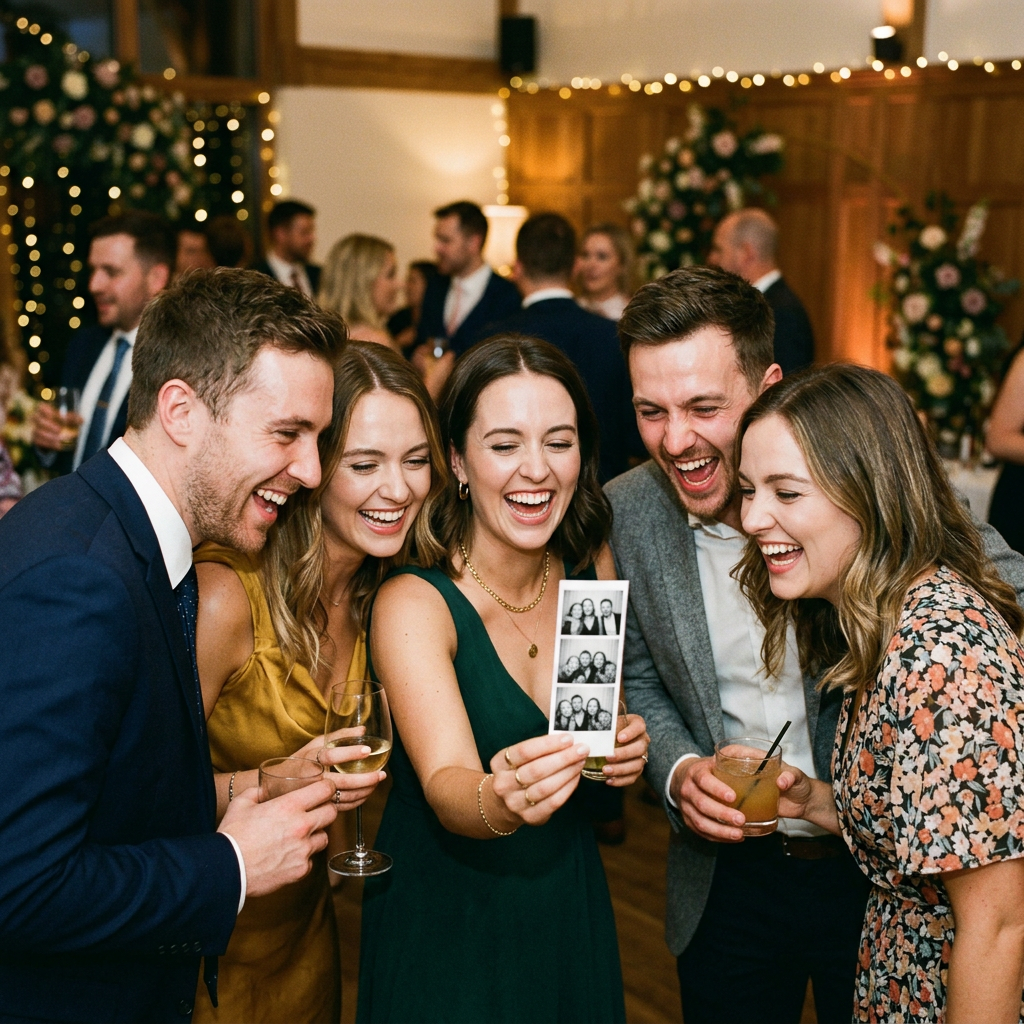
The modern wedding is no longer just a ceremony; it’s an experience. Today’s couples are curating full, immersive narratives, turning their special day into a multi-sensory story their guests can actively participate in, not just observe. From themed decor to interactive stations, the goal is to create memories that feel immediate, raw, and deeply personal.
But what happens when the lights come up and the dance floor clears? How do you distill a night-long, elaborate narrative into a single, tangible keepsake?
Enter the ZillaBooth photo strip.
For decades, the photo booth has been a wedding staple, but the traditional four-frame strip is vastly undervalued as a storytelling tool. It’s not just a place to snap silly selfies; it is a four-panel canvas…a miniature storyboard…that can capture a complete, compelling narrative arc in a matter of seconds. It offers a unique challenge: tell an immersive story using nothing but four perfectly timed frames.
This guide will teach you, the junior writer and the enthusiastic guest, how to transform the ZillaBooth strip from a sequence of random poses into a powerful, four-act story. Mastering this technique allows guests to leave the wedding not just with a photo, but with a physical record of a micro-performance, a piece of the night’s immersive narrative that will be treasured long after the vows.
The Four-Frame Story Arc: Your Narrative Blueprint
Think of the four frames not as individual snapshots, but as the rising and falling action of a classic short story. Each frame has a distinct, mandatory role in the narrative. By adhering to this structure, you guarantee a payoff, a beginning, middle, and end that makes the strip feel complete and satisfying.

Frame 1: The Inciting Incident (The Setup)
This is your establishing shot, the “Once upon a time…” moment. The purpose of Frame 1 is to set the scene, introduce the character(s), and hint at the action to come. It should be relatively static, yet full of intention. You are loading the gun for the next three shots. What to do: * Introduce the Prop: Hold a mustache, a sign, or a silly hat, but do not use it yet. Look at it with curiosity, or hold it up to the camera like a silent declaration.

- Establish Tension: Two people look at each other with a serious, anticipatory, or even slightly bored expression. The lack of action is the setup.
- The Silent Cue: One person points to the other or looks off-camera as if about to begin a task. The focus is on the “before” moment.
Frame 2: The Rising Action (The Reaction/The Turn)
This is where the story gets its momentum. Something must happen between Frame 1 and Frame 2. This is often the quickest frame, a blur of motion, a moment of profound realization, or a quick change of state. The action begins, or the subject reacts to the action that has just started. This frame is the key pivot point. What to do: * The Quick Change: The prop from Frame 1 is now partially on, or an aggressive change of pose/expression has taken place. The person who was looking bored is now actively engaging.

- The Visual Dialogue: If it’s a two-person strip, the action starts on one person and the other person has a clear, shocked, or amused reaction. This turn elevates the story from simple posing to genuine interaction.
- The Build-Up: If the climax is a huge kiss, Frame 2 is the dramatic lean-in, the lips-not-quite-touching moment. It’s the moment of maximum anticipation before the payoff.
Frame 3: The Climax (The Peak Moment/The Punchline)
This is the moment the whole strip has been building toward. It must be the most visually dynamic, emotionally charged, and satisfying shot. This frame represents the peak of the action, the visual punchline, or the grand emotional fulfillment of the miniature story. It should leave no doubt as to the story’s main point. What to do: * The Full Transformation: The prop is fully in use, the pose is at its most exaggerated, or the initial tension is completely broken. The energy must be at 100%.

- The Shared Emotion: This is the perfect moment for a shared, uninhibited belly laugh, a full, dramatic dip-and-kiss, or a triumphant high-five/fist bump that takes up the frame. It must be a moment of full release.
- The Visual Statement: If the story is about love, this is the most affectionate kiss or hug. If it’s about silliness, this is the most ridiculous, tongue-out, eyes-crossed face possible. Go big or go home.
Frame 4: The Resolution (The Aftermath)
The story is over, the climax has passed, and the tension has been resolved. The final frame serves as a cool-down, a shared look of satisfaction, exhaustion, or simply the acknowledgment that a story has just been successfully told. It’s the visual equivalent of the curtain closing, letting the audience know the performance is complete. The key is to drop the energy from Frame 3, but not the connection. What to do: * The Satisfied Smirk: Look directly at the camera with a look of “We did it” or “You just saw that.” A shared, knowing glance.

- The Exit: The subjects slightly back out of the frame, giving a small wave or a thumbs-up as a visual sign-off.
- The Embrace: A quiet, affectionate lean on one another, suggesting comfort and resolution after the high-energy climax. The mood is relaxed, happy, and conclusive.
Case Study: The Proposal Re-enactment
The suggestion to use the ZillaBooth strip to re-enact “The Proposal” is a perfect demonstration of a powerful, mini-narrative that uses the four-frame structure flawlessly. Here is a step-by-step breakdown of how a guest couple could capture this timeless story in under a minute, creating a treasured memento of the event:
The Goal: To capture the emotional arc of a proposal…the setup, the shock, the acceptance, and the triumph…using only expressions and body language.
Frame 1: The Setup * Action: Person A kneels awkwardly (or dramatically) on one knee in the booth, perhaps holding a prop like a small paper ring or a champagne cork. Person B stands over them with a look of mild confusion or intense anticipation. The atmosphere is tense.
* Narrative Role: Establishes the core dramatic situation (the proposal) before the action begins. The tension is palpable. This frame provides all the necessary context.
Frame 2: The Rising Action/The Question * Action: Person A is still kneeling, but now dramatically presenting the prop to Person B. Person B’s hands fly up to their mouth or their eyes widen in a sudden, theatrical moment of shock or realization. The action is fully underway.
* Narrative Role: The question has been asked, and the reaction is immediate. The story accelerates, heightening the emotional stakes and making the viewer anticipate the answer.
Frame 3: The Climax/The Acceptance * Action: Person B (who was shocked) is now lunging forward, dramatically hugging Person A (who is still attempting to kneel, or has risen for the embrace). It’s a chaotic, loving, all-encompassing embrace.
* Narrative Role: The peak of the emotion. The answer is “Yes!” The physical explosion of love confirms the story’s happy outcome. This frame should feel the most crowded, joyful, and visually intense.
Frame 4: The Resolution/The Triumph * Action: Person A and Person B stand side-by-side, holding up their hands in a celebratory gesture. Person A shows a proud fist pump or a confident, satisfied smile. Person B shows off the imaginary ring (or the prop) with an exaggerated, happy smirk directly to the camera.
* Narrative Role: The story is complete. The tension is resolved into shared joy and success. It’s the final, triumphant sign-off, confirming that their “immersive story” has a happy ending. This frame grounds the emotional explosion of the previous shot.
Advanced Pro-Tips for Storytelling in the Booth
Once you understand the four-frame blueprint, you can elevate your booth performance from good to editorial-quality content. The secret is to use the constraints of the booth…the speed, the small space, and the props…as narrative tools.1. Props as Plot Devices, Not Decorations
Don’t just wear the feather boa; use it to drive the plot. For example, the boa could be the prize in a dramatic conflict: *
Frame 1: Two people are looking at the same feather boa, both reaching for it.
*
Frame 2: They are having a comical tug-of-war over it (conflict).
*
Frame 3: One person successfully wears it like a trophy, giving a triumphant, “I win!” face (climax/victory).
*
Frame 4: The winner is preening into the camera while the loser is slumped in the corner with a mock pout (resolution/consequence). The prop is a core character in the story.2. The Power of the Gaze
Since there is no verbal dialogue, your eye line is the dialogue. Direct your gaze to tell the viewer where the focus is and how the relationship between the subjects is shifting: * Start Frame 1 looking at each other (establishing the relationship or anticipation). * Shift Frame 2 looking at the action/prop (reaction to the inciting incident).
* Frame 3, the climax, should be a quick look at the camera to share the moment with the “audience” (the machine/the person holding the strip). * End Frame 4 looking back at each other (the shared secret/completion).3. Mastering the Temporal Jump The most common mistake is to try and pose.
You must act . The machine is taking pictures very quickly, often with a slight delay. Use this time lag to your advantage. Between Frame 1 and 2, commit to a quick, dramatic shift of body language and expression. This rapid change is what makes the strip feel like a genuine, unfolding narrative instead of four separate portraits. A great four-frame strip feels like a flipbook, with smooth, intentional transitions. The best storytellers in the booth are those who are already preparing for Frame 3 while Frame 2 is still being taken…always plan your next move.
- Creating Themed Mini-Series
Encourage guests to pick a single character or persona…The Villain, The Hero, The Diva…and commit to telling a full four-frame story based on that character. A collection of these mini-narratives from the same booth becomes an authentic, multi-perspective view of the wedding’s “immersive story,” far more compelling than a scrapbook of random, uncontextualized smiles. The wedding album becomes a collection of tiny, perfect, themed plays. - The Value of Imperfection
Do not try to be technically perfect. A slightly blurry Frame 2 because you were mid-action (mid-lean, mid-toss) adds authenticity and movement to the story. It shows the raw, immediate action. The small, confined space of the ZillaBooth and the harsh flash lighting are your friends, forcing you to focus on the expressive performance. Let the environment work for the narrative, not against it. The light will often cast deep, dramatic shadows, which you can use to amplify the dramatic tension of your story.In an age where every moment is captured, filtered, and uploaded to the cloud, the physical ZillaBooth strip offers a powerful, tactile rebellion. It’s an immediate, unfiltered, non-editable piece of tangible art. When you and your guests step into that booth, you’re not just taking photos; you’re writing a script, directing a scene, and leaving the wedding with a tiny, perfect, and completely unique four-act play that memorializes the joy and narrative experience of the day. Master the structure, and you master the story. Go forth and narrate! (1110 words)
❤️