

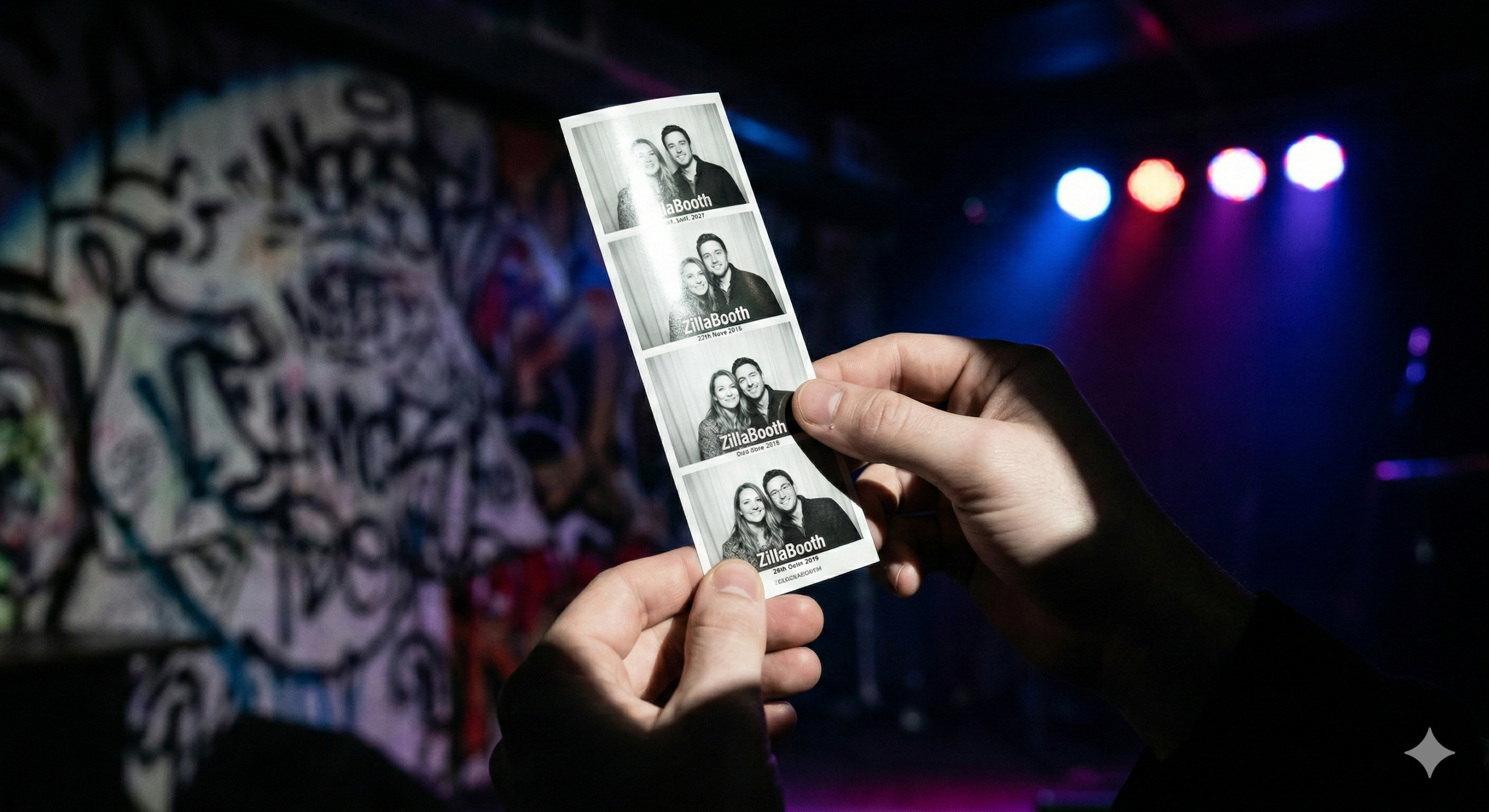
The irony is not lost on us: in a world where everything is captured, shared, and stored digitally…from your most recent brunch to your wildest night out…one of the most popular and evocative social media trends involves deliberately stepping away from the screen to embrace the tangible, only to capture it all over again. This is the heart of the “meta-trend”: taking a brand-new digital photograph of a physical photo, a printed artifact, a moment captured on paper. It’s a deliberate layer of visual storytelling that adds texture, history, and a potent dose of nostalgia to your feed, and right now, the ZillaBooth photo strip is the undisputed king of this aesthetic.
The rise of the perfect digital image has created an aesthetic fatigue. We’ve spent a decade chasing golden hour, mastering portrait mode, and using sophisticated apps to erase every wrinkle, shadow, or imperfection. The ‘meta-trend’ is a cultural rebellion against this polished perfection. By introducing a physical print, you’re instantly layering imperfection, and that’s the point. The print itself is a historical object. It carries the crease from your pocket, the fingerprint smudge from your friend, the slightly blurry quality of a flash-fired moment. When you photograph that object, you are not just capturing the original moment; you are capturing the current moment in which you are holding that artifact, bridging the past and the present. It turns a simple social media post into an archaeological exercise…a story within a story.
This is a movement powered by two main cultural forces: a craving for authenticity and an intense wave of visual nostalgia.
Authenticity is the most valuable commodity online. In an era of deepfakes and AI-generated imagery, a photo of a photo acts as a verifiable physical proof of experience. It says: “I was here. I printed this. I physically touched this memory.” The light reflections on the glossy paper, the way the edges curl, the shadows cast by your fingers…all of these elements testify to the object’s reality. It’s an un-retouchable truth embedded within your feed’s flawless scroll, offering a visual sigh of relief to viewers tired of the digital artifice.
Nostalgia, particularly for the late ’90s and early 2000s, is the aesthetic fuel. Photo booths, disposable cameras, and point-and-shoot digital cameras defined an era of spontaneous, low-fidelity photography. The vertical ZillaBooth photo strip, with its four iconic frames, instantly evokes that sense of carefree, low-stakes fun. By holding that strip up against the venue background…the very place it was taken…you are collapsing time, bringing the energy of the moment out of the past and into the now. You’re giving your digital followers a tangible, haptic reference point.
The ZillaBooth Guide: Capturing the Photo-Within-A-Photo
To truly master this meta-trend for Instagram, you need to think of your ZillaBooth photo strip not just as a picture, but as a lens through which you are framing a larger, ongoing story. Here is the definitive, step-by-step guide to transforming a physical print into a captivating digital post, using the venue as your essential backdrop.
Step 1: Secure Your Artifact (The ZillaBooth Strip)
First, the obvious: you need the strip. The ZillaBooth is designed for high-quality, high-speed printing, making its vertical strip format the ideal canvas for this trend. After you take your strip, do not immediately flatten it or file it away. The most compelling meta-photos often have strips that are slightly bent, crinkled, or have the perforated edges still intact. These slight imperfections are the marks of authenticity that digital photography has tried so hard to eliminate. Embrace them.
Step 2: Scoping the Scene – The Venue Background is Key
The description specifically calls for holding the strip up “against the venue background,” and this is the most critical compositional element. The goal is to provide contextual layering.
The Echo Effect: The most impactful posts photograph the print against a background that matches the environment within the print. Did you take the strip in front of the bar’s neon sign? Go stand in front of that sign and hold the strip up. The repetition of the location creates a dizzying, visually satisfying echo effect that emphasizes the “you are here” moment.
The Contrast Shot: Alternatively, you can use the background to create a strong visual contrast. If the strip was taken in a dark, interior space, try holding it up against a brightly lit, exterior backdrop of the venue. For instance, holding the dark strip up against the venue’s brightly lit marquee or a busy street scene outside the door. The contrast draws the eye directly to the strip while still anchoring the photo in the physical location.
The Atmosphere Shot: Use an environmental detail that screams ‘venue.’ This could be the pattern of a crowded dance floor, a distinctive piece of art on the wall, or a recognizable stage setup. Even if the detail isn’t in the original photo strip, it acts as a silent witness to the current moment.
Step 3: Mastering the Hold and Composition
The way you physically hold the print is where the magic happens and where the trend gets its “meta” designation. The inclusion of your hand or fingers is not a mistake…it is a mandatory compositional tool.
The Finger Frame: Hold the strip at the very top and bottom using your thumb and forefinger. This frames the vertical strip and instantly tells the viewer, “This is an object I am physically presenting to you.” The slight shadow your fingers cast adds depth and proof of the physical plane. Ensure your fingers are clean, but don’t worry about minor smudges on the print itself; the grime is part of the charm.
Rule of Thirds Placement: When capturing the digital photo, don’t center the strip dead-on. Place the ZillaBooth strip along one of the vertical lines of the rule of thirds. This leaves two-thirds of the digital frame to showcase the venue’s background, creating a more dynamic and visually engaging composition than a simple straight-on shot. The eyes of the viewer will move from the background context to the framed print and back again.
The Peek-Through: For an advanced shot, position the print so that one of the frames perfectly lines up with an element in the background. For example, if one frame shows a person laughing, position the print so that the top edge of the frame lines up with the natural horizon line of the background, making it seem as if the action in the print is happening in the background scene.
Step 4: The Digital Capture Settings (Intentional Imperfection)
Your phone’s camera is powerful, but for this trend, you need to use that power wisely. You are aiming for a high-quality capture of a low-fidelity object.
Focus is Paramount: This is the most crucial step. Use your phone’s manual focus (tap-to-focus) function and lock the focus directly on the ZillaBooth photo strip. Do not let the focus drift to the background. The text, the faces, and the glossy texture of the print need to be razor-sharp. If the background is slightly out of focus (shallow depth of field), that only enhances the print’s prominence.
Embrace the Reflection: You will inevitably get reflections on the glossy paper, especially from ambient venue lights. Do not try to edit these out. A slight glare or reflection is another marker of the print’s physicality. It proves the image is being held in a real, live-action environment. The reflection is the “meta” light source.
Use the Flash (The Power Move): For maximum effect, especially in dark venues, consider forcing your phone’s flash ON. The harsh, direct flash will brilliantly illuminate the photo strip while pushing the already dark background further into deep shadow. This mimics the low-fi aesthetic of a disposable camera shot, creating a dramatic, high-contrast image where the photo strip practically glows in your hand.
Step 5: Minimal Editing and The Caption
The beauty of the meta-trend is that the physical print is the “filter.” Keep your digital editing minimal to maintain the authenticity.
Color and Contrast: A slight increase in contrast can help the photo strip stand out against the background. Avoid heavy-handed filters. If the photo strip itself is slightly desaturated, a simple black and white conversion of the entire digital image can create a cohesive and timeless editorial look.
The Caption: The caption is where you provide the final layer of context. Use it to date the original event or to narrate the current situation. Instead of just “Last night was fun,” try: “Held onto this ZillaBooth proof of life from 2 AM and had to capture it against the neon one last time.” Use language that emphasizes the object and the memory. Popular hashtags include #PhotoOfAPhoto #AnalogMeetsDigital #MetaTrend #ZillaBoothStrip #PhysicalProof.
Pro Tips: Elevating Your Meta-Game1. The Time-Travel Shot: Use an old ZillaBooth strip from a prior event…perhaps an entirely different venue or city…and hold it up in your current location. This is the advanced level of storytelling. The visual dislocation (a summer beach photo strip held up in a snowy city street) creates a powerful, dream-like contrast that viewers instantly engage with. It’s a literal representation of a memory being present in the now.
2. The Collage/Grid: Don’t just post the single meta-photo. Use Instagram’s carousel feature. The first photo should be the digital picture of the physical print. The second and third photos should be zoomed-in details of the print itself, showing the texture, the gloss, and the perforated edges. The final photo could be the environment without the print. This tells the complete story of the artifact and its surroundings.
3. The Photo-Frame: For a truly creative twist, use the ZillaBooth strip to frame an object other than the background. For example, hold the strip around a cocktail glass, a musician on stage, or a distinctive piece of furniture. You are using the nostalgia of the photo strip’s border to elevate a new subject, giving a mundane object the gravity of a preserved memory.
4. Backlight the Artifact: For the most dramatic effect, find a light source (like an emergency exit sign, a stage light, or a window) and hold the print slightly over it. The light will bleed through the thinner parts of the photo paper, creating a subtle, glowing edge that visually separates the print from the background and gives the entire image a surreal, luminous quality.The trend of “taking photos of photos” is more than just an aesthetic quirk; it’s a profound statement about how we value and curate our memories in the digital age. By turning your ZillaBooth print into a physical prop, holding it up against the very background that hosted the moment, and capturing the resultant composite with your phone, you are performing a small, personal act of resistance against the relentless flatness of the digital feed. You’re celebrating the crease, the reflection, and the sheer, physical reality of being there. It’s imperfect, it’s raw, and it is the most honest, authentic way to share a memory right now.


