

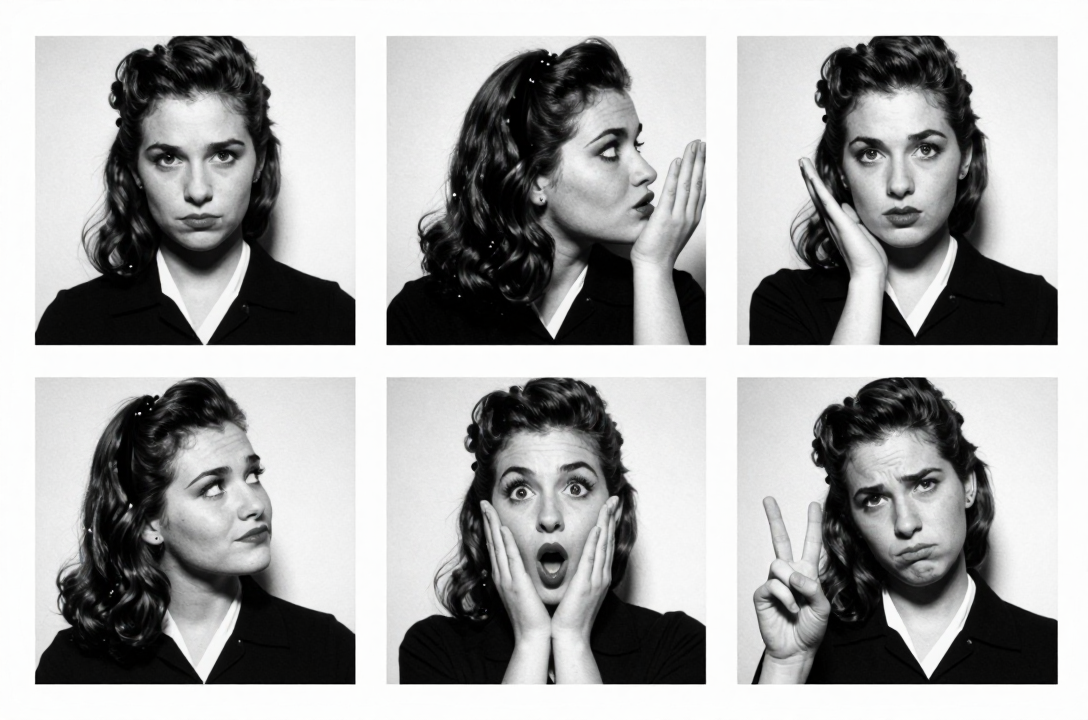
Long before phone cameras gave us a million takes and filters could erase a shadow, there was the photo booth. A simple, curtained-off enclosure that offered four flashes, four moments, and one strip of undeniable, unfiltered truth. It was more than just a novelty; the photo booth became a democratic canvas, a stage for cultural expression, and an accidental time machine, perfectly chronicling the evolution of how we present ourselves to the world.
We all know the ritual: You pay your coin, pull the curtain, and suddenly the pressure is on. Four poses. A countdown begins. What do you do?
The way people answered that question changed dramatically from decade to decade. The poses, the expressions, the proximity…they weren’t random; they were a direct reflection of the social, cinematic, and artistic trends of the era. To celebrate this history, we’re launching the ultimate style guide and fun experiment: How to Pose Like Every Decade, perfectly timed and executed using ZillaBooth’s unique in-app countdown feature.
Your mission, should you choose to accept it, is to step into your ZillaBooth…whether in real life or via the app…and dedicate each of your four precious flashes to a specific decade. Ready to travel through time without leaving your seat?
Flash One: The Stiff Upper Lip (The 1920s & 1930s)
The first automatic photo machine, or “Autophotograph,” opened in New York City in 1925. In its earliest days, getting your picture taken was still a serious, formal affair. Photography was expensive, and the tradition of the studio portrait…where you stood stock-still for minutes…had not yet faded. The mood was less “fun” and more “proof of existence.” People viewed the resulting image as a legacy piece, something that needed to convey dignity, not fleeting joy.
The Pose: Think of silent film stars and passport photos.1. The Head-On Gaze: Look directly and unsmilingly into the lens. The technology was slow, and holding a genuine, relaxed smile for the duration was physically uncomfortable, leading to the serious, almost somber expression we associate with early photography. Smiles were considered undignified for formal portraits.
2. The Stiff Spine: Shoulders back, chin slightly down, and zero slump. Posture was paramount. Even when sitting with a partner, there was often a visible inch of space between bodies, a relic of Victorian formality that lingered in public life.
3. The Somber Expression: No teeth, no exuberant joy. A subtle, almost stoic expression conveys respectability and maturity. The focus is on the architecture of the face, not the emotion.How to Execute with ZillaBooth: Use the first flash for your most formal, head-of-state portrait. The ZillaBooth timer gives you just enough time to perfect your posture and set your gaze, reminding you that this pose is about solemnity, not spontaneity. Challenge yourself to keep your eyebrows neutral and your jaw relaxed, avoiding any hint of a smile. This pose is the most historically challenging, forcing you to suppress modern instincts for cheerfulness.
Flash Two: The Wartime Sweetheart (The 1940s & 1950s)
The photo booth took on a new, deeply sentimental significance during World War II. For soldiers shipping overseas and the loved ones they left behind, a photo strip became a precious, tangible token of intimacy. The booth was no longer just for formal portraits; it was a private place for emotional connection, a final moment of contact before separation. This era gave rise to the classic, intimate “kiss strip,” a raw form of documentation that spoke to the era’s emotional intensity.
The Pose: Focus entirely on the human connection…this is where posing begins to get playful and deeply emotional.1. The Shared Close-Up: Partners squeeze tightly together to ensure both faces are in the frame, often pressing cheek-to-cheek. This physical closeness was a direct, necessary contrast to the formality of the prior decade. The focus is exclusively on the two individuals.
2. The Classic Kiss: The most iconic pose of the era. A deep, long-lasting kiss that lasted for multiple flashes, often with eyes closed to heighten the sense of privacy. Alternatively, the “Forehead Press,” where two heads touch, eyes closed, conveying deep affection and reliance.
3. The Dramatic Prop: This era was heavily influenced by film noir. A cigarette, a fedora, a letter from the front, or a flower could be held, adding a cinematic, bittersweet drama to the moment, hinting at the context outside the curtain.How to Execute with ZillaBooth: If you’re alone, use the frame to capture an emotional moment with a hand gesture (a heart shape or a dramatic wave of farewell). If with a partner, challenge yourself to hold the kiss for the first two flashes after the ZillaBooth timer goes off, recreating the timeless romantic reel. The proximity is crucial; you should fill the frame.
Flash Three: The Rebel’s Edge (The 1960s & 1970s)
The rise of youth culture, rock and roll, and the counter-culture movement injected a new, playful, and often chaotic energy into the photo booth. This was the era of the ‘go-go’ pose…rapid, chaotic, and brimming with personality. Poses began to borrow heavily from magazine covers, album art, and fashion photography, becoming more performative. The goal was no longer dignity, but attitude and showing off one’s ‘groovy’ personality.
The Pose: Think Twiggy, Andy Warhol, and Studio 54 disco queens. The poses are sharp, angular, and often feature the hands.1. The Exaggerated Reaction: Hands fly to the face…a shocked open mouth, eyes widened, a tongue might stick out. The expressions are intentionally over the top and designed to be funny or provocative. This is a move toward embracing imperfection.
2. The Head Tilt and Chin Prop: The classic “pensive” or “intellectual” look. Tilt the head dramatically and rest the chin on a fist or open palm. It’s an intellectual-meets-model moment, often looking away from the camera for an aloof effect.
3. The Side Profile: Instead of facing the camera, subjects would turn to the side and look ‘out of frame,’ adding an element of mystery or high-fashion drama, mimicking candid shots by a photographer.
4. The Peace Sign: While fully embracing the 90s, the peace sign had its roots here, used as a sincere symbol of anti-war and counter-culture sentiment, often combined with long, flowing hair obscuring the face.How to Execute with ZillaBooth: Use the ZillaBooth’s flash notification sound as a trigger for a dramatic switch in attitude. Start calm, then when the timer counts down, switch to an exaggerated expression or a sharp profile turn. The speed of the pose change is key to capturing the chaotic, restless energy of the era. Aim for a graphic, bold silhouette against the background.
Flash Four: Pop Culture Irony (The 1980s & 1990s)
This is the era that cemented the photo booth as a truly iconic pop culture staple, largely thanks to its prominence in malls, arcades, and movies like Clerks and Amelie. The poses became self-aware, ironic, and often a parody of celebrity culture. The 80s brought big hair, bold makeup, and power poses, and the 90s ushered in grunge, anti-fashion, and a universal hand gesture that reigns supreme: the peace sign. This is the last stop on our historical tour before the digital selfie revolution.
The Pose: A complex mix of super-confidence (80s) and complete apathy (90s).1. The Power Shrug (1980s): A flash of dramatic shoulder-pad posture, a hands-on-hips stance, and an intense, direct glare. This pose is about projecting ambition and saying, “I’m important, and I know it,” even if the subject is a teenager in acid-wash jeans.
2. The Peace Sign (1990s): The most essential element of the challenge. The peace sign went from a serious symbol to a casual, ubiquitous placeholder for “Hey, I’m here.” Hold it up next to your face, slightly off-center, with a genuine sense of relaxed irony.
3. The Duck Face / Kissy Face (Pre-Selfie Era): A precursor to modern posing. Pout the lips slightly for an exaggerated, playful kissy face. Crucially, in this era, it was often done ironically to mock the idea of ‘sexy’ posing, not seriously.
4. The Group Huddle: Squeezing three or four people into a tiny booth, all looking in different directions, was a badge of social honor. The goal was to maximize the chaos and make sure everyone’s hair was perfectly visible.How to Execute with ZillaBooth: For this flash, go full 90s. Use your ZillaBooth timer to nail the perfect peace sign right as the light fires. For the ultimate nostalgic touch, pair your peace sign with a genuine shrug and a deadpan expression. The ZillaBooth’s countdown is the perfect cue for the spontaneous-yet-practiced casualness of the 90s aesthetic.—–The 4-Pose Challenge: Your ZillaBooth Checklist
Ready to put history into practice? Here is your quick-fire checklist for the ultimate 4-Pose Photo Booth Challenge, using the ZillaBooth in-app timer to control your flashes and ensure authentic, high-pressure results.
Step 1: Set the Stage
Find your best photo booth environment…a real booth, the ZillaBooth app, or a simple wall with direct, harsh lighting. Use the ZillaBooth app’s countdown timer, which perfectly replicates the high-stakes pressure of the classic four-frame strip.
Step 2: Pose Like a Puritan (The 1920s) * The Pose: The Serious, Formal Stare.
* Action: Shoulders back, chin level. Look straight at the lens. Zero smile. Look like you’re posing for a marble bust that will be placed in a library. Hold your breath for the flash.
* ZillaBooth Cue: When the countdown hits 1, freeze and hold the stare with complete stillness.Step 3: Pose Like a Soldier’s Sweetheart (The 1940s) * The Pose: Intimacy and Emotion.
* Action: If alone, a hand dramatically covering half your face, eyes looking up with longing. If with a partner, squeeze in close and execute a tight, affectionate cheek-to-cheek pose, or a partial kiss that gets cut off by the frame.
* ZillaBooth Cue: Use the last two seconds of the timer to adjust your hand or head placement for maximum dramatic, film-noir effect before the flash.Step 4: Pose Like a Pop Artist (The 1970s) * The Pose: Attitude and Profile.
* Action: A sharp 45-degree turn of your head to the side. Chin up, a slight, knowing smirk. This is your ‘high-fashion’ moment. Alternatively, flash an exaggerated ‘gasp’ with hands pressed to your cheeks.
* ZillaBooth Cue: Do a rapid, sharp turn into the profile pose just as the timer ends…the sharper the movement, the better the moment will look in the final, fixed frame.Step 5: Pose Like You’re Over It (The 1990s) * The Pose: Casual Irony (The Peace Sign).
* Action: A relaxed shoulder shrug, a slight head cock, and the classic, two-fingered peace sign held casually up next to your eye or cheek. Your expression should be completely deadpan or slightly amused, embodying the era’s anti-effort cool.
* ZillaBooth Cue: Hold this relaxed pose for the full countdown. This pose is about studied casualness; no last-second change is needed. Let the timer count down while you look unimpressed.The photo booth strip, across a century of change, has always been the visual scrapbook of human interaction. It’s a spontaneous moment, forever encased in glossy paper. By taking The 4-Pose Challenge, you’re not just taking four pictures; you’re honoring the history of self-expression, from the dignified silence of the Jazz Age to the ironic flash of the Grunge era. Now go, get into your ZillaBooth, and show us how you pose like every decade! Don’t forget to share your 4-Pose strip with the hashtag #ZillaBoothChallenge!