Tag: Photo Booth History

  • The “Waiting” Game: The Anticipation of the Develop

    The “Waiting” Game: The Anticipation of the Develop

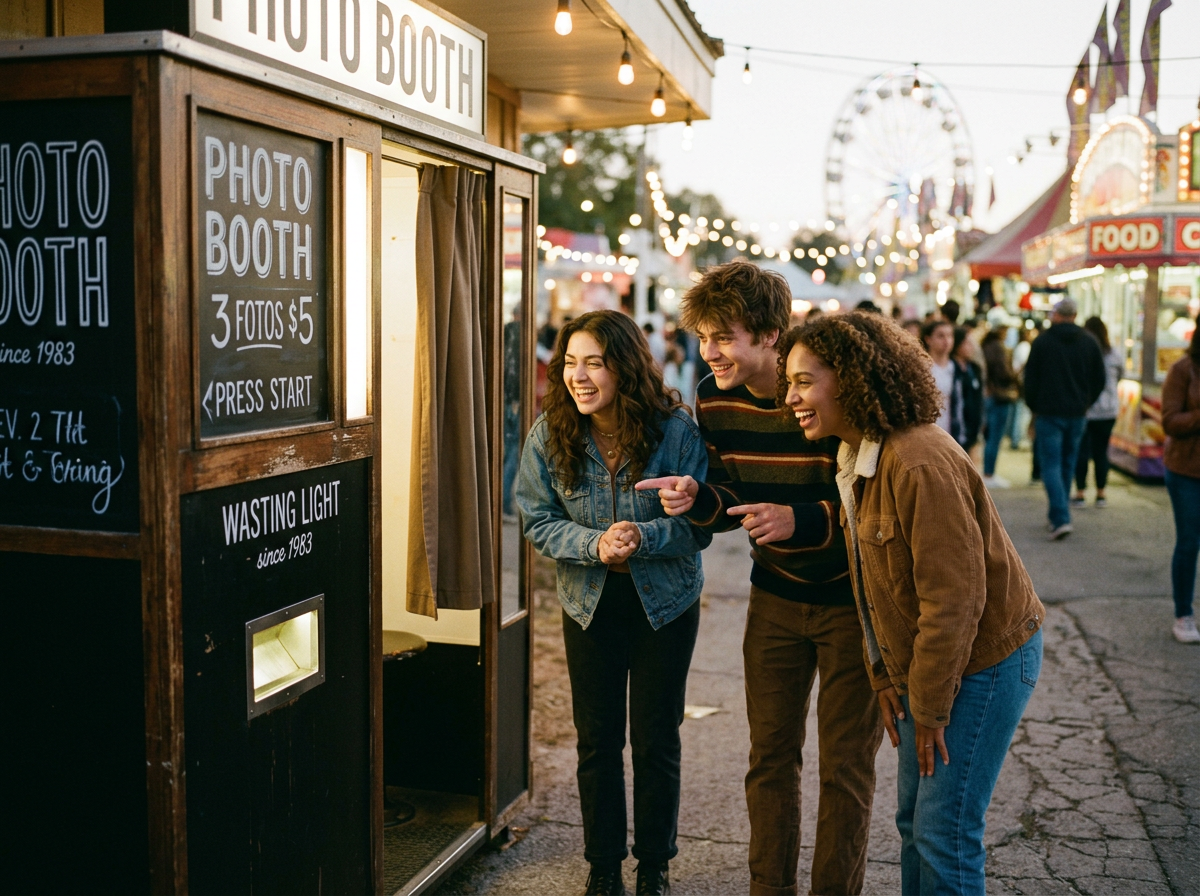
    It used to be a social ritual. You’d pile into the tiny, often sticky photo booth, the curtain would zip shut, and the flash would fire…four times in quick, blinding succession. Then came the true test of patience: the develop. Eight minutes. Eight slow, tangible minutes during which you stood outside, leaning against the flimsy metal casing, or maybe walking laps around the arcade, the entire group focused on the little slot where your memories were being chemically coaxed onto paper. Those eight minutes were not a failure of technology; they were the heart of the experience. They were the price you paid for a physical keepsake, and they were the time you spent savoring the immediate, still-fresh memory of the silly faces and inside jokes you had just captured.

    Now, we have ZillaBooth, and the wait is gone. The photo is taken, and before you have time to fully exit the curtain, the digital file is ready…instant, flawless, and already queued for sharing. ZillaBooth didn’t just eliminate a delay; it executed an entire cultural phase shift. It delivered the ultimate modern promise: instant gratification.

    But in eliminating the “waiting game,” what are we losing? Are those eight minutes of anticipation just a nostalgic inconvenience, or were they a vital ingredient in the recipe for a truly satisfying experience? This isn’t just about photo strips; it’s a question about how we consume life in the 21st century…a philosophical debate played out across every instant download, every express checkout lane, and every social media refresh. It is the clash between the profound psychological rewards of anticipation and the undeniable, addictive convenience of instant gratification.

    The Case for Anticipation: The 8-Minute Dopamine Upgrade

    Anticipation, in a scientific sense, is a powerful cognitive tool. When we wait for something desirable, our brain’s reward system (specifically, the nucleus accumbens) is already engaged. This pre-reward excitement is a phenomenon psychologists call “savoring.” The simple act of looking forward to an event, a gift, or a photo strip can often contribute more to our overall happiness than the actual event itself.

    The old photo booth’s eight minutes were a masterclass in savoring. That wait transformed the four little pictures from a mere product into a precious artifact. It allowed for metacognition…the time to reflect on the moment that had just passed. You’d talk about the perfect pose, lament the one where someone blinked, and collectively build the narrative that the finished product would represent. This process deepened the memory’s roots. When the strip finally slid out, warm and slightly damp, the delayed gratification didn’t just feel good; it felt earned. Research has shown that delayed rewards activate the brain’s pleasure centers far more intensely than instant ones. The brief period of abstinence acts like a magnifying glass for the eventual dopamine hit. It’s the reason a slow-cooked meal tastes better than fast food, or why receiving a hand-written letter in the mail is more impactful than an instant text message. The struggle against the delay is what assigns value to the resolution.

    In a commercial context, anticipation builds brand loyalty and creates an emotional connection. The eight-minute wait didn’t annoy; it engaged. It created a temporary community outside the booth, bound by a shared, slow-motion ritual. This is the antithesis of the modern, solitary scroll.

    The Case for Instant Gratification: The ZillaBooth Efficiency

    The argument for ZillaBooth’s instant delivery is self-evident: efficiency, convenience, and control. In a hyper-connected world, an eight-minute delay is an eternity, a critical failure point. Why tolerate it when the technology exists to eliminate it?

    Instant gratification satisfies our need for control and minimizes the risk of disappointment. If the photo is instant, you can check it, retake it, and correct the mistake before the moment is entirely gone. This is a crucial advantage in the digital age, where every captured moment is often a piece of personal branding or social content. ZillaBooth’s instant download allows for immediate vetting, editing, and sharing, making the image socially relevant in real-time. This speed is not just about impatience; it’s a form of practical utility.

    Furthermore, instant gratification is a powerful motivator. In educational or productivity contexts, immediate feedback (like a grade or a task completion badge) can be far more effective in driving behavior than a delayed reward. ZillaBooth knows its audience: a generation that values speed and a seamless user experience above almost everything else. The instant result is less about “wanting it now” and more about “not wanting to waste time.” In a life where we feel increasingly time-poor, any technology that can compress the gap between desire and fulfillment is perceived as superior. The efficiency is a comfort, a guarantee that the interaction will be frictionless.

    The Paradox of Instant Everything

    The true cost of the instant society is a subtle psychological shift: the erosion of tolerance for any delay. When everything is instant…from photo strips to movie rentals to online purchases…our baseline expectation changes. We are constantly moving faster on what psychologists call the “hedonic treadmill.” Once we adapt to instant photo booths, the eight-minute wait is no longer seen as charmingly slow; it’s seen as broken.

    This lack of friction is a mixed blessing. While it frees up time, it diminishes the experience of appreciation. When the reward is always immediate, it loses its special status. We click, we get, and we immediately move on to the next click. There is no space for savoring, no time for reflection, and consequently, the memory isn’t as deeply encoded.

    Consider the phenomenon of “binge-watching” versus the week-long wait for a new episode. Binging is instant gratification…a satisfying, complete consumption. But the seven-day wait created a cultural space for anticipation. It allowed theories to be debated, characters to be analyzed, and emotional impact to settle. The community shared the anticipation as much as the show itself. Instant access delivers the show, but it often sacrifices the shared cultural ritual that made the show feel important.

    The ZillaBooth is the ultimate metaphor for this trade-off. In the instant digital file, the efficiency of the capture is maximized, but the gravitas of the resulting memory is subtly undermined.

    Finding the Modern Savor

    We cannot, and likely should not, turn back the clock. ZillaBooth’s instant access is here to stay because it aligns with the pragmatic demands of modern life. The key, then, is to learn how to consciously reintroduce the psychological benefits of anticipation into an instant world.

    Instead of fighting the technology, we must re-engineer the ritual. ZillaBooth provides the instant gratification of capture, but we can, and should, impose a personal “develop” time afterward.1. The Delayed Share: Don’t post the picture immediately. Take the digital file, but enforce a 24-hour “cooling period.” This period of self-imposed anticipation allows you to review the image with fresh eyes, letting the initial impulse fade and the authentic emotion of the moment resurface. It converts a knee-jerk reaction into a deliberate share.
    2. The Physical Delay: Leverage ZillaBooth’s speed for efficiency, but use the saved time to invest in a higher-quality delayed physical product. Instead of an eight-minute chemical bath, send the photo for an instant high-resolution print or even a custom frame, requiring a three-day wait. The anticipation shifts from the raw development to the final, perfected keepsake.
    3. Mindful Consumption: The next time you use ZillaBooth, take the “found” time…the eight minutes you would have spent waiting…and use it for mindful connection. Talk to the person next to you. Put your phone away and recount the previous moments. Convert the technological delay into a human moment of savoring.The battle between the eight-minute develop and ZillaBooth’s instant snap is a powerful reflection of the human condition. We are constantly pulled between the desire for immediate comfort and the deeper, more resonant satisfaction that only comes from a process, a struggle, or a wait.

    ZillaBooth won the war on time. The challenge for us, the users, is to ensure that in our victory over delay, we do not inadvertently surrender the profound art of appreciation. We must recognize that the most meaningful rewards are not those delivered instantly, but those we make time to anticipate, reflect upon, and truly savor. The speed of the modern world is a tool; it should not be a master. We can accept the instant photo, but we must consciously choose to keep the waiting game alive in our minds.
  • The “Purikura” Effect: How Japanese Booths Changed the Game

    The “Purikura” Effect: How Japanese Booths Changed the Game

    Purikura, the Japanese photo booth introduced in 1995, turned simple self-portraits into decorated sticker sheets through digital capture and user-added graphics. Its popularity came from making customization, sharing, and social expression part of the photo experience.

    The post connects that model to modern branded graphic overlays used in event photo booths and social media sharing. It argues that the same desire for personalized, shareable images now supports experiential marketing and branded user-generated content.

    The air was thick with pop music and the metallic scent of fresh prints. Inside the brightly lit arcade in late 1990s Tokyo, a line snaked out the door for a machine that wasn’t a video game, wasn’t a crane machine, but a simple, oversized photo booth. This was the birthplace of Purikura, a contraction of “print club,” and it was here that one of the most powerful and enduring trends in digital graphic personalization was born. Long before Snapchat filters, Instagram Stories, or branded digital frames, the Purikura machine established the fundamental human desire to not just take a photo, but to remake it, to cover it in decorative graphics, and to claim ownership of the image through digital customization.

    The history of photo booths is global, but the history of the decorated photo booth is uniquely Japanese. Developed by Atlus and Sega and first released in 1995, Purikura was an immediate sensation. It took the basic concept of a self-portrait booth and added two revolutionary elements: digital capture and a dedicated decoration station. Users didn’t just get four passport-style photos; they got a sheet of small, adhesive, highly personalized stickers…a physical, tangible product of their creativity.The Original Sticker Shock: An Explosion of Kawaii Culture

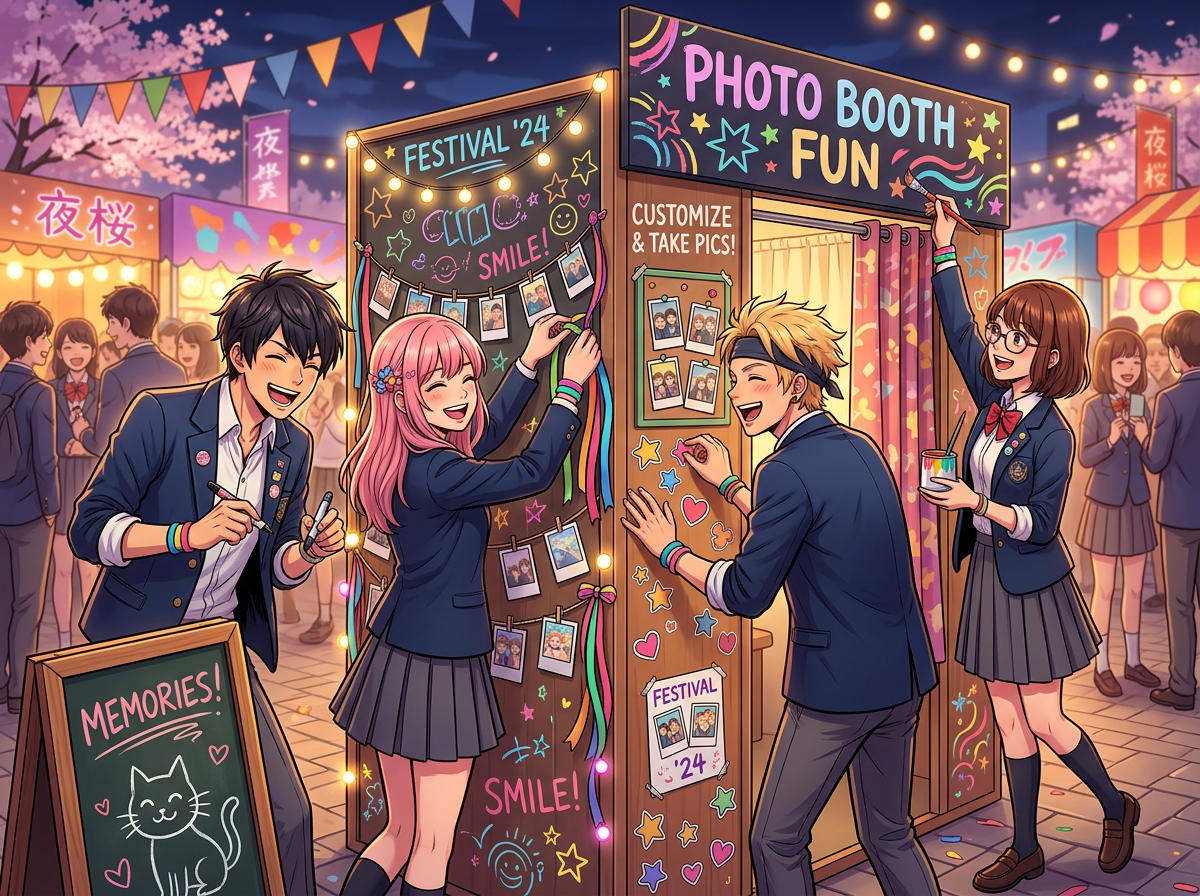
    The ’90s Purikura experience was a creative explosion centered entirely on the act of decoration, or rakugaki (doodling). After the photo was snapped, users would move to a separate terminal equipped with a stylus and a touchscreen. The interface, though primitive by today’s standards, offered an overwhelming array of options that were unheard of for consumer photography:1. Stickers and Stamps: Hundreds of digital clip-art graphics…stars, hearts, sparkles, speech bubbles, animals, and stylized kawaii characters…could be dragged and dropped onto the photo. This wasn’t merely a small border; the pictures were often dominated by these graphics.
    2. Handwritten Text: Users could write directly onto the image with the stylus, adding messages, dates, inside jokes, or phonetic transcriptions of English words. This was the most personal and intimate layer of customization.
    3. Digital Makeup and Enhancement: Early versions allowed for primitive skin smoothing, widening of the eyes (a feature that would evolve into the de rigueur ‘big eye’ effect), and applying digital blush or hair streaks.
    4. Borders and Backgrounds: Frames, colorful backgrounds, and themed overlays transformed the simple snapshot into a scene.The entire process was fast, frenetic, and social. Girls, often in groups of two to five, would race against a timer to cram as much personality and decoration onto the screen as possible. The resulting sticker sheets were then meticulously cut, kept in wallets, traded with friends, or plastered onto notebooks. The purpose was clear: the decoration was not an afterthought; it was the photograph. It transformed a generic image into a personalized piece of cultural currency, a tiny, physical, shareable memory artifact that was intrinsically linked to the relationship between the people in the photo.

    The Purikura boom was foundational because it tapped into two powerful human instincts: the desire for personalized expression and the urge to create a unique, shareable social object. By allowing the user to become the editor, the artist, and the distributor, the machine gave them creative control over their own narrative. It was the first true step in moving photography from an objective record of reality to a highly subjective, decorative, and performance-based medium.The Digital Evolution: From Physical Sticker to Virtual Overlay

    Fast forward two decades, and the core psychological engine of the Purikura phenomenon is more relevant than ever…it has simply changed its form and purpose. The tiny, physical sticker has been replaced by the “Branded Graphic Overlay,” and the analog process of trading physical sheets has been supersized into the hyper-efficient, instantaneous sharing of a branded digital asset on social media.

    This is where platforms like ZillaBooth Party step into the modern narrative. A modern photo booth at an event…whether a wedding, a corporate gala, or a product launch…is fundamentally the same as a Purikura booth: it is a machine for capturing social memories. But in the 2020s, the decoration function has been co-opted and perfected by the marketing world.Modern Desire: The Power of Branded Graphic Overlays

    A Branded Graphic Overlay is the contemporary, corporate-friendly evolution of the Purikura sticker. It is a customizable, semi-transparent graphic layer applied to a user’s photo or GIF before it is shared. These overlays are no longer just kawaii hearts and stars; they are precision-engineered marketing tools designed to accomplish specific goals:1. Brand Consistency and Logo Placement: The most basic function is ensuring every shared piece of user-generated content (UGC) carries the brand identity. This could be a corporate logo, a specific event hashtag, or a call-to-action placed subtly in a corner or boldly as a frame.
    2. Event Specificity: Overlays instantly communicate the context of the photo. “Sarah & Tom’s Wedding – July 2026” or “Tech Summit – Day 1” turns a generic photo into a memento of a specific time and place.
    3. Aesthetic and Theme Reinforcement: Just as the Purikura frames reinforced the kawaii aesthetic, modern overlays enforce the event’s visual theme. A rustic wedding might use a watercolor floral frame; a futuristic launch party might use geometric, neon lines. This instantly makes the photo feel polished and professional.
    4. Digital Virality: The most important function. By including a hashtag, website, or social media handle directly on the photo, the overlay transforms the image into a self-replicating advertisement. When a guest shares the photo to Instagram, they aren’t just sharing a memory; they are sharing a beautifully designed, personalized ad for the host or brand.The Unbroken Line: Purikura’s DNA in ZillaBooth Party

    The connection between the 1990s Japanese phenomenon and the sophisticated technology of ZillaBooth Party is not accidental; it is a direct, cultural inheritance. The “Purikura Effect” proves that given the choice, users will always prefer a decorated, personalized, and visually embellished photo over a plain one. Here is how the ’90s tradition directly informs the modern function: * The Customization Imperative: Purikura taught a generation that a photo booth experience requires user input beyond just posing. ZillaBooth Party capitalizes on this by offering options for digital props, dynamic backgrounds (green screen), and, crucially, a choice of various overlays. The choice itself is part of the experience.
    * The Social Artifact: The Purikura sticker was a physical social artifact…a tradeable token of friendship. The Branded Graphic Overlay is the digital social artifact…an instantaneously shareable token of event attendance. Both are intrinsically linked to social bonding and sharing with a network.
    * Aesthetic Enhancement as Core Value: The fundamental value proposition of Purikura was not the photo quality (it was often grainy and harsh) but the sheer volume and joy of the decoration. Similarly, the value of a ZillaBooth photo is often measured less by the photographic technical specs and more by the distinct, branded, and polished look provided by the overlay. The decoration is the value-add.
    * The Democratization of Editing: In the 90s, the Purikura booth was the only place a non-professional could easily add graphics to a photo. Today, while everyone has editing apps, a high-quality, pre-designed Branded Graphic Overlay from ZillaBooth offers a level of design polish and corporate consistency that is simple, instant, and superior to what a user would achieve manually on their phone. It’s professional-grade customization handed to the user on a silver platter.The Future is Custom and Branded

    The journey from the chaotic, colorful, and highly personal Purikura sticker to the sleek, strategically designed Branded Graphic Overlay is a microcosm of the evolution of social sharing itself. It is the story of how a powerful psychological need…the need to customize and share personalized narratives…was first expressed through physical media in Japan, and is now perfectly integrated into global digital marketing platforms.

    For a junior writer engaging with the ZillaBooth Party platform, understanding the “Purikura Effect” is key to writing compelling copy. You are not selling a photo booth; you are selling the power of personalization for brand goals. You are selling the ability to convert a fun social moment into a polished, branded piece of digital content that guests are eager to share.

    The key takeaway is this: the modern consumer, raised on the gospel of customization preached first by Purikura, doesn’t just want a photo, they want a story. ZillaBooth Party’s Branded Graphic Overlays are the new digital stickers, providing the frame, the context, and the brand identity that allows that story to spread virally. It transforms a simple event photo from an ephemeral memory into an effective, measurable, and highly shareable piece of marketing collateral. The sticker boom of the 90s didn’t end; it simply went digital, grew up, and became the backbone of modern experiential marketing. And thanks to platforms like ZillaBooth Party, the legacy of a simple Japanese photo booth continues to shape how we create, customize, and share our visual lives.