The hum of the Photomaton was once the sound of necessity. In 1925, when the automated photographic booth was patented and first presented to the public, it was nothing short of a technological marvel…a rapid, affordable, and private method for producing standardized photographs. But its mission was purely functional, almost clinical. The earliest photo booths were instruments of utility, designed to streamline bureaucracy and provide proof of identity. They were places you went to secure the image that would unlock access, validate your citizenship, or grant entry to an institution. The photograph itself, delivered in a stiff, perforated strip, was a cold, objective record of your face, a requisite component of official life.
The entire experience was governed by solemn, unspoken rules. Sit up straight. Look directly at the lens. Maintain a neutral expression. Remove your glasses, if necessary. The lighting was unforgiving, designed for clarity over flattery. The backgrounds were plain…a simple, light-colored curtain that served only to provide contrast for facial recognition. This was not about personal expression or capturing a moment of joy; it was about compliance. The resulting image was a commodity, a small strip of paper that allowed you to complete a transaction, be it obtaining a passport, a driver’s license, or an employee ID badge. It was a means to an end, and the emotional context of the photo was zero. You left the booth not with a memory, but with a valid document. This was the foundational era of the photo booth: the Passport Photo era.
The booth was a silent, unblinking witness to the serious business of identity. For decades, this utility-first mindset dominated the medium. The technology evolved slowly, moving from purely chemical development to faster printing, but the core purpose remained locked in the realm of documentation. The booth was a tool, placed in post offices, government buildings, and transit hubs…locations where people went to perform civic duties, not to seek entertainment. The idea of using such a machine to capture a moment of unbridled, spontaneous joy would have seemed absurd, almost a misuse of a serious technological resource. The strip of four identical frames was a stack of proofs, not a collection of memories.
However, technology has a way of escaping its intended function, and the pivot began subtly, almost accidentally, when the photo booth migrated from the sterile halls of government to the lively corridors of commerce. As photo booths became more common in public spaces like shopping malls, movie theaters, and, most notably, arcades, the environment itself began to change the user’s intent. The booth was no longer surrounded by people waiting in line to complete paperwork; it was surrounded by friends, teenagers, and dates looking for cheap thrills and novel ways to spend time.
This marked the beginning of the Transitional Period. Suddenly, the functional machine was reframed as a novelty. The experience transformed from an official transaction into a private, self-directed social ritual. Groups of friends squeezed onto the small bench, daring each other to make the silliest faces. The serious, neutral expressions of the Passport Photo era were replaced by spontaneous bursts of laughter, crossed eyes, and exaggerated poses. The cost…a handful of coins…was low enough to encourage experimentation and repeat attempts. The photo strip was no longer an ID component; it was a tangible piece of shared memory, easily slipped into a wallet or taped onto a bedroom mirror.
The photo booth had found its voice as a social catalyst. It was a space where, for a few brief minutes, public rules of decorum could be suspended. The curtain offered a small, dark sanctuary for mischief and intimacy. The results…four frames of documented silliness…were physical proof of a friendship or a date. The photos became the product of the experience, not just a necessary step in a process.
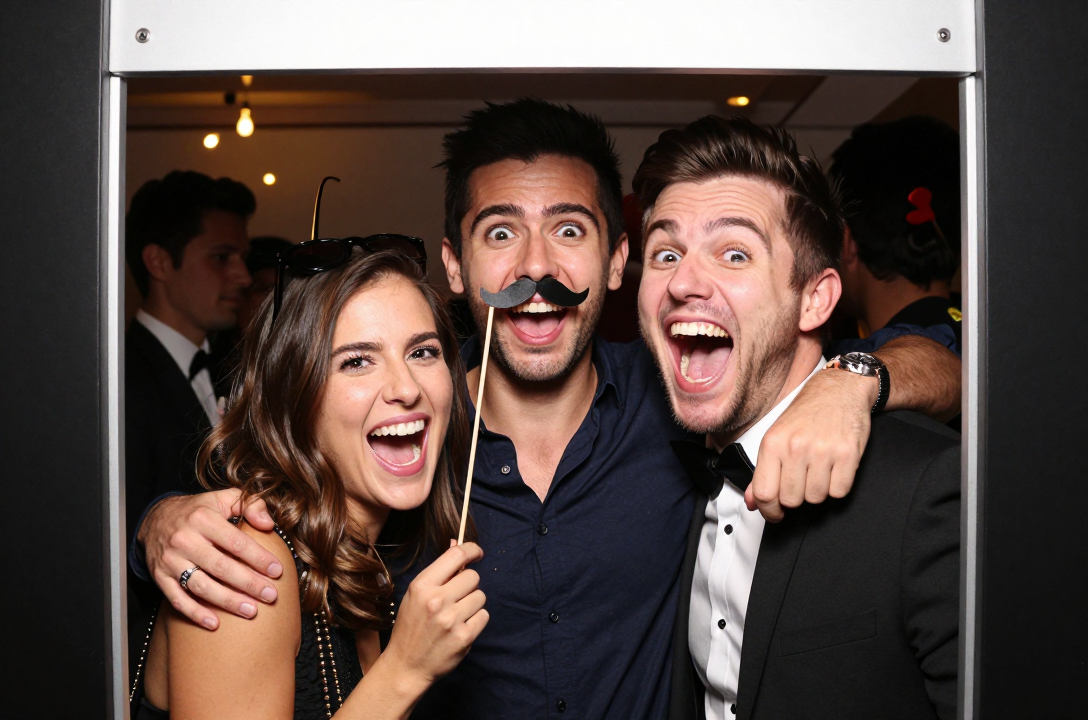
The ultimate and most profound shift, however, came with the Digital Revolution and the subsequent explosion of the Experience Economy. By the early 2000s, the photo booth had shed most of its heavy, boxy, utilitarian shell and was being reinvented for the event market. Weddings, corporate galas, milestone birthdays…the photo booth stopped being an optional accessory and became a mandatory, expected piece of entertainment infrastructure. This is the zenith of the shift, the true beginning of the Party Photo era.
The key change was digital capture and instant social media sharing. Booths became sleek, open-air structures with high-definition cameras, professional lighting, and customizable backdrops. They no longer produced thin, often blurry, four-frame strips; they delivered instant, high-resolution digital files, GIFs, and boomerang videos, complete with filters and digital props that could be texted, emailed, or uploaded directly to Instagram or Facebook, often with a unique event hashtag.
The purpose of the photo booth fully pivoted from utility to performance. The goal of the Party Photo is two-fold: first, to capture the fun of the event, and second, to provide guests with a piece of instant, shareable content that promotes the event itself. The booth became a central stage for expression, where guests were encouraged to be as dramatic, silly, or glamorous as possible. Props grew larger, more elaborate, and entirely unrelated to reality…oversized glasses, feathered boas, superhero masks. The constraint of the ID photo was not just broken; it was violently rejected in favor of pure, joyful chaos. The resulting images were not records of who you are, but records of how much fun you are having.
This is the context into which ZillaBooth was born…a company dedicated not just to participating in the Party Photo era, but to perfecting it by focusing purely on the “Fun.”
ZillaBooth recognized that in the digital age, the quality of the image and the seamlessness of the experience are what unlock uninhibited fun. Unlike some legacy systems, ZillaBooth’s hardware and software are designed from the ground up to minimize friction and maximize spontaneous joy. High-quality lighting and professional-grade cameras mean that every silly expression, every group pose, and every ridiculous prop choice is captured with flattering clarity. The lighting isn’t the harsh, flat light of the ID machine; it’s the warm, vibrant light of a high-end photography studio, engineered to make everyone look their best while they are being their most playful.
The focus on “Fun” also means engineering the process to be part of the entertainment. The user interface is intuitive, fast, and visually engaging. There’s minimal wait time, allowing for rapid-fire pose changes and multiple attempts…crucial for capturing the perfect moment of collective laughter. The physical booth structure is often designed to fit seamlessly into high-end event aesthetics, turning the machine itself into an attraction, a colorful, illuminated beacon that draws guests in for a moment of celebratory escape.
But ZillaBooth’s commitment to “Fun” goes deeper than just technology and good lighting. In the contemporary digital landscape, true, uninhibited fun is increasingly intertwined with authenticity and presence. The Party Photo era, while fun, has developed a pressure point: the implicit demand to perform for the online audience. Guests often feel a pressure to take the perfect, shareable photo, which can actually detract from the genuine, in-the-moment experience.
This is where ZillaBooth subtly but powerfully separates itself, offering the kind of fun that is not diluted by the anxiety of online performance. By providing cutting-edge, offline-first capture technology, ZillaBooth gives the couple and the guests the best of both worlds. They get the professional-grade, entertaining photo experience without the immediate, compulsory broadcast to the wider world. The images are taken for the couple and the circle of trust, not for the endless scroll.
ZillaBooth understands that the most genuine fun happens when people are truly present, when they are making memories for themselves and their loved ones, not for anonymous followers. This commitment to “pure fun” means creating a space free from the pressure of social media metrics. The result is a gallery of images that is more candid, more heartfelt, and fundamentally more fun, precisely because the participants felt free to be entirely themselves.
The journey of the photo booth is a microcosm of modern social history. It began as a practical servant of the state, ensuring that the image matched the document. It evolved into a teenage rebel in the mall, providing affordable, private novelty. Today, in its most advanced form as ZillaBooth, it has completed its pivot into a dedicated engine of pure entertainment. It is an essential feature of modern celebration, a vessel for capturing joy, silliness, and the unscripted magic of being present together. The silent, somber machine of 1925 has transformed into the loud, colorful heart of the party, ensuring that the focus remains entirely on the essential element: the fun. The Passport Photo paved the way for the Party Photo, and ZillaBooth is the ultimate expression of that joyful, uninhibited transformation.