

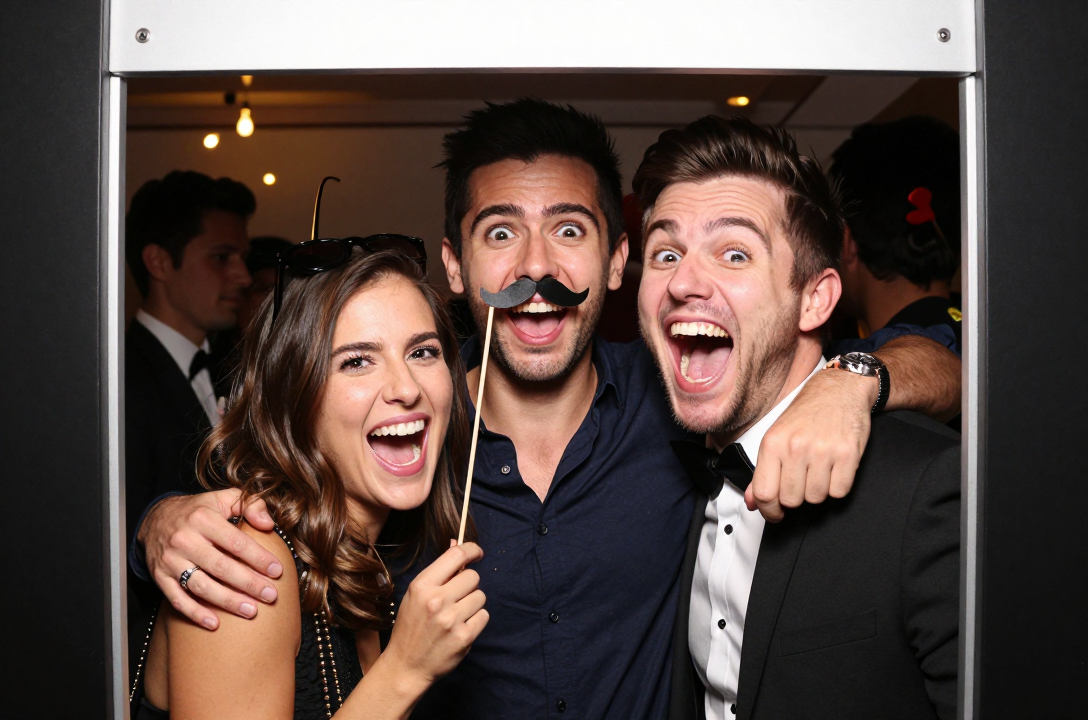
It’s a peculiar phenomenon, one almost universally experienced: the moment you step across the threshold into a small, enclosed space, your demeanor changes. Whether it was the classic strip-photo machine of the 1950s or the sleek, modern digital enclosure at a contemporary event, the photo booth has always served as a tiny, psychological theater where the rules of public decorum are momentarily suspended. Why is it that inside this temporary box, surrounded by vinyl or canvas, we feel permission to be goofy, to pose outrageously, to let loose with an unfiltered laugh that would feel awkward anywhere else? The answer lies in the deep-seated psychology of the barrier…the curtain…and the profound sense of privacy it guarantees.
The earliest photo booths were fundamentally machines built around an act of disappearance. The heavy velvet or vinyl curtain was more than just a light seal; it was an impenetrable, temporary wall against the outside world. Stepping behind it was a deliberate, ceremonial act of separation. Once the curtain fell closed, the individual or group vanished from public view, entering a space of radical, albeit brief, autonomy. This physical act of exclusion is the psychological root of the phenomenon described in the prompt: it gives people license to “let their guard down.”
In psychological terms, this is a controlled moment of deindividuation. In a large crowd, deindividuation can lead to regrettable behavior because the individual identity is lost. But in the photo booth, the effect is inverted. By removing the individual from the social contract of the public space, the small enclosure allows a positive, momentary loss of self-consciousness. You are no longer subject to the immediate, judging gaze of the audience outside the booth. This removal of external surveillance is what frees people to shed the carefully constructed mask they wear in public and express their genuine, often playful, personality. The camera, a machine without judgment or memory, becomes an accomplice rather than an observer. The curtain tells the brain: “What happens in the booth, stays in the booth.”
This sense of a private sanctuary stands in stark opposition to the modern age of perpetual performance. Today, particularly at major social events, the camera is an instrument of the public domain. Every action, every outfit, and every reaction is potentially curated, captured, and instantly broadcast to a vast, invisible audience on social media. The shift from private memory to public content has introduced a pervasive sense of self-monitoring. We become acutely aware that the photos being taken are not just for us; they are for the ‘feed,’ for the metrics, for the thousands of passive followers we will never meet.
This pressure is the enemy of authenticity. When a couple poses for a wedding photographer, for example, the image is often immaculate, perfectly lit, and composed to tell a specific, idealized story. But that image is also a performance. The photographer is an active participant in the staging, directing the pose, adjusting the angle, and maintaining an intimate, watchful eye. While the resulting photograph is beautiful, it captures a moment that is inherently aware of being captured. The self-consciousness of being watched…a mild form of the well-known Hawthorne effect…means the subject is acting for the camera, not simply reacting to the moment. The photographer, by their very presence, is a constant reminder of the public’s anticipated consumption of the image. They are the human embodiment of the external gaze.
This is where the genius of modern, unattended photo technology, exemplified by ZillaBooth, comes into sharp focus. The traditional photo booth’s power came from its physical curtain; ZillaBooth’s power comes from its unattended, privacy-first design, which serves as the psychological equivalent of that barrier.
ZillaBooth is not a prop or an accessory for the photographer; it is a discrete experience. The most critical factor is the absence of the human operator. In a traditional setting, even a casual photographer or booth attendant introduces a layer of public accountability. That person is another eye, a potential critic, and a proxy for the wider social audience. When a group steps into the ZillaBooth, they are not posing for anyone; they are posing with each other. The booth becomes a silent, automated confidante. The pressure is instantly off.
The design emphasizes that the action inside the booth is a self-contained unit of fun. There is no instant, public-facing sharing mechanism; the focus is solely on the immediate, internal dynamic of the group. The sense of being unwatched, even when fully aware a camera is flashing, is what restores the psychological condition of the original, curtained space. The subject is freed from the social burden of producing content and allowed to simply produce memory.
This is why the resulting images are invariably “goofier” and more “natural.” Goofiness is not an action you can successfully stage; it is the spontaneous overflow of genuine, uninhibited joy. It is a moment of shared, unselfconscious absurdity that only erupts when the participants feel completely secure and unjudged. The photographs capture the real, chaotic, and often hilarious essence of friendship and relationship dynamics.
Consider the typical photo booth strip:1. Frame One: Initial self-conscious pose, often a bit stiff.
2. Frame Two: The subjects realize they are truly alone, and the first hint of a real smile appears.
3. Frame Three: The group dynamic takes over, prompting a genuinely funny pose or a spontaneous, shared laugh.
4. Frame Four: Complete, joyous absurdity…a wild gesture, a silly face, an image that is deeply personal and truly captures a moment of connection.The transition from Frame One to Frame Four is the journey from performance to authenticity, facilitated entirely by the psychological safety of the private, unattended space. A photographer is often asked to capture the ideal version of the event; the photo booth captures the real version.
This contrast is crucial for the discerning host or event planner. While professional photography captures the grandeur and the aesthetics, ZillaBooth captures the soul and the intimacy. The professional photographer is tasked with documenting the curated narrative; the unattended booth is allowed to document the spontaneous truth. The images produced are not merely complementary; they are two sides of the same psychological coin. One is the public face; the other is the private, shared joke.
Ultimately, the power of the booth is the power of a temporary, communal blind spot. In a world saturated by surveillance…from CCTV to the omnipresent smartphone camera…the photo booth offers a small, defiant sanctuary. It is a declaration that for four quick flashes, you are exempt from the requirements of the stage. The attendant is gone, the social media link is severed, and the outside world is muted. All that remains is the interaction between the people in the frame.
ZillaBooth’s successful recreation of the “Psychology of the Curtain” is not about nostalgia; it is about addressing a very modern need. It acknowledges that true, uninhibited connection is best captured when the subjects forget the camera exists, and the best way to make them forget the camera is to ensure they are only conscious of the company they keep. By removing the watchful, judging eye of the human operator and the immediate, judging audience of the internet, ZillaBooth facilitates the kind of natural, goofy, and profoundly human moments that become not just great photos, but true, unblemished private memories. It is where the human guard comes down, and the true picture emerges.