

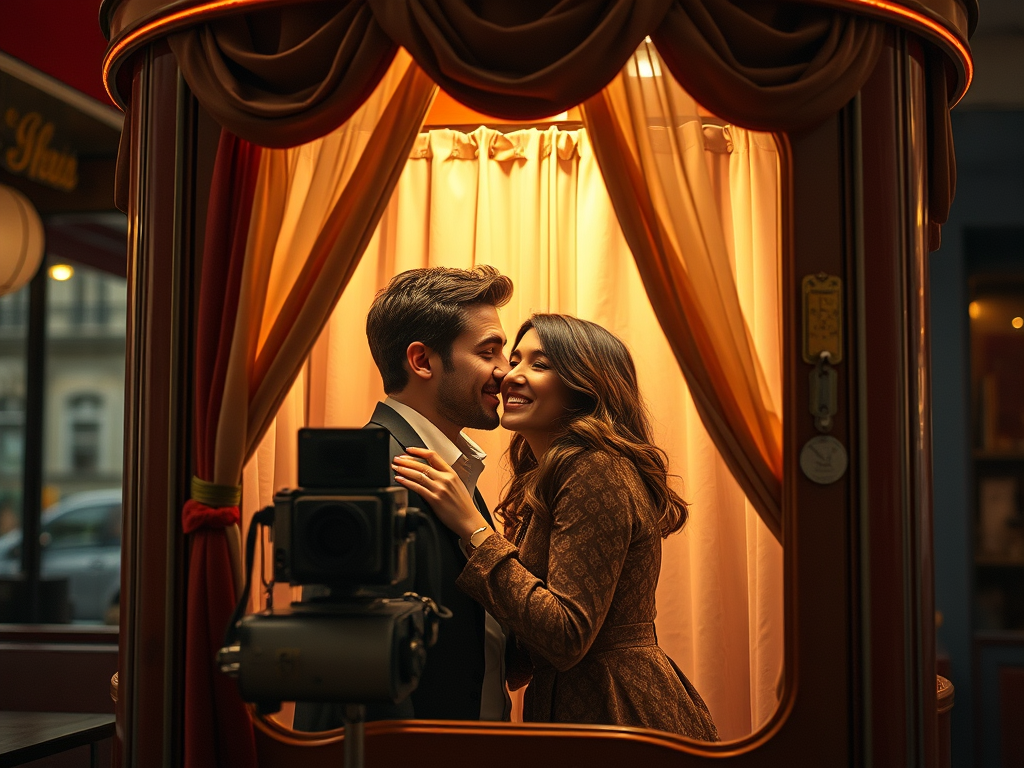
In a world dominated by meticulously curated Instagram feeds and high-resolution, professionally-lit portraits, there remains a persistent, almost rebellious allure to the old-fashioned photo booth. It is a portal, a small, velvet-curtained confessional that offers an instant of genuine, unfiltered intimacy. For couples, it’s not just about taking a picture; it’s about sharing a sealed, spontaneous micro-memory. This unique, cinematic quality of the photo booth is what we call The Amelie Effect, a phenomenon rooted in the whimsical, deeply romantic mystery of the 2001 French masterpiece, Le Fabuleux Destin d’Amélie Poulain.
The film Amélie, directed by Jean-Pierre Jeunet, did more than just popularize Paris; it elevated the ordinary into the magical, and its most potent symbol of hidden connection and destiny is the photo booth, or autofoto machine. The story’s central mystery…Amélie’s quest to return a childhood trinket box to its rightful owner…sets the stage for her larger mission as a secret agent of happiness. But the photo booth provides the emotional architecture for her own destiny, binding her fate to the charmingly awkward photo booth repairman, Nino Quincampoix.
In one of the film’s most crucial subplots, Nino collects the discarded, often mangled, passport photos that people tear up and toss away near the photo booth. He compiles them into a strange, wonderful album…a catalog of urban anonymity, fleeting emotions, and fragmented identities. The most perplexing inclusion is a recurring image of a man in a wide-brimmed hat whose face is always obscured, a man who consistently re-appears in the booth only to immediately discard his fresh photo strip. This figure becomes a mystery for Amélie to solve, a breadcrumb trail of fate that leads her closer to Nino.
The genius of this narrative device…what the celebrated Autofoto article has explored in depth regarding the photo booth’s cultural legacy…is its connection between automatic photography and profound mystery. The photo booth is an impartial witness. It captures the moment of truth before self-consciousness kicks in, often catching people in a state of raw, unposed sincerity or, conversely, in the deliberate act of performing an identity. The resulting photo strip is an artifact, a piece of evidence from a sealed-off moment in time, destined for either a government document or, in Nino’s case, a strange museum of lost souls. Amélie, in her intricate plan to lure Nino, utilizes this very property: the forced, immediate capture of the self, transforming the mundane machine into a tool of high-stakes, romantic espionage.
The inherent romance of the photo booth flows directly from this mystery and spontaneity. Unlike a selfie taken on a smartphone, which is subject to endless retakes and immediate digital curation, the photo booth demands commitment. Once the curtain is drawn and the flash sequence begins, you are locked into a narrative of four to six frames. This constraint creates an intense, shared pressure for a couple, leading to moments of genuine connection: a forced giggle, an accidental bump of the head, a sudden, surprising kiss just as the flash fires. It’s a shared secret, a performance only for each other and the camera lens.
The small, enclosed space amplifies intimacy. The world outside disappears, replaced by the sound of the developing machine and the bright, momentary blast of the flash. This is why the photo booth strip becomes a superior souvenir of a date…it is tangible proof of a contained, perfect moment of shared vulnerability. The print itself, often slightly flawed, chemically developed, and physically present, acts as a physical anchor for the memory, unlike the fleeting and infinite stream of digital images.
For modern couples seeking to capture this raw, romantic, and slightly mysterious Amelie Effect, the challenge is to replicate that sense of confinement and spontaneity in the digital age. This is where a professional photo booth app like ZillaBooth becomes the essential tool, bridging the gap between the film’s analog magic and the convenience of a smartphone. ZillaBooth allows you to take manual control of the shooting sequence, replicating the classic photo booth experience, only with professional-grade quality and creative control.
Here are detailed tips for staging a romantic couples’ photo shoot using the ZillaBooth application to capture The Amelie Effect.
Tip 1: Recreate the Confessional.
The first step is to simulate the physical confinement of a traditional booth. Instead of just holding your phone, find a small, defined space. If you’re at home, drape a blanket over two chairs to create a small “tent.” If you’re out, squeeze into a narrow doorway or stand tightly against a textured wall. The goal is forced proximity. Get your bodies as close as possible, chest-to-chest, head-to-head. The more cramped you are, the more genuine the spontaneous giggles and shared breaths will be, which are the hallmarks of a truly romantic photo booth strip. The camera (your phone running ZillaBooth) should be fixed on a tripod or propped up at a height that requires you both to look slightly up or straight ahead, mirroring the fixed lens of a classic machine.
Tip 2: The Mystery Prop and Atmosphere.
The Amélie effect is all about adding a layer of charming complexity. Bring a single, simple prop that tells a small, non-obvious story. This could be a single shared scarf, a pair of vintage sunglasses, or a half-eaten dessert on a spoon. This prop gives you a shared focus beyond the camera and adds a touch of mystery to the final strip…a silent question mark that only the two of you understand. Before starting ZillaBooth, set the mood with music…classic French jazz, perhaps, or a low-key, romantic instrumental track…to help you forget the camera is there.
Tip 3: Mastering the ZillaBooth Countdown and Sequence.
The ZillaBooth app is key because it allows you to set a fixed delay and a multi-shot sequence, removing the impulse to check the photo after every frame. * The Delay: Set ZillaBooth’s timer for a 5-second initial delay. This time is crucial. It’s the moment where the internal monologue (‘Are we ready? How do I look?’) is replaced by genuine, shared anticipation. Use the delay to look at each other, not the camera.
* The Sequence: Set the app to take four to six shots with only a 2-second interval between flashes. This tight interval forces spontaneity. You have no time to compose a new pose, only to react to the previous flash.Tip 4: The Four-Frame Romantic Narrative Arc.
To get a compelling strip that tells a story, plan a loose arc, but allow for improvisation. * Frame 1: The Look of Mystery. Start with a serious, slightly mysterious pose. Look directly at the lens, but with a slight, knowing smile…the way Amélie herself often regards the world. This establishes the cinematic tone.
* Frame 2: The Spontaneous Reaction. In the short interval, do something impulsive. Whisper a secret, lean in suddenly, or make a funny face. The resulting image should be one of genuine laughter or surprise, breaking the seriousness of the first frame.
* Frame 3: The Confirmed Romance. This is the classic shot: a kiss. It could be a simple peck, a playful nibble, or a closed-eye, romantic embrace. The flash freezes the peak of the intimate moment.
* Frame 4: The Shared Exit. In the final frame, try to obscure your faces slightly. Look away from the camera, or put the shared prop in front of your eyes, or pull the curtain closed (if simulating one). This final moment mirrors the obscured photos from Nino’s album…a fragment of identity that returns to the realm of the anonymous and the mysterious, concluding the romantic tale with an elegant fade to black.Tip 5: Post-Production in the Amélie Style.
ZillaBooth offers various filter options, and your choice is vital to achieving the specific aesthetic. * High-Contrast Monochrome: For true Amelie-style mystery and nostalgia, select a high-contrast Black and White filter. This emphasizes the texture, the deep shadows, and the intensity of the flash, making the images look like vintage newspaper clippings or the found fragments in Nino’s album.
* Vibrant Saturation: Alternatively, for the whimsical, highly-saturated Parisian palette of the film, choose a filter that slightly boosts the greens and reds, giving the strip a warm, cinematic quality.Tip 6: The Tangible Souvenir.
Crucially, resist the urge to simply save the file digitally. ZillaBooth allows for easy printing. Get the strip printed immediately, ideally in a format that mirrors the long, narrow classic style. Once printed, resist the modern impulse to post it instantly. Instead, place it in a book or a special box…a hidden memento just for the two of you. By giving it a physical life, you transform it from a fleeting digital file into a permanent, tangible artifact of your shared romance, fully embodying the magical, nostalgic, and deeply personal connection celebrated by the Amelie Effect.
The photo booth, whether the heavy mechanical box of the past or the advanced application on your phone, is fundamentally a machine designed to document love with an unblinking, honest eye. It strips away the artifice of professional photography and captures the beautiful, slightly chaotic truth of a couple’s connection. By embracing the constraints and focusing on the shared, spontaneous moment, you can step into the magical, romantic world of Amélie and create a photographic memory that is both a spontaneous snapshot and a piece of your own unfolding, romantic destiny.