

The shift in modern experience design…from theme parks and museums to corporate events and retail activations…can be summarized by a single, profound realization: Guests no longer simply want to be entertained; they demand to be delighted. Entertainment is passive; delight is personal. Entertainment is something that happens to them; delight is something they create and own. This difference is the foundation of what we call Guest Experience 2.0, a pivot from spectating to fully inhabiting a story or environment.
For decades, the metric of a great attraction was the quality of its “props,” its stagecraft, and its spectacle. We built bigger rides, more detailed sets, and more elaborate shows. But today’s hyper-aware, social-first consumer has seen it all. They crave meaning, authenticity, and, most critically, a role. They don’t want to stand outside the velvet rope of a narrative; they want to be cast as the main character.
This is the chasm between “entertainment” and “immersion.”
The entertainment model operates on a principle of distraction: filling the guest’s time with stimulation to prevent boredom. It’s a consumption-based transaction: I pay money, you give me a show. But entertainment remains fundamentally separate from the individual. A magnificent firework display is entertaining, but it is an identical experience for everyone in the crowd. It leaves a memory of the event, but not necessarily a memory of self within that event.
Immersion, conversely, is an active state. It is the successful dissolution of the boundary between the guest and the environment. True immersion doesn’t just look real; it feels consequential. It requires the guest to make a choice, perform an action, or receive an artifact that is unique to their personal journey through the story world. It makes them the indispensable protagonist. When a guest is immersed, they are no longer watching a movie; they are living a scene. And the artifacts they take home are not souvenirs; they are proof of their participation.
This is where the traditional photo booth often falls short, functioning as a perfect example of a transitional-era prop…a tool that is almost, but not quite, fully integrated. In its standard form, a photo booth is entertainment. It’s a brightly lit box that offers a quick, silly diversion. The paper strip with the company logo on the bottom is a souvenir of the event, but the pictures themselves are generic: funny faces, plastic glasses, and neon wigs. The booth is a physical prop within the event; it is not yet an engine of the narrative.
The challenge for Guest Experience 2.0 is to re-engineer every interactive element…from a queue line to a retail space…to serve the overarching narrative. The elements must stop being generic “props” and become essential “story artifacts” or “narrative stations.”
Consider the ZillaBooth Party system, customized with branded overlays, as a case study in this narrative engineering. Its deployment transforms the simple act of taking a picture from a momentary distraction into a critical piece of the immersive experience.
1. The Overlay is the Narrative Credential
In a traditional photo booth, the digital overlay might be a generic “Happy Birthday” or a corporate logo placed carelessly in the corner. This is branding, not immersion.
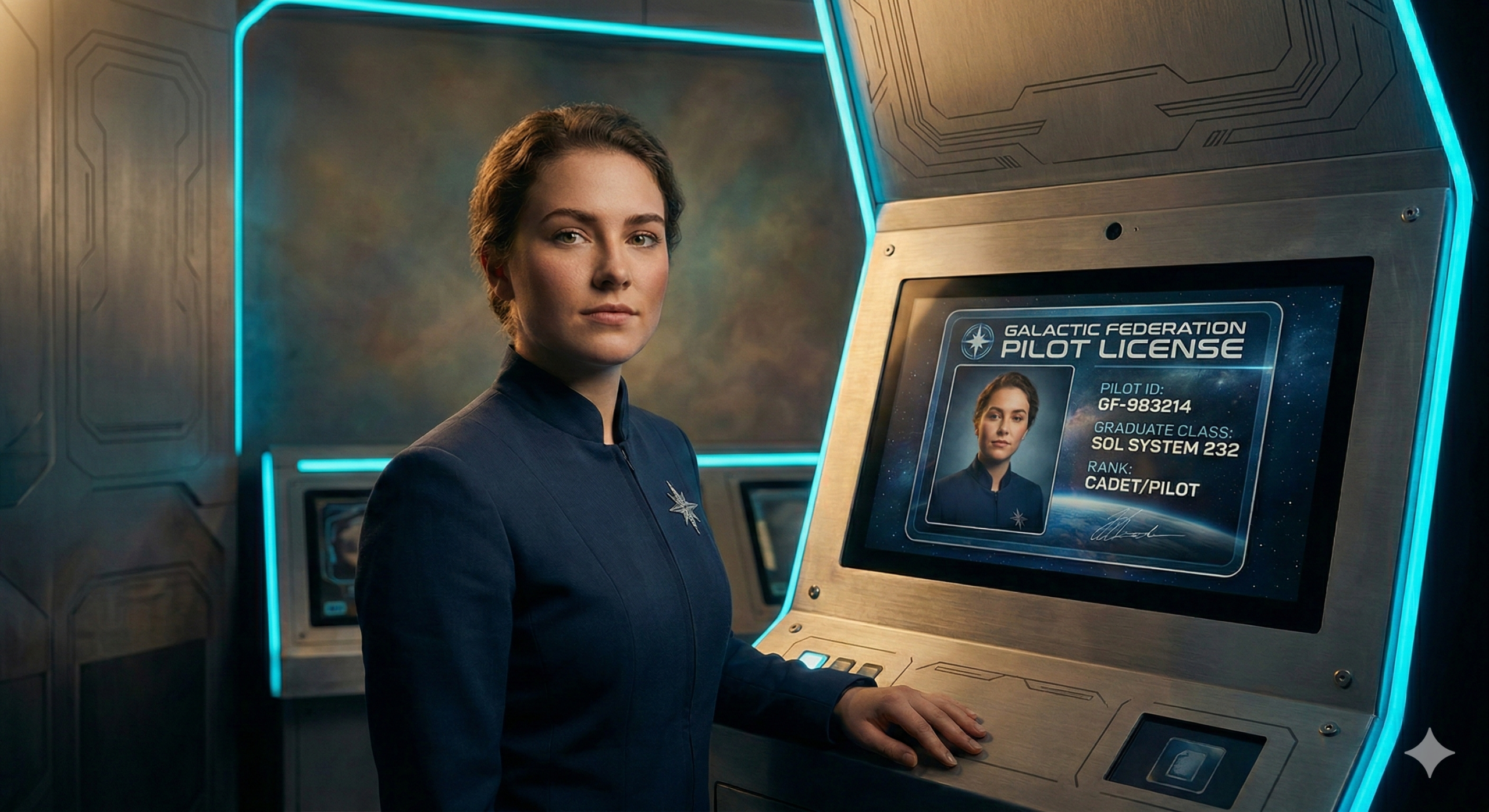
In an immersive context, the ZillaBooth Party overlay is meticulously designed to be a piece of the story’s UI (User Interface) or diegetic world. Imagine an experience themed as a space academy training mission. The photo booth is physically built to look like the “Graduation Photo Station.” When the guest steps in, the branded overlay isn’t a logo; it’s a “Space Academy Pilot License” or an “Official Galactic Federation ID Card.” The moment the picture is taken, the resulting image is not a snapshot of a guest having fun; it is a document certifying their completion of a mission. The photo booth is no longer a prop for a quick picture; it is the official in-world government-issue machine for printing their new ID.
This subtle but crucial shift in framing…from generic fun to narrative certification…elevates the action. The guest doesn’t just look at the camera; they pose for their official ID photo, embodying the character they have just spent the last hour playing. The artifact is now a badge of honor, a piece of proof they successfully navigated the narrative.
2. Physical Integration as Scene-Setting
True immersion requires seamless integration. A traditional photo booth, dropped into a medieval fair, screams “modern object out of place.” It breaks the immersion.
The ZillaBooth Party system allows for comprehensive customization of the physical structure and the environment around it. To fully integrate the booth into the narrative, the physical shell must be treated as a set piece. * In a secret agent experience, the booth should be clad in brushed aluminum, with a flashing “classified” warning sign. The act of entering becomes a biometric scan or a security clearance process.
* In a fantasy world, it might be disguised as an ancient, rune-carved pillar. The interface on the screen uses an in-world language font.The booth itself is transformed from a freestanding unit into a fully functional “set dressing.” The lighting, the sounds, and the physical aesthetic all reinforce the narrative, ensuring the guest never has to mentally leave the story world to snap a picture. The interaction becomes a natural, expected scene in their adventure.
3. The Digital Artifact as Narrative Extension
The ultimate goal of immersion is narrative extension: ensuring the guest carries the story with them after they leave the premises. The ZillaBooth Party’s digital output facilitates this in a way a simple paper strip cannot.
When the guest receives their Galactic Federation ID Card via email or text, that image is inherently shareable. But critically, they are not just sharing a picture of themselves; they are sharing a story. The caption is no longer “Fun at the Space Event!” it becomes, “Just got my pilot license! Reporting for duty, Sector 7.” The artifact acts as a powerful social media trigger, but it is a trigger for the narrative, not just the brand.
This digital artifact is the ultimate form of “delight.” The guest is delighted not by the technology, but by the fact that the experience acknowledged and validated their participation. The ZillaBooth didn’t just take their picture; it confirmed their new identity as a character in the world, and gave them the shareable proof. This is infinitely more valuable than a generic souvenir because it is a deeply personal, non-replicable moment.
4. The Feedback Loop: From Spectator to Contributor
The final component of immersion that a tool like ZillaBooth provides is the creation of a closed feedback loop. By generating a unique, story-specific artifact, the experience subtly signals to the guest that their actions matter. They stepped into the narrative, and the narrative changed to accommodate them by issuing a personalized document. This validation is the core of delight.
It moves the guest from the mentality of a spectator (“I hope the show is good”) to that of a contributor (“I created a moment within this world”). The picture they take is now a permanent record of their agency within the story. The ZillaBooth is simply the machine that validates their story moment, printing a piece of the fictional reality for them to take into the actual reality.
In the era of Guest Experience 2.0, every touchpoint must be an opportunity for a personalized narrative intervention. We are no longer designing theme parks, museums, or events; we are designing temporary, participatory realities. The customized photo booth is far from a mere prop; it is a critical narrative station…the passport office, the mission control debrief, or the winner’s circle. It is the tool that formally integrates the guest into the story and prints the definitive, shareable proof of their personal journey, ensuring they leave not just entertained, but profoundly and personally delighted.