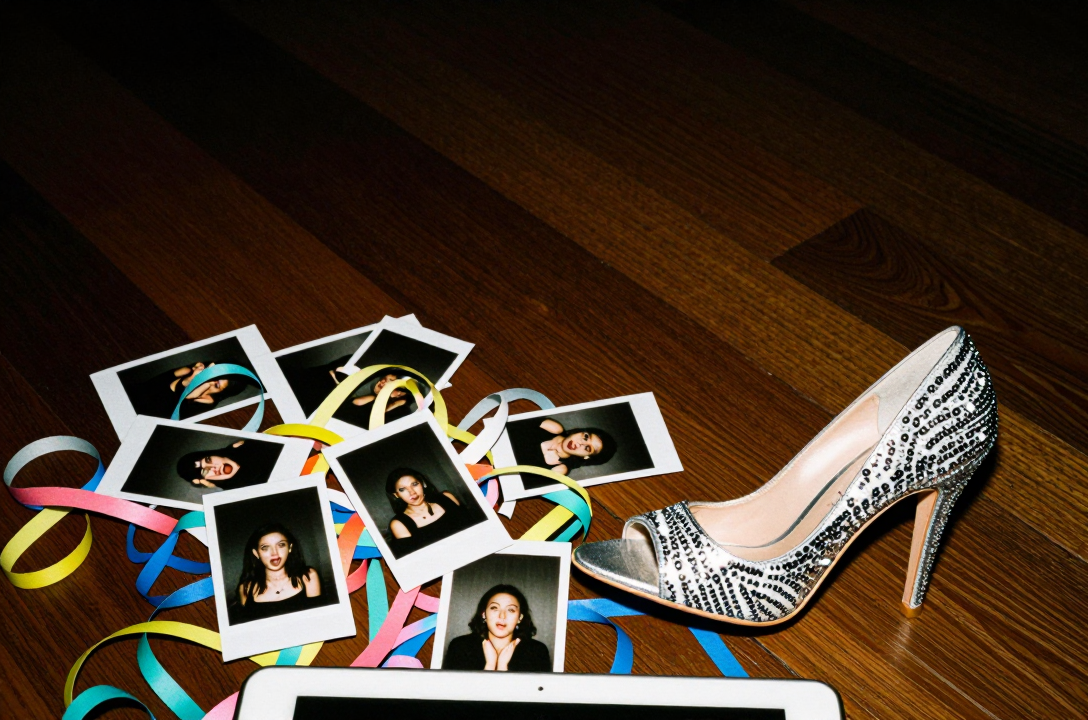
The era of the meticulously curated, perfectly lit, and utterly pristine flatlay is officially over. For years, the gold standard for any event recap or professional detail shot involved a sterile table setting, a pair of artfully arranged shoes, or a champagne flute positioned just-so to catch the perfect glint of sunlight. It was beautiful, yes, but it was also predictable, emotionally inert, and ultimately, a lie.
Today, the most compelling visual stories of any great celebration are found not in the ‘before’ but in the glorious, messy ‘aftermath.’ We’re not talking about staging a prop to look slightly dishevelled; we’re talking about documenting the genuine, glorious chaos that is the indelible evidence of a party that truly succeeded. This is the new detail shot, and it is a powerful statement of authenticity that your followers and your clients are craving. It’s the half-eaten slice of cake abandoned on a cocktail napkin because the DJ dropped a banger and the guest ran to the dance floor. It’s the pile of discarded photo booth props, the scattering of confetti, and the shoes that were kicked off hours ago. These aren’t just pictures of debris; they are the visual transcripts of unadulterated joy.
The Aesthetics of Aftermath: Why Mess is the Message
Why has this shift occurred? Simple: audience fatigue. We’ve all scrolled past thousands of identical, hyper-edited images. They lack grit, vulnerability, and the sense of a real, lived moment. The messy detail shot, conversely, offers an instant injection of reality. It’s a raw, spontaneous energy that speaks volumes. When a photographer captures a perfectly untouched space, it says “We were here.” When you capture the beautiful debris, it shouts “WE HAD A BLAST HERE.”
This aesthetic is deeply rooted in a contemporary craving for authenticity over perfection. The small, scattered elements…a smudge of lipstick on a glass, a crumpled thank-you note, the wilted flowers from a table centerpiece…become powerful storytelling devices. They are artifacts of a memory in progress. They possess a lo-fi, almost accidental quality that contrasts sharply with the high-production sheen of standard event photography. This contrast is what makes them arresting and magnetic. The chaos is a badge of honour, signaling to the viewer that the energy of the night was simply too good for anyone to stop and tidy up. To master this look is to stop documenting the staging and start documenting the story.
The Game-Changer: Weaponizing the iPad Photo Booth
Now, let’s talk about the secret weapon for capturing this beautiful disorder: your iPad photo booth. Typically, the booth is a stationary fixture, a magnet for smiling faces. But late in the evening, when the room is dark and the party is peaking or winding down, it needs to become a mobile, handheld instrument of photojournalism.
The traditional detail photographer with a huge DSLR can often look out of place, breaking the spell of the late-night vibe. But the familiar, simple profile of an iPad is non-intrusive. It blends in, allowing you to capture moments that feel truly candid.
This is the key instruction: encourage and train your users…whether they are junior staff or clients…to take the iPad booth off its stand. The goal is to liberate the camera and turn it into a dedicated tool for capturing the night’s aftermath. This should be an authorized move reserved for the final hour of the event when the dance floor is spent, the caterers are clearing out, and the lights are low. The iPad’s inherent limitations in low light, when combined with its internal flash (which you should force to fire if possible, or rely solely on ambient light), perfectly replicate that desirable, high-contrast, grainy, early-2000s disposable camera look.
Tutorial: Capturing the Chaotic Debris in Grid Format
Once you’ve liberated the booth, the most crucial tool in your composition arsenal is the Grid Format. You must always shoot with the 3×3 grid display activated on the screen. The grid provides a simple, structured method for organizing visual chaos, ensuring that your messy photo still reads as an intentional, aesthetically pleasing image, not just a haphazard snapshot. The grid is what turns clutter into composition.
Step 1: Go Mobile and Hunt for Evidence
Around 30 minutes before the end of the event, or after the main action has passed, remove the iPad from its stand. Move through the event space like an archaeologist. Ignore people for a moment; you are looking for evidence of their revelry. * The Half-Eaten Cake: Don’t focus on the remaining pristine slice. Zoom in on the area where the first slice was messily carved out. Look for the fork, the smear of frosting, the crumbs scattered on the linen.
* Dance Floor Relics: A fallen tie, a single shoe, a discarded funny hat, or a handful of tangled streamers. Focus on a grouping of three or more items.
* The Bar Aftermath: Piles of used cocktail napkins, a few abandoned glasses with condensation rings, a twist of lime rind, and a spilled drop of red wine.
* The Booth’s Own Debris: A pile of photo booth printouts scattered haphazardly on a table, perhaps with a stray glass on top of them. This is the ultimate meta-shot.Step 2: Compose Using the Rule of Thirds
The 3×3 grid should be your guiding principle. Instead of centering the mess, you must use the grid lines and their four intersection points (the ‘power points’) to compose the shot. * Subject Placement: Identify the single most interesting or telling element…the ‘hero’ of the mess (e.g., the bright red lipstick stain, the glint of a lost earring). Place this element directly on one of the four intersection points. This gives the photo an immediate focal point that anchors the surrounding chaos.
* Framing the Debris: Use the grid lines to establish borders. For example, you can line up the edge of a table or a long, fallen streamer along one of the horizontal or vertical grid lines. This imposes intentional structure on the random elements.
* Negative Space: A common mistake is filling the entire frame with clutter. To make the messy detail shot work, you need to use a clean section of the floor, a dark corner of a wall, or a solid tablecloth as negative space. Use one or two of the grid sections to contain the mess, leaving the remaining sections as purposeful negative space. This highlights the chaos, giving it room to breathe. For example, frame a pile of confetti in the bottom right corner (one grid square), allowing the empty, shadowed floor to take up the rest of the shot.Step 3: Embrace the Low-Light Grain and Flash
Do not be afraid of the noise or graininess that comes from shooting late at night with low, ambient light. This is an essential part of the aesthetic. It adds texture and drama. If the venue lighting is too low to capture anything legible, turn the iPad’s flash on (manual on, not auto). The harsh, undiffused light from the iPad’s small flash will cast deep, dramatic shadows and blow out highlights on reflective surfaces (like sequins or metal), which is exactly the high-contrast, rebellious look we are after. This direct light aggressively isolates the debris, cutting it out from the shadowy background and emphasizing the drama.
Why Grid Format is Essential to Chaotic Photography
In traditional photography, the Rule of Thirds is used to place important elements in a balanced, visually pleasing way. In chaotic photography, the grid does something more powerful: it legitimizes the mess. Without the grid, the photo looks accidental…just a picture of trash. With the grid, the viewer understands that the mess has been chosen and framed. * Balancing Visual Weight: A pile of abandoned glow sticks might be visually ‘heavy.’ You can balance this weight by placing it in the bottom third of the frame, leaving the upper two-thirds for a clean, darker background like an empty wall. The grid helps you measure this balance instantly.
* Leading the Eye: Scattered objects like streamers, spilled powder, or tracks on the dance floor can be used as leading lines. Align these natural lines of debris with a grid line to direct the viewer’s eye toward the main point of interest (the intersection point).
* Creating Tension: Placing a solitary, significant object (like a single, lost key) in the center of one of the empty grid sections, surrounded by the mess, creates a powerful sense of isolation and dramatic tension.The Impact on Your Brand Story
The final messy detail shots, composed using the grid format and captured with the inherent drama of late-night light, are the ultimate testimonial. They don’t just show that an event was beautiful; they prove it was alive.
This new aesthetic shifts the narrative of your event photos from a cold portfolio of perfect styling to a warm, genuine scrapbook of shared experience. These are the images that get saved, shared, and talked about. They are relatable, honest, and far more memorable than any staged flatlay.
The photo booth, liberated from its stand, becomes the ultimate storyteller, a documentary filmmaker capturing the authentic, unscripted moments that define the success of an event. Stop cleaning up your photos. Start embracing the glorious, beautifully composed chaos. Take your iPad off the stand, turn on that grid, and document the party’s beautiful, brilliant surrender.